Chinese economy bounces back; expands 3.2 per cent as coronavirus curbs lifted
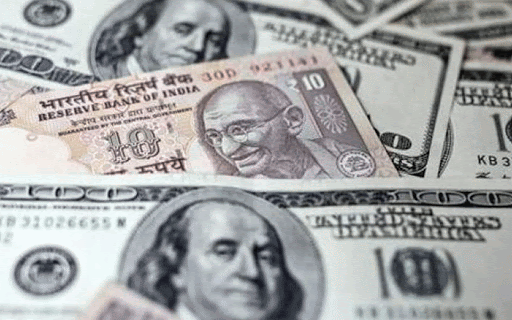
Beijing: China's economy bounced back by posting 3.2 per cent growth in the second quarter after a record 6.8 per cent slump in the first quarter due to the coronavirus crisis, avoiding a recession.
The world's second-biggest economy saw a sharp decline in growth in the first three months of the year during unprecedented coronavirus lockdowns when the GDP plummeted by 6.8 per cent.
China's gross domestic product (GDP) expanded 3.2 per cent year on year in the second quarter of 2020, the country's National Bureau of Statistics (NBS) said on Thursday.
In the first half of this year, the country's GDP stood at 45.66 trillion yuan (about USD 6.53 trillion) amid COVID-19 impact, down 1.6 per cent year on year, according to NBS data.
A breakdown of the data showed the output of the primary industry rose 0.9 per cent year on year, while the service sector and the secondary industry saw a decline of 1.6 per cent and 1.9 per cent, respectively.
Thursday's data showed China's job market improved slightly in June, with the surveyed unemployment rate in urban areas standing at 5.7 per cent, down 0.2 percentage points from the previous month.
Judging by the official data, analysts say it is a turnaround of sorts for the world's second-largest economy, which is the first one to recover from the coronavirus crisis without the hassles of lockdowns experienced by almost all countries in the world including the US.
As it came out from the coronavirus crisis in March-April, China cashed on growing COVID-19 demand for medical equipment from all around the world by exporting billions of dollars' worth of materials.
Analysts, however, predict it would be an uphill climb for export-reliant China's economy going forward as it faced intensified conflict with the US and the negative fallout on its external trade due to Beijing's increasingly aggressive policies towards India, Hong Kong, Taiwan and the South China Sea resulting in bans of its products and services.
The UK has joined the US in banning Huawei and its 5G rollout and India has already banned 59 Chinese apps, including hugely popular TikTok.
China's GDP took the worst hit since the disastrous Cultural Revolution in 1976, plummeting by 6.8 per cent in the first quarter of 2020 as the country took unprecedented measures to fight the coronavirus pandemic that brought the world's second-largest economy to a standstill.
On a slowdown mode, China's economy grew by 6.1 per cent in 2019, the lowest annual growth rate in 29 years amid the bruising trade war with the US but it remained above the psychologically important mark of six per cent.
The GDP in 2019 expanded to USD 14.38 trillion from USD 13.1 trillion in 2018.
"The second-quarter performance was better than expected, as production on the supply-side picked up and investment caught up," Tian Yun, vice director of the Beijing Economic Operation Association, told the state-run Global Times.
"The economy in the latter half of the second quarter moved from post-virus recovery to periodic climbing up to a certain extent," Tian said.
China's Q2 figure is higher than experts were predicting and points towards a V-shaped recovery - that is, a sharp fall followed by a quick recovery, a BBC report said.
It also means China avoids going into a technical recession - signified as two consecutive periods of negative growth.
A technical recession is defined as two consecutive quarters of contraction in GDP.
China's growth could also lend credibility to Beijing's claims that its approach in containing the outbreak, including draconian control over people movement and massive testing, provides the right balance between economic growth and pandemic control, Hong Kong-based South China Morning Post reported.
As per NBS data, China's retail sales of consumer goods declined 3.9 per cent year on year in the second quarter of this year.
The figure narrowed 15.1 percentage points from the first quarter, the data showed.
In the first half of the year, retail sales of consumer goods went down 11.4 per cent year on year to 17.23 trillion yuan (about USD 2.5 trillion) narrowing by 7.6 percentage points from the first quarter.
China's surveyed unemployment rate in urban areas stood at 5.7 per cent in June, 0.2 percentage points lower than that of May, the data said.
A total of 5.64 million new urban jobs were created in the first half of 2020, completing 62.7 per cent of the annual target, it said.
Also, China's fixed-asset investment went down 3.1 per cent year on year in the first half of 2020, narrowing from the 6.3-per cent decline in the first five months.
The total fixed-asset investment came in at 28.16 trillion yuan (about USD four trillion).
China's value-added industrial output, an important economic indicator, went up 4.4 per cent year on year in the second quarter as factories stepped up production amid COVID-19 control, the NBS data said.
In the first half of the year, industrial output fell 1.3 per cent, dragged down by the 8.4-per cent slump in the first quarter as the novel coronavirus outbreak disrupted economic activities during the period.
Let the Truth be known. If you read VB and like VB, please be a VB Supporter and Help us deliver the Truth to one and all.
Mumbai-Pune Expressway connecting link now fully operational
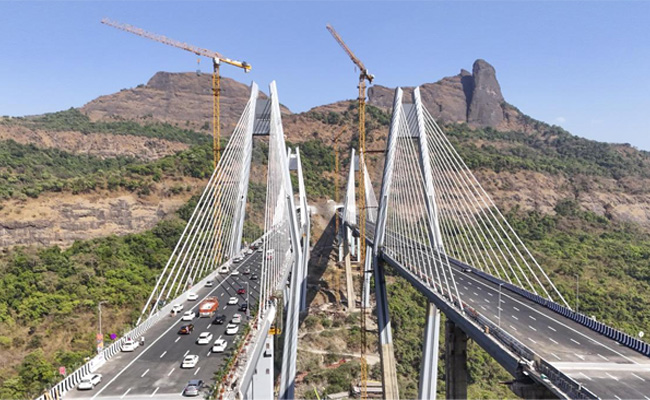
Mumbai (PTI): The Mumbai-bound carriageway of the Mumbai-Pune Expressway connecting link was opened to vehicular traffic on Saturday noon after a delay caused by the dismantling of inauguration infrastructure and cleaning work, a day after the Pune section became operational.
The 13.3 km-long "missing link", which bypasses a section of the Bhor Ghat stretch of the expressway and cuts travel time between Mumbai and Pune by 25 to 30 minutes, was inaugurated a day earlier by Chief Minister Devendra Fadnavis in the presence of Deputy CMs Eknath Shinde and Sunetra Pawar.
The Pune-bound carriageway of the corridor was opened to traffic immediately; however, the Mumbai-bound section remained closed to traffic for several hours after the inauguration.
An official of the Maharashtra State Road Development Corporation told PTI on Saturday that the opening of the Mumbai-bound carriageway was delayed mainly due to the dismantling of the inauguration infrastructure and cleaning work.
The removal of the stage and other decorations was completed in the morning. The work to load and transport the material slightly delayed the opening of the carriageway.
Vehicular movement on the carriageway began after all the remaining material was cleared and road cleaning was completed, the official added.
The expressway control room said that despite significant vehicular movement, the access-controlled highway has not witnessed any major traffic snarls since Friday evening, after the Pune-bound carriageway of the missing link was opened to traffic.
The Missing Link project connects Khopoli (in Raigad) on the Mumbai side to Kusgaon near Lonavala in Pune district and is expected to make the expressway fully access-controlled, easing congestion in the ghat section.
Developed by the MSRDC and dubbed an "engineering marvel", the project includes two tunnels, two viaducts and a cable-stayed bridge over Tiger Valley. It bypasses the steep, accident-prone ghat section, where frequent traffic snarls are reported during weekends and on public holidays.