Clashes in northwest Syria kill more than 40 fighters: monitor
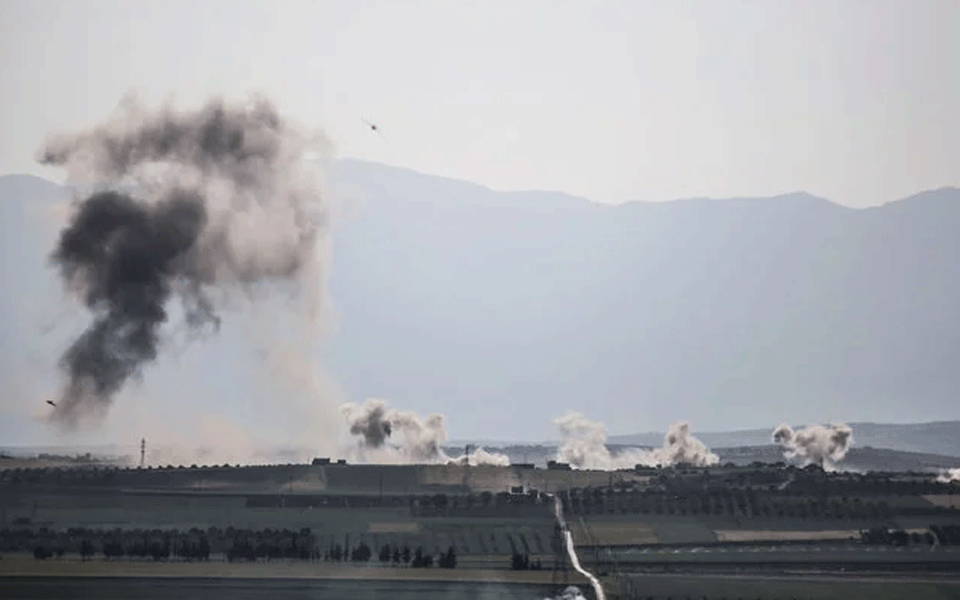
Beirut: Clashes in northwestern Syria have killed at least 42 fighters in 24 hours, a monitor said Monday, after regime bombardment on the region devastated health services.
The northwestern region has come under increasing fire by the regime and its ally Russia in recent weeks, despite a months-old buffer zone deal intended to shield it from any government offensive.
The Syrian Observatory for Human Rights said 16 loyalists and 19 jihadists died from Sunday to Monday in clashes in the area of Jabal al-Akrad in Latakia province, which lies on the bastion's northwestern edge.
Russian and regime aircraft bombarded the area on Monday, while they also hit southern parts of the jihadist stronghold, said the Britain-based war monitor.
Russian air strikes hit a branch of the White Helmets rescue volunteers in the town of Kafranbel, rendering it unable to operate, the Observatory and a rescue worker said.
At the White Helmets facility, an AFP correspondent saw a concrete roof had collapsed in on a bulldozer and other vehicles, and the ground was covered with rubble.
"Two high-explosive missiles hit the centre" just minutes after its personnel had headed out to the site of strikes in a nearby village, Oneida Zikra, the civil defence chief for the area, told AFP.
To the south, rocket fire killed one child in the regime-held town of Suqaylabiyah in Hama province, the Observatory and the state news agency SANA said.
HTS and its allies launched a counter-attack late Monday, bombing areas in the north of the province and sparking fierce clashes on the ground, according to the Observatory.
Idlib's three million inhabitants are supposed to be protected from a massive regime assault by a September buffer zone deal signed by Russia and rebel backer Turkey.
But an uptick in air strikes and shelling displaced 180,000 people between April 29 and May 9 alone, the United Nations says. The Observatory says 119 civilians have been killed in the bombardment since late April.
On Monday, the UN Office for the Coordination of Humanitarian Affairs said 18 health facilities had been knocked out of service in a little over a fortnight, two of them hit twice.
"Attacks on health facilities in northwest Syria continue to exact a devastating toll on the civilian population," said OCHA spokesman for Syria David Swanson.
"Such violence is appalling. Hospitals are and must remain a place of sanctuary and unequivocal neutrality," he told AFP.
UN-linked aid groups on Saturday said they had suspended activities in parts of the region, as the violence has jeopardised the safety of humanitarian workers.
In a filmed interview released on Sunday night, HTS chief Abu Mohammad al-Jolani urged supporters to "take up weapons" to defend Idlib.
The spike in violence signalled "the death of all previous agreements and conferences", he said. In a joint statement on Monday, Britain, France and Germany said the military escalation in northwestern Syria "must stop".
"The current brutal offensive by the Syrian regime and its backers on millions of civilians living in the area is not about fighting terrorism. It is about pushing forward the ruthless reconquest by the regime," they said.
Damascus has not announced a wide offensive, but analysts believe there could be a limited military operation.
The civil war in Syria has killed more than 370,000 people and displaced millions since it started with the brutal repression of anti-government protests in 2011.
Let the Truth be known. If you read VB and like VB, please be a VB Supporter and Help us deliver the Truth to one and all.
Kohli's U-19 teammate Amanpreet Singh Gill dies at 36

New Delhi (PTI): Former India U-19 and Punjab medium pacer Amanpreet Singh Gill died at the age of 36 in Chandigarh on Wednesday, leaving the cricket fraternity in mourning.
The cause of death is not yet known.
Gill, who was Virat Kohli's U-19 teammate, featured in six first-class matches for Punjab, picking up 11 wickets.
He was also part of the Punjab franchise (Kings XI Punjab) in the inaugural Indian Premier League season, and later served as a member of Punjab's senior selection committee.
"Punjab Cricket Association deeply mourns the sad demise of Amanpreet Singh Gill, former Punjab cricketer and Member, Senior Selection Committee Punjab,” the Punjab Cricket Association announced on X.
"Our heartfelt condolences to the bereaved family and loved ones. May Waheguru grant eternal peace to the departed soul and strength to the family in this difficult time."
Two-time World Cup-winning India all-rounder Yuvraj Singh also paid tribute to Gill.
"Deeply saddened to hear about Amanpreet Singh Gill’s passing. Shared the dressing room in our early days, he was a quiet, hardworking cricketer who loved the game. My heartfelt condolences to his family and loved ones. Rest in peace Om Shanti,” Singh posted on X.
Gill played five Youth ODIs and one Youth Test for India in 2007.
In the longer format, he claimed the wicket of former Sri Lanka all-rounder Thisara Perera.
However, he did not make the Virat Kohli-led India U-19 side that went on to win the 2008 World Cup.
“Deeply saddened by the passing of Amanpreet Singh Shergill, who proudly represented Punjab and was a part of the Punjab Kings family. Our heartfelt condolences to his family, friends, and the entire cricketing fraternity,” Punjab Kings posted on their official Instagram account.