Classified UK defence ministry documents found at bus stop: Report

London, Jun 27: Classified documents from the UK Ministry of Defence (MoD) containing secret information about a warship and the British military was discovered at a bus stop in south-eastern England, according to a media report on Sunday.
The MoD said an employee reported the loss of the documents last week, which were discovered by a member of the public in a soggy heap behind a bus stop in Kent early on Tuesday morning, the BBC report said.
One set of documents reportedly discusses the likely Russian reaction to HMS Defender's passage through Ukrainian waters off the Crimea coast on Wednesday and another lays out plans for a possible UK military presence in Afghanistan after the US-led NATO operation there ends this year.
"It would be inappropriate to comment further," an MoD spokesperson said, as it was confirmed an investigation has been launched into the incident.
A member of the public, who wishes to remain anonymous, found the 50-odd pages of documents and contacted the BBC when he realised the sensitive nature of the contents. The BBC believes the documents, which include emails and PowerPoint presentations, originated in the office of a senior official at the MoD.
The documents relating to the Royal Navy's Type 45 destroyer, HMS Defender, show that a mission described by the MoD as an "innocent passage through Ukrainian territorial waters", with guns covered and the ship's helicopter stowed in its hangar, was conducted in the expectation that Russia might respond aggressively.
On Wednesday, more than 20 Russian aircraft and two coastguard ships shadowed the warship as it sailed about 19-km off Crimea's coast. Moscow's defence ministry said a patrol ship fired warning shots and a jet dropped bombs in the destroyer's path but the UK government rejected this account, denying any warning shots had been fired.
The mission, dubbed "Op Ditroite", was the subject of high-level discussions as late as Monday, the documents show, with officials speculating about Russia's reaction if HMS Defender sailed close to Crimea.
The bundle of documents also includes updates on arms exports campaigns, including sensitive observations about areas where Britain might find itself competing with European allies. And there are briefing notes for last Monday's session of the UK-US Defence Dialogue, including observations on US President Joe Biden's first months in office.
Most of the papers are marked "official sensitive", a relatively low level of classification used, according to the government, "where there is a clear and justifiable requirement to reinforce the 'need to know'".
But one document, addressed to UK Defence Secretary Ben Wallace's private secretary, and marked "Secret UK Eyes Only", outlines highly sensitive recommendations for the UK's military footprint in Afghanistan, following the end of Operation Resolute Support, the NATO operation currently winding down in the wake of President Joe Biden's decision earlier this year to withdraw American forces.
The document discusses an American request for British assistance in several specific areas, and addresses the question of whether any British special forces will remain in Afghanistan once the withdrawal is complete.
Due to the sensitivity of the document, the BBC said it has decided not to report details which could endanger the security of British and other personnel in Afghanistan.
Let the Truth be known. If you read VB and like VB, please be a VB Supporter and Help us deliver the Truth to one and all.
Two injuries, one DNF, a DQ as India end messy World Relays campaign
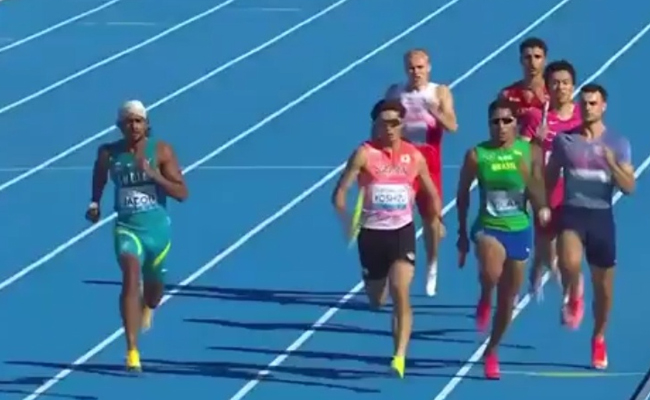
Gaborone (Botswana) (PTI): Amoj Jacob and Ragul Kumar got injured during the men's 4x400m and 4x100 races respectively as India ended their World Athletics Relays campaign in disappointment on the second day of competitions here on Sunday.
The Indian camp had high hopes of making the 2027 World Championships in the men's 4x400m relay but the team did not finish (DNF) the race as Jacob suffered cramps and pulled out of the race after taking the baton from the first leg runner Dharamveer Choudhary. Rajesh Ramesh and Vishal TK were to run in the third and fourth legs.
Those teams which could not qualify for the 2027 Beijing World Championships by reaching the final round of each of the six relay events on Saturday were given another chance in the second qualification round on Sunday.
The top two teams in each of the two heats (in all six relay events) booked the Beijing ticket on Sunday.
India will now have to try and qualify for the World Championships through the Top Lists of the World Athletics, which is a long and tedious process.
In the men's 4x100m race, third leg runner Ragul Kumar fell down the track after failing to hand over the baton inside the exchange zone to fourth leg runner Gurindervir Singh, which clearly showed the lack of coordination among the runners.
Harsh Santosh Raut and Animesh Kujur ran the first two legs.
The Indian quartet was disqualified and Kumar was seen being taken away from the Field of Play with the help of the volunteers.
It was a comedy of errors in the case of the women's 4x100m race, which saw the baton being dropped during an exchange between first leg runner Tamanna and second runner Nithya Gandhe, though the Indians finished the race in 53.09 seconds.
Gandhe started running quite a distance, but after realising that the baton was not in her hand, she turned and ran back to pick it up.
The only silver-lining for the Indian contingent was the national record time in the mixed 4x100m relay race, though the quartet of Ragul Kumar, Nithya Gandhe, Animesh Kujur and Sneha SS finished sixth in heat number two with a time of 41.35 seconds, bettering the previous national mark of 42.30 seconds set in March in Chandigarh.
The mixed 4x400m relay quartet of Theerthesh P Shetty, Kumari Saloni, Nihal William and Rashdeep Kaur ended at fifth in heat number one with a time of 3 minutes and 19.40 seconds.
On Saturday, all the five Indian relay teams had failed to make it to the respective final rounds and thus missed out on the 2027 World Championships berths.