CNN bans conservative commentator Ryan Girdusky after verbal attack on journalist Mehdi Hasan
Mehdi Hasan expresses disbelief over verbal attack, says he has "never been so stunned”
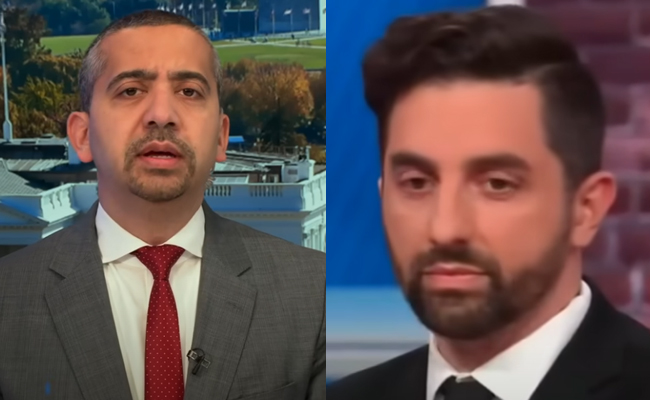
Washington DC: CNN has permanently banned conservative political commentator Ryan Girdusky after he verbally attacked British-American journalist Mehdi Hasan during a heated debate on "NewsNight With Abby Phillip." The incident occurred on Monday night when Girdusky made a controversial remark, saying, "I hope your beeper doesn’t go off," in reference to a series of deadly explosions in Lebanon.
The discussion centred around the upcoming United States presidential election and criticisms of a recent rally by Republican candidate Donald Trump, where derogatory remarks were made against various minority groups. Hasan, the founder of the new media company Zeteo, criticised the inflammatory rhetoric at the rally and asserted, “If you don’t want to be called Nazis, stop doing, stop saying.”
After Girdusky's remark, Hasan responded, questioning whether Girdusky suggested he should die. Host Abby Phillip interjected, apologising to Hasan and confirming Girdusky's removal from the panel, stating, "There is a line that was crossed there, and it’s not acceptable to me."
https://youtu.be/e6qjI2xK4XM?si=6vtMALn3Bj6g5ZXt
Following the broadcast, CNN released a statement asserting, "There is zero room for racism or bigotry at CNN or on our air." The network condemned Girdusky's comments, stating he would not be welcomed back.
New: CNN says in a statement that Ryan Girdusky will no longer appear on the network after this remark https://t.co/CQu2ILswNm pic.twitter.com/Jjny0eE60c
— Aidan McLaughlin (@aidnmclaughlin) October 29, 2024
Phillip later expanded on the incident in a statement posted on X, clarifying that Hasan had been welcome to continue the show but chose not to return. “As you may have seen, Ryan was asked to leave the show, and we put out a statement saying that he’s not welcome back on our air,” she wrote. “We really wanted [Hasan] to come back and finish the show… but I just wanted to make sure that you all knew that was not what happened there.”
Sharing @CNN’s statement and a quick message from me about what happened on tonight’s show.
— Abby D. Phillip (@abbydphillip) October 29, 2024
I take this very seriously and want to again apologize to @mehdirhasan and I hope he’ll join us another time. pic.twitter.com/O9l0Ftv5NZ
Girdusky later tweeted, "Apparently, you can’t go on CNN if you make a joke," in response to the backlash.
You can stay on CNN if you falsely call every Republican a Nazi and have taken money from Qatar-funded media. Apparently you can't go on CNN if you make a joke. I'm glad America gets to see what CNN stands for.
— Ryan James Girdusky (@RyanGirdusky) October 29, 2024
Responding to the incident, progressive commentator and journalist Mehdi Hasan said that he was "so stunned" when a conservative commentator told him, "I hope your beeper doesn't go off," during a panel on CNN.
Hasan, a frequent critic of Israel, said on Wednesday in a video message shared on YouTube that while he has "interviewed" and "sparred with controversial, opinionated, offensive people from across the world ... never in my 25 years as a journalist, and 15 years of doing live TV, have I been so stunned by what was said to me."
"But as shocked and stunned as I was, there was no way I was going to let him say that to me unchallenged," Hasan added. He said that he was happy to see CNN decide to ban Girdusky from appearing on air and that Phillip took the time to apologise to viewers "after I walked off set."
Hasan strongly condemned Harris' policies toward the Israel-Hamas conflict in his video message on Wednesday but raised an even bigger warning about a second Trump presidency should the former president win on November 5. "If she [Harris] loses—and to be clear, because of her refusal to budge even an inch on Gaza ...—we will get a Trump presidency," Hasan said. "A white supremacist presidency, an anti-Black, antisemitic, Islamophobic presidency, in which people like the bigot I had to deal with on CNN will be emboldened like never before," Hasan added.
https://youtu.be/iSq7vnw3gWI?si=TPNsCEZH1RLI6gA3
Let the Truth be known. If you read VB and like VB, please be a VB Supporter and Help us deliver the Truth to one and all.
CM Siddaramaiah alleges ‘criminal conspiracy’ in Sringeri recount, vows legal action
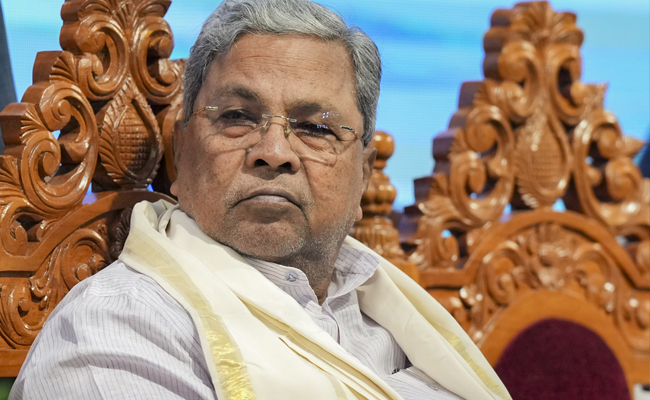
Bengaluru (PTI): Alleging a “criminal conspiracy” by BJP candidate D N Jeevaraj in the Sringeri Assembly poll recounting, Karnataka CM Siddaramaiah on Tuesday said the outcome was manipulated after valid postal ballot votes in favour of Congress leader T D Raje Gowda were tampered with during the recounting process.
Following a Karnataka High Court order on an election petition filed by Jeevaraj, challenging Raje Gowda’s election, the reverification and recounting were conducted on Saturday.
After the reverification and recount of postal ballots for the Sringeri Assembly constituency, votes polled in favour of Raje Gowda were reduced by 255, the returning officer said.
A report on the matter has been submitted to the Election Commission of India for further action, the officer added.
Congress leader Raje Gowda had won the 2023 Assembly polls from Sringeri by 201 votes, defeating his nearest rival Jeevaraj.
Addressing a press conference in Bengaluru, Siddaramaiah said the High Court had directed the recounting of postal ballots and that irregularities were noticed during the exercise conducted on May 2.
“This is a clear case of criminal conspiracy,” Siddaramaiah said, alleging that valid votes cast in favour of Raje Gowda were altered after being accepted by counting agents of all parties, including Congress, BJP, and JD(S).
He claimed that during the recounting of postal ballots, 255 votes were initially accepted as valid by all agents but were later tampered with by subordinate officials.
“There is a second mark on the votes polled in favour of Raje Gowda. They had accepted these as valid votes. Subsequently, another mark was made by officials. This is a clear case of criminal conspiracy,” he said.
When asked who was behind the alleged conspiracy, the CM replied, “It was hatched by Jeevaraj and others. It is planned.”
Siddaramaiah further alleged that the returning officer acted improperly by declaring the result despite the presence of an Election Commission observer during the recounting.
“Immediately after the counting, the returning officer announced the result. He should not have done so; this is against the law,” he said.
He pointed out that Raje Gowda had originally won by 201 votes, but after the recounting, the BJP candidate was declared the winner by 52 votes.
“The BJP has committed a criminal act of conspiracy. This is not vote chori but vote dacoity,” he alleged.
The CM said a police complaint had already been filed by Raje Gowda’s election agent, Sudhir Kumar, and emphasised the need for electoral integrity.
“We want transparency and free and fair elections. That is what our Constitution mandates,” he added.
Stating that the government would pursue legal remedies, Siddaramaiah said, “We are preparing an appeal challenging the returning officer’s announcement in a court of law.”
Responding to a separate query on elections in other states, the CM said there appeared to be an anti-incumbency factor in West Bengal, while results in Tamil Nadu were “surprising,” adding that Vijay’s party was emerging as the largest there.
Following the victory of party candidates in Bagalkote and Davanagere South, Siddaramaiah expressed confidence about future electoral prospects in Karnataka.
“Even in 2028, we will win the Assembly elections. We will come back,” the CM said.
Siddaramaiah added that he would order a forensic examination into the alleged tampering of postal ballots.