CNN journalist apologizes for claiming Hamas beheaded babies

Washington: CNN journalist Sara Sidner has issued an apology for reporting unverified claims regarding the beheading of babies, which she stated had been confirmed by the office of Israeli Prime Minister Benjamin Netanyahu. Sidner made the apology on X (formerly Twitter) after the Israeli government stated that it could not confirm the alleged incident.
Sidner expressed regret for her earlier report, stating, "Yesterday, the Israeli Prime Minister's office said that it had confirmed Hamas beheaded babies and children while we were live on air. The Israeli government now says today it CANNOT confirm babies were beheaded. I needed to be more careful with my words and I am sorry."
Furthermore, CNN also issued an update on X, acknowledging the contradiction in their earlier report. The update clarified that Israel could not confirm the claims, retracting their previous statement.
The initial claims regarding the beheading of children at the Kfar Aza kibbutz had surfaced during a live broadcast by Israeli news channel i24News. The channel's reporter had mentioned the discovery of babies with their heads cut off following the Israeli army's recapture of the kibbutz, citing testimonies from Israeli soldiers. These claims quickly circulated in the international media and social networks, prompting a response from various leaders, including US President Joe Biden.
However, the White House later clarified President Biden's remarks, stating that he and other US officials had not independently confirmed the alleged beheadings. The clarification cited information from "Netanyahu's spokesperson and media reports from Israel" for the comments made by President Biden.
Yesterday the Israeli Prime Minister's office said that it had confirmed Hamas beheaded babies & children while we were live on the air. The Israeli government now says today it CANNOT confirm babies were beheaded. I needed to be more careful with my words and I am sorry. https://t.co/Yrc68znS1S
— Sara Sidner (@sarasidnerCNN) October 12, 2023
The words I used were the PM's office must have proof if they are confirming this. Then President Biden confirmed seeing it. And then backed tracked.
— Sara Sidner (@sarasidnerCNN) October 12, 2023
Let the Truth be known. If you read VB and like VB, please be a VB Supporter and Help us deliver the Truth to one and all.
Ordinance issued to increase number of Supreme Court judges from 34 to 38
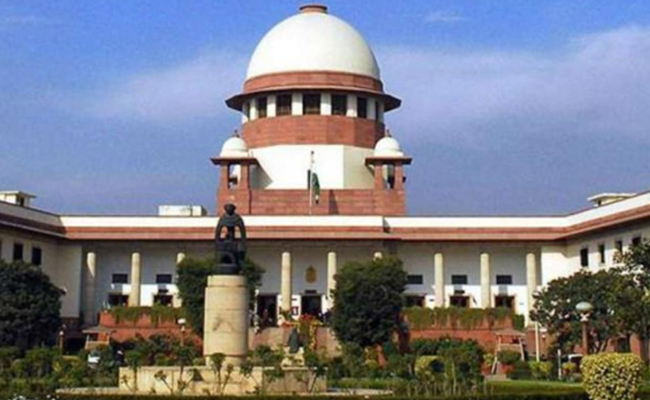
New Delhi (PTI): The government has promulgated an ordinance to increase the strength of the Supreme Court from the present 34 judges to 38, including the Chief Justice of India.
The law ministry notified the ordinance on Saturday, which amended the Supreme Court (Number of Judges) Act, 1956, to increase the sanctioned strength of the top court.
So far, the sanctioned strength of the top court was 34, including the Chief Justice of India (CJI). Now, the number of judges has been increased by four, taking the sanctioned strength to 38.
The top court will now have 37 judges, other than the CJI.
With the apex court having two vacancies at present, and the ordinance coming into force immediately, the Supreme Court Collegium will now have to recommend six names for appointment as judges in the top court.
A bill will be brought in the Monsoon Session of Parliament to convert the ordinance – an executive order – into a law passed by Parliament.
The Union Cabinet had cleared a draft bill on May 5 to increase the number of apex court judges.
The strength of the Supreme Court was last increased from 30 to 33 (excluding the CJI) in 2019.
The Supreme Court (Number of Judges) Act, as originally enacted in 1956, put the maximum number of judges (excluding the CJI) at 10.
This number was increased to 13 by the Supreme Court (Number of Judges), Amendment Act, 1960, and to 17 by another amendment to the law.
The Supreme Court (Number of Judges) Amendment Act, 1986, augmented the strength of judges from 17 to 25, excluding the CJI.
A fresh amendment in 2009 further increased the strength from 25 to 30.
Article 124(3) of the Constitution lists the qualifications required to become a Supreme Court judge.
An Indian citizen who has either served as a high court judge for at least five years, or as an advocate for 10 years, or is a distinguished jurist, can be appointed to the top court.
The strength of the Supreme Court is increased based on the recommendations of the CJI, who writes to the Union law minister. After consulting the finance ministry, the Department of Justice under the law ministry moves the Cabinet with a draft bill.