Columbia University expels, revokes diplomas, suspends pro-Palestine students for campus protests
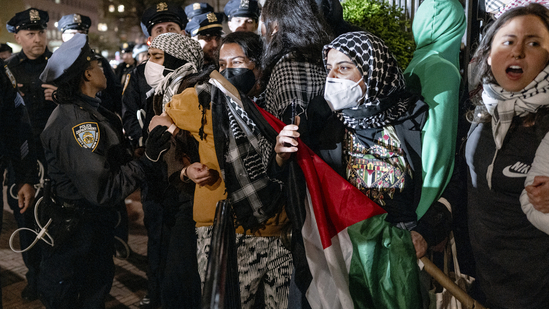
New York (AP): Columbia University has expelled or suspended some students who took over a campus building during pro-Palestinian protests last spring and temporarily revoked the diplomas of others who have since graduated, officials said on Thursday.
The university said in a campus-wide email that a judicial board brought a range of sanctions against students who occupied Hamilton Hall last spring to protest the war in Gaza.
Columbia did not provide a breakdown of how many students were expelled, suspended or had their degrees revoked, but it said the outcomes were based on an "evaluation of the severity of behaviours".
The culmination of the monthslong investigative process comes as the university is reeling from the arrest of a well-known Palestinian campus activist, Mahmoud Khalil, by federal immigration authorities last Saturday in what President Donald Trump said would be the "first of many" such detentions.
At the same time, the Trump administration has stripped the university of more than USD 400 million in federal funds over what it calls a failure to combat campus antisemitism. Congressional Republicans have pointed specifically to a failure to discipline students involved in the Hamilton Hall seizure as proof of inaction by the university.
The building occupation followed a tent encampment that inspired a wave of similar demonstrations at college campuses across the country.
On April 30, 2024, a smaller group of students and their allies barricaded themselves inside Hamilton Hall with furniture and padlocks in a major escalation of campus protests.
At the request of university leaders, hundreds of New York police stormed onto campus the following night, arresting dozens of people involved in both the occupation and the encampment.
At a court hearing in June, the Manhattan district attorney's office said it would not pursue criminal charges for 31 of the 46 people initially arrested on trespassing charges inside the administration building.
But the students still faced disciplinary hearings and possible expulsion from the university. Some faced interim suspensions.
The final sanctions announced on Thursday followed a lengthy process that involved hearings for each student led by Columbia's long-running Judicial Board.
Separately, a newly-created disciplinary board has brought a flurry of new cases against students -- including Mahmoud Khalil -- who have expressed criticism of Israel, triggering alarm among free speech advocates. Khalil was not among the protesters accused of seizing Hamilton Hall.
The expulsion announcement drew praise from some faculty members, including Gil Zussman, chair of the electrical engineering department and member of Columbia's Task Force on Antisemitism.
"Finally demonstrating that breaking university rules has consequences is an important first step towards going back to the core missions of research and teaching," he said in a post on social media platform X.
Let the Truth be known. If you read VB and like VB, please be a VB Supporter and Help us deliver the Truth to one and all.
Maharashtra sets up state vaccination task force to strengthen immunisation programme

Mumbai (PTI): The Maharashtra government has set up a State Vaccination Task Force to strengthen the regular immunisation programme and review the progress of related campaigns, a health department official said on Monday.
The State Vaccination Task Force will comprise at least 29 members and will be headed by the administrative head of the health department, he informed.
The government has also constituted separate district-level and municipal vaccination task forces to improve implementation and address challenges at the grassroots level, he said.
Municipal task forces, chaired by respective civic commissioners, have been constituted in view of the vast urban population in Maharashtra and the role of civic bodies in implementing different health programmes.
The district-level task forces will function under the chairmanship of collectors.
"Complete immunisation of children at the appropriate age is an extremely simple, cost-effective and highly effective measure to reduce child mortality and the prevalence of diseases among kids. Immunisation is a powerful tool for reducing illness in children," maintained the official.
To ensure full vaccination of all children, the state government implements various campaigns from time to time as per the central government guidelines, he pointed out.
"Active participation and cooperation of other relevant government departments are essential (in making these campaigns successful)," according to the official.
The state-level body will review the regular immunisation programme, associated campaigns and vaccine-preventable diseases in detail. It will also conduct focused assessments of high-risk districts and municipal corporations, including vacancies at district, municipal and sub-district levels, availability of cold chain equipment, resource gaps and training requirements, he noted.
The state task force will review allocation and utilisation of funds for immunisation and ensure timely action by officers concerned based on reports from district and municipal task forces and state-level monitoring mechanisms, the official said.
It will also ensure active coordination and participation of other government departments in immunisation drives, while district and municipal task forces will carry out similar functions at their respective levels, the official added.