Construction on 'own territory' normal, says China on report of building village in Arunachal
Beijing: China's construction activities on "its own territory" is "normal" and is entirely a matter of sovereignty, the Chinese Foreign Ministry said here on Thursday, reacting to a report about China building a new village in Arunachal Pradesh.
"China's position on the east sector of the China-India boundary, or Zangnan region (the southern part of China's Tibet), is consistent and clear. We have never recognised the so-called Arunachal Pradesh illegally established on the Chinese territory," Chinese Foreign Ministry spokesperson Hua Chunying told a media briefing while responding to a question.
China claims Arunachal Pradesh as part of southern Tibet, while India's consistent stand has been that the northeastern state is an integral and inalienable part of the country.
"China's normal construction on its own territory is entirely a matter of sovereignty," Hua was quoted as saying by the Chinese foreign ministry on its website in an updated statement.
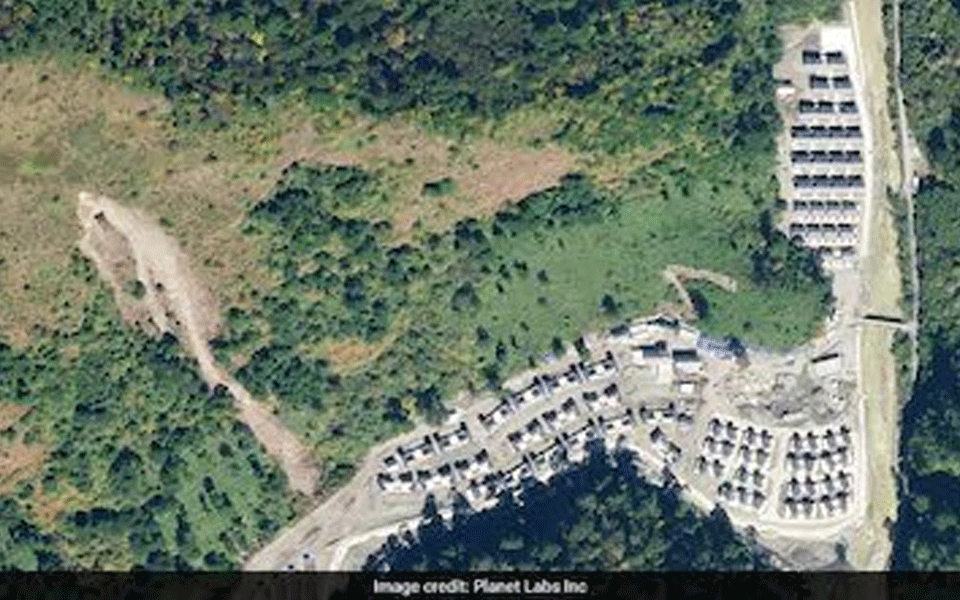
In a report, NDTV news channel showed two images of the area in Arunachal Pradesh where it said a new village has been set up by China and it consisted of about 101 homes. According to the channel, the first image dated August 26, 2019 did not show any human habitation but the second one of November 2020 shows a row of structures.
In a cautious reaction to the report, India on Monday said it keeps a constant watch on all developments having a bearing on the country's security, and takes necessary measures to safeguard its sovereignty and territorial integrity.
The Ministry of External Affairs in New Delhi said India has stepped up the construction of border infrastructure, including roads and bridges for the improvement of livelihood of its citizens.
"Government keeps a constant watch on all developments having a bearing on India's security and takes all the necessary measures to safeguard its sovereignty and territorial integrity," it said.
The India-China border dispute covers the 3,488-km-long Line of Actual Control (LAC).
The report about China setting up a new village in Arunachal Pradesh comes amid a military standoff in eastern Ladakh for over eight months.
India and China have held several rounds of military and diplomatic talks to resolve the face-off in eastern Ladakh, but no significant headway has been made so far.
Let the Truth be known. If you read VB and like VB, please be a VB Supporter and Help us deliver the Truth to one and all.
NCW chief condemns rape-murder of 4-year-old girl in Pune, calls for swift action
New Delhi (PTI): National Commission for Women (NCW) Chairperson Vijaya Rahatkar has condemned the alleged rape and murder of a four-year-old girl in Maharashtra's Pune, calling it "deeply distressing" and a "blot on humanity".
The girl was allegedly raped and killed by a 65-year-old labourer, who has a criminal record, in Bhor tehsil of Pune on Friday. The accused allegedly lured the child to a cattle enclosure on the pretext of giving her food. After raping her, he killed her by hitting her with a stone, according to police.
The accused has been arrested.
In a post on X on Saturday, Rahatkar said the incident in the Nasrapur area in Pune was heartbreaking and has shaken society.
"The brutal torture and murder of a four-year-old innocent girl in Nasrapur (Bhor, Pune) is deeply painful, heartbreaking, and shocking. It is a blot on humanity," she said.
She said Pune Rural police has arrested the accused and noted that Maharashtra Chief Minister Devendra Fadnavis and Deputy Chief Minister Sunetra Pawar have assured strict action in the case.
Rahatkar said the NCW has taken cognisance of the matter and written to the National Commission for Protection of Child Rights (NCPCR), requesting the body to ensure necessary and prompt action.
It has also been recommended that the case be pursued under stringent provisions of the Protection of Children from Sexual Offences (POCSO) Act and be closely monitored from the filing of the chargesheet to proceedings in a fast-track special court to ensure time-bound justice, she added.
Ensuring justice for the victim and stringent punishment for the accused is a collective responsibility, the NCW chairperson underlined.
In a post on X, the NCW said it has taken suo motu cognisance of the extremely "heinous" incident.
"This heinous crime causes profound pain and outrage, and it highlights serious concerns regarding the safety of young girls," it said.
Strongly condemning this grave "inhuman act", the NCW said such crimes constitute a serious violation of children's rights and raise questions about society's security system.