Coronavirus: Kenyan boy who made hand-washing machine awarded
The report was originally posted on bbc.com and has been posted here without making any changes or alterations. Click here to read the original story.
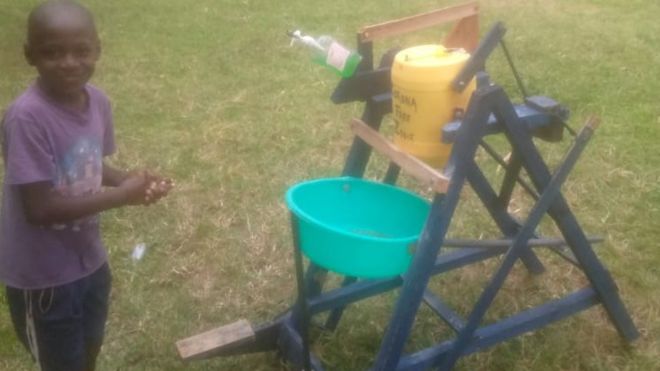
A nine-year-old Kenyan boy who made a wooden hand-washing machine to help curb the spread of coronavirus has told the BBC he is "very happy" after receiving a presidential award.
"I now have two machines and I want to make more," Stephen Wamukota said.
They allow users to tip a bucket of water using a foot pedal to avoid touching surfaces to reduce infections.
Stephen came up with the idea after learning on TV about ways to prevent catching the virus.
Kenya has reported more than 2,000 cases of Covid-19 and 69 deaths.
Stephen and his family live in Mukwa village, in Bungoma country, western Kenyan, which has not reported a single case of the virus.
His father, James Wamukota, however, worries that it could still come to his area.
How was the machine-made?
"I had bought some pieces of wood to make a window frame, but when I came back home after work one day I found that Stephen had made the machine," Mr. Wamukota told the BBC.
"The concept was his and I helped tighten the machine. I'm very proud," he said.
Mr Wamukota, who repairs electronic goods for a living, said that his son has always been keen to learn his trade.
He posted his son's invention on Facebook and was surprised how quickly it was shared, he said.
Stephen was among 68 Kenyans given the Presidential Order of Service, Uzalendo (Patriotic) Award on Monday.
Stephen said that he wants to be an engineer when he grows up and the county government has promised to give him a scholarship, Mr Wamukota said.
Let the Truth be known. If you read VB and like VB, please be a VB Supporter and Help us deliver the Truth to one and all.
Man held for blackmailing woman using explicit photos, videos
Bengaluru (PTI): A 46-year-old man has been arrested for allegedly blackmailing a woman using her explicit photos and videos to force her into a sexual relationship with him, police said on Saturday.
The accused, Haniyur Chandregowda, is a member of the Child Welfare Committee in Ramanagara, they said.
Obscene photos of several other women were also found on his mobile phone during examination, police said.
The case came to light after a 43-year-old woman, who works as a make-up artist, filed a complaint at the Rajarajeshwari Nagar police station on April 30, they said.
According to FIR, the woman met Chandregowda in 2021. He told her he was connected to TV serials and took her phone number on the pretext of offering make-up work. The woman had been living separately from her husband for about eight years.
The accused started visiting her house frequently and told her he was a lecturer with a good salary and promised to marry her and entered into a physical relationship with her, she alleged.
Police said Chandregowda later used private photos and videos of their intimate moments to threaten her. He allegedly warned that he would make them public if she did not agree to his demands, and continued the relationship under pressure.
The FIR also stated that in 2024, he rented a house using the woman's documents by falsely claiming to be her husband.
The woman also alleged that he used a fake ID claiming he was a Superintendent of Police to avoid paying toll fees.
She claimed that he had taken around Rs 5 lakh from her since 2021 and had not returned the money.
The FIR further stated that he added his name to the educational documents of the woman's daughter, pretending to be her husband.
Based on the complaint, a case under sections 69 (sexual intercourse by deceitful means) and 204 (impersonating a public servant) of the Bharatiya Nyaya Sanhita was registered. He was later arrested, a senior police officer said.