COVID-19 cases in Wuhan hospitals to zero for 1st time: official
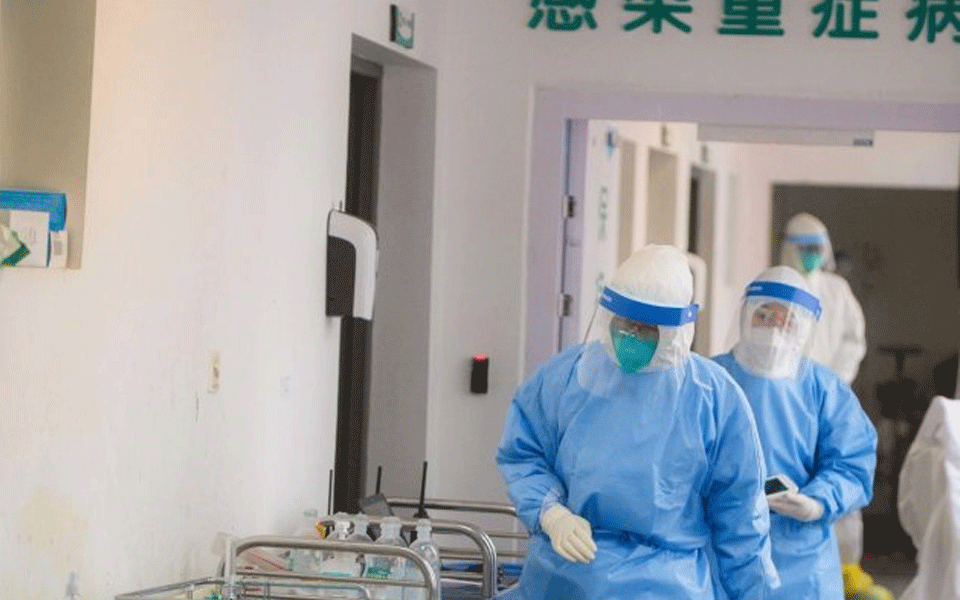
Beijing/Wuhan: The number of hospitalised COVID-19 patients in China's Wuhan, where the virus first emerged before turning out to be a pandemic, on Sunday dropped to zero for the first time, marking yet another milestone for the city which was opened up on April 8 after a 76-day lockdown.
The result has been achieved with the hard efforts of medical workers in Wuhan and those who were dispatched to assist the city in the fight against the virus from across the country, said Mi Feng, a spokesperson for China's National Health Commission (NHC).
The last patient in Wuhan was cured on Friday, reducing the number of coronavirus patients in the city to zero, Mi said, state-run Xinhua news agency reported.
The health commission of Hubei province, whose capital is Wuhan, said that no new confirmed cases or new deaths due to COVID-19 were reported on Saturday.
It said that 11 coronavirus patients were discharged from hospital after recovery in Wuhan. Hubei has so far reported 68,128 confirmed COVID-19 cases, including 50,333 in Wuhan.
Hubei and Wuhan were in the thick of the coronavirus outbreak since early January this year, bearing the brunt of it.
China officially said that the coronavirus was noticed in late December in Wuhan but announced severe measures like the lockdown of 56 million-strong province from January 23, which drew criticism from the US and other countries that it acted late, leading to its spread globally.
There was a controversy about whether the virus, with the ability to transmit from human-to-human, emerged from the Huanan Seafood Market of Wuhan or escaped from the Wuhan Institute of Virology (WIV) as alleged by the US.
China has said that the coronavirus origin is a matter of science and it should be left to science and medical community to reach a conclusion.
China also revised the death toll in Wuhan by 50 per cent amidst criticism that it is underreporting the cases.
Local municipal authority said as of April 16, the total number of confirmed coronavirus cases in Wuhan was increased by 325 to 50,333 and the number of fatalities up by 1,290 to 3,869.
The revised figure raised China's overall COVID-19 death toll to 4,632. The total number of cases as of Thursday stood at 82,692.
Chinese Foreign Ministry officials said the revision was due to some late reports, omissions and inaccurate information in the initial stages.
Officials said that over five million residents of Wuhan travelled out before the lockdown to avail the Chinese New Year holidays starting from January 24 which was cited as a possible reason for the spread of the virus in China and the world.
China has highlighted the strong measures it has taken in Hubei like prolonged lockdown besides building 14 temporary hospitals and deployment of 42,000 medical personnel to contain the virus.
The lockdown was lifted on April 8 after the virus cases abated.
The 11 million-strong Wuhan city has not yet become fully normal due to the steady increase in asymptomatic cases.
By the end of Saturday, the province had 572 asymptomatic cases under medical observation, after 19 new such cases were reported on Saturday, the local health commission reported on Sunday.
Asymptomatic cases refer to the people who test positive for the coronavirus but develop no symptoms such as fever, cough or sore throat. They are infectious and pose a risk of spreading the virus to others.
More than 200,000 people globally have died of the new coronavirus, including more than 50,000 in the US. It has infected nearly three million people across the world.
Let the Truth be known. If you read VB and like VB, please be a VB Supporter and Help us deliver the Truth to one and all.
Man arrested with Rs 2.54-crore heroin in Mumbai

Mumbai (PTI): Police have arrested a man and seized over 500 grams of heroin worth Rs 2.54 crore in the illicit market from him in Mumbai, officials said on Friday.
The police's Anti-Narcotics Cell (ANC) made the drug seizure in Santacruz in the western suburbs. The operation was conducted by the Kandivali unit of the ANC on Thursday as part of a special crackdown against drug trafficking in the area, they said.
Acting on specific inputs, an ANC team conducted a raid in Santacruz (East) and intercepted a man. During a search, the team recovered 508 grams of high-grade heroin from his possession, an official said.
The seized contraband, a highly addictive, opioid drug derived from morphine, is estimated to be worth Rs 2.54 crore in the international market, he informed.
Following the seizure, a case was registered against the man under relevant sections of the Narcotic Drugs and Psychotropic Substances (NDPS) Act, 1985, and he was formally placed under arrest in the early hours of Friday.
The police are currently investigating the source of the drug and trying to identify the intended recipients of the consignment, he said.