COVID-19: Global death toll estimated to be 15 mn; India had 4.7 mn deaths, says WHO
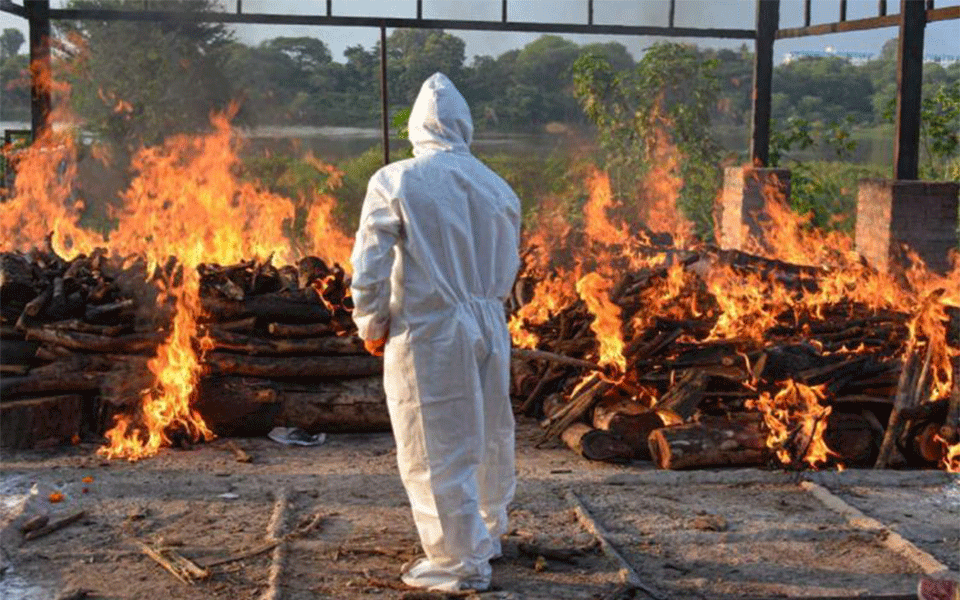
United Nations/Geneva (PTI): The WHO on Thursday said that 14.9 million people were killed either by COVID-19 directly or due to the pandemic's impact on health systems and society, with the global health agency estimating that India had 4.7 million fatalities.
In New Delhi, India strongly objected to the use of mathematical models by the World Health Organization (WHO) for projecting excess mortality estimates linked to the coronavirus pandemic in view of the availability of authentic data, saying validity and robustness of the models used and methodology of data collection are questionable.
New estimates from the WHO show that the full death toll associated directly or indirectly with the COVID-19 pandemic, described as excess mortality, between January 1, 2020 and December 31, 2021 was approximately 14.9 million, ranging from 13.3 million to 16.6 million.
These sobering data not only point to the impact of the pandemic but also to the need for all countries to invest in more resilient health systems that can sustain essential health services during crises, including stronger health information systems, said Dr Tedros Adhanom Ghebreyesus, WHO Director-General.
WHO is committed to working with all countries to strengthen their health information systems to generate better data for better decisions and better outcomes, he said.
Excess mortality includes deaths associated with COVID-19 directly (due to the disease) or indirectly (due to the pandemic's impact on health systems and society).
Deaths linked indirectly to COVID-19 are attributable to other health conditions for which people were unable to access prevention and treatment because health systems were overburdened by the pandemic.
The estimated number of excess deaths can be influenced also by deaths averted during the pandemic due to lower risks of certain events, like motor-vehicle accidents or occupational injuries.
For India, the cumulative excess deaths associated with COVID-19 pandemic (mean) estimated by the WHO is 4,740,894.
In a technical note for India, WHO said the estimates may not be regarded as the national statistics officially produced by India due to differences arising from the data and methods used by WHO.
It noted that the information from the Civil Registration System (CRS) in India for 2020 was made publicly available by the Registrar General of India (RGI) on May 3, 2022 in a report.
The newly published information in the report is being carefully examined and will be taken into consideration in revisions of the estimates.
According to sources in New Delhi, India is likely to raise the issue at the World Health Assembly and other required multilateral forums.
India has been consistently objecting to the methodology adopted by the WHO to project excess mortality estimates based on mathematical models, the Union Health Ministry said in a statement.
"Despite India's objection to the process, methodology and outcome of this modeling exercise, WHO has released the excess mortality estimates without adequately addressing India's concerns," the statement said.
India had also informed the WHO that in view of the availability of authentic data published through CRS by the RGI, mathematical models should not be used for projecting excess mortality numbers for India.
The Indian government on Tuesday published the CRS report 2020 based on birth and death reports.
In case of registered deaths, the number has gone up from 76.4 lakh in 2019 to 81.2 lakhs in 2020, an increase of 6.2 per cent, the RGI's report 'Vital Statistics of India based on the Civil Registration System' for 2020 said.
"Now that actual count of excess deaths from all the causes are available, there is no rationale for using modeling-driven estimates based on pure conjectures and assumptions," NITI Aayog member V K Paul told PTI.
He pointed out that compared to the calendar year 2018, in 2019 there was 6.9 lakh excess mortality.
The findings of the CRS study assume significance with India recently questioning the WHO's methodology to estimate Covid mortalities in the country, saying using such a mathematical modeling cannot be applied to estimate the death figures for such a vast nation of geographical size and population.
Covid deaths were 1.49 lakh in 2020, according to official data based on a robust surveillance system set up for Covid, he said.
WHO said that most of the excess deaths (84 per cent) are concentrated in South-East Asia, Europe, and the Americas.
Some 68 per cent of excess deaths are concentrated in just 10 countries globally. Middle-income countries account for 81 per cent of the 14.9 million excess deaths (53 per cent in lower-middle-income countries and 28 per cent in upper-middle-income countries) over the 24-month period, with high-income and low-income countries each accounting for 15 per cent and 4 per cent, respectively.
The estimates for a 24-month period (2020 and 2021) include a breakdown of excess mortality by age and sex. They confirm that the global death toll was higher for men than for women (57 per cent male, 43 per cent female) and higher among older adults.
The absolute count of the excess deaths is affected by the population size.
The number of excess deaths per 100,000 gives a more objective picture of the pandemic than reported COVID-19 mortality data.
Measurement of excess mortality is an essential component to understand the impact of the pandemic. Shifts in mortality trends provide decision-makers information to guide policies to reduce mortality and effectively prevent future crises.
Because of limited investments in data systems in many countries, the true extent of excess mortality often remains hidden, said Dr Samira Asma, Assistant Director-General for Data, Analytics and Delivery at WHO.
These new estimates use the best available data and have been produced using a robust methodology and a completely transparent approach.
Data is the foundation of our work every day to promote health, keep the world safe and serve the vulnerable. We know where the data gaps are, and we must collectively intensify our support to countries, so that every country has the capability to track outbreaks in real-time, ensure delivery of essential health services, and safeguard population health, said Dr Ibrahima Soc Fall, Assistant Director-General for Emergency Response.
The United Nations system is working together to deliver an authoritative assessment of the global toll of lives lost from the pandemic. This work is an important part of UN DESA's ongoing collaboration with WHO and other partners to improve global mortality estimates, said Mr Liu Zhenmin, United Nations Under-Secretary-General for Economic and Social Affairs.
Stefan Schweinfest, Director of the Statistics Division of UN DESA, added: Data deficiencies make it difficult to assess the true scope of a crisis, with serious consequences for people's lives.
The pandemic has been a stark reminder of the need for better coordination of data systems within countries and for increased international support for building better systems, including for the registration of deaths and other vital events.
Let the Truth be known. If you read VB and like VB, please be a VB Supporter and Help us deliver the Truth to one and all.
EAM Jaishankar meets Jamaican PM, gifts over 10 BHISHM Cubes
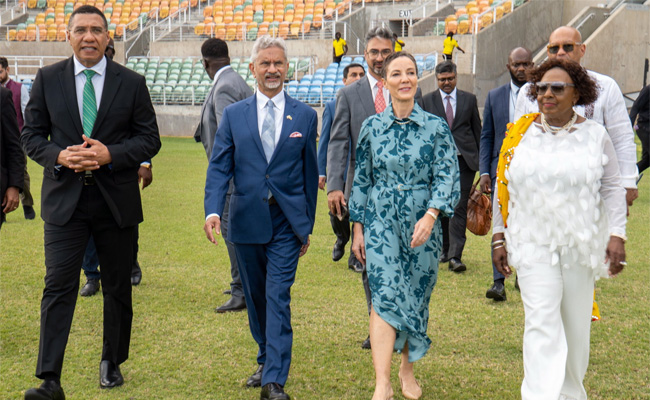
Kingston (PTI): External Affairs Minister S Jaishankar on Monday met Jamaican Prime Minister Andrew Holness and discussed ways to further deepen "political, economic and people-to-people cooperation."
Jaishankar also conveyed greetings from Prime Minister Narendra Modi to Holness.
"Pleased to call on Prime Minister @AndrewHolnessJM in Kingston. Conveyed the greetings of PM @narendramodi," Jaishankar posted on X.
"Discussed deepening our political, economic and people-to-people cooperation. Value his commitment towards further strengthening India-Jamaica relations," the post further read.
Also, the external affairs minister handed over 10 BHISHM (Bharat Health Initiative for Sahyog Hita & Maitri) Cubes as a gift to Jamaica.
"Formally handed over 10 BHISHM Cubes as a gift from India to Jamaica, in the presence of PM @AndrewHolnessJM, Health Minister @christufton and FM @kaminajsmith," Jaishankar posted on X.
"The BHISHM Cube mobile hospital system, designed for rapid deployment, will help Jamaica during disasters and emergencies. The gift of these cubes is a statement of friendship, a commitment to disaster preparedness, and an outcome of innovation," the post said.
Jaishankar arrived in Kingston on Saturday evening, marking the first leg of his nine-day tour of Jamaica, Suriname, and Trinidad and Tobago, aimed at further strengthening India's strategic and cultural ties with the Caribbean nations.
Earlier in the day, he interacted with the Indian diaspora and discussed India's ongoing transformation in infrastructure, human development and technology-driven governance and entrepreneurship with them.
He also highlighted the cricket bond between both countries as India gifted a scoreboard to Jamaica.
A scoreboard was dedicated at Sabina Park in Kingston. It is the home of the Jamaica cricket team and is the only Test cricket ground in the Caribbean island nation.
The minister expressed hope that the new scoreboard would witness many memorable innings, including those symbolising the enduring friendship between the two countries.
Cricket has long been a strong cultural bridge between India and Jamaica, which is part of the West Indies cricket team.
Jamaican players, including Chris Gayle, Courtney Walsh and Michael Holding, have played a major role in shaping the legacy of West Indies cricket in the international arena, contributing to its dominance in earlier decades and its continued global appeal.