Davos: Billionaire George Soros hits out at Modi, says he is 'creating a Hindu nationalist state'!

Davos: US financier and philanthropist George Soros criticised Indian PM Narendra Modi at the World Economic Forum at Davos and said that the "biggest and most frightening setback" was in India, accusing Prime Minister Narendra Modi of "creating a Hindu nationalist state."
His comments come at a time when the Modi government is facing huge backlash over the contentious Citizenship Amendment Act. Soros also said that Modi imposed “punitive measures on Kashmir, a semi-autonomous Muslim region, and was threatening to deprive millions of Muslims of their citizenship .”
He again slammed Trump, describing the US leader as a "conman and the ultimate narcissist". He also commented that the current surge in economic strength for the United States may have come too soon for the US leader as he faces re-election later this year.
On Thursday, he pledged one billion dollars for a new university network project to battle the erosion of civil society in a world increasingly ruled by "would-be and actual dictators" and beset by climate change.
Soros added that humanity was at a turning point and the coming years would determine the fate of rulers like President Donald Trump and China's Xi Jinping as well as the world itself.
On US-China relations he said, “Trump "is willing to sacrifice the national interests for his personal interests and he will do practically anything to win re-election. By contrast, Xi Jinping is eager to exploit Trump's weaknesses and use artificial intelligence to achieve total control over his people."
He expressed grief that the world's strongest powers — the United States, China and Russia under President Vladimir Putin— were "in the hands of would-be or actual dictators and the ranks of authoritarian rulers continued to grow," adding that, “most troublingly, Xi was seeking to bring into existence "a new type of authoritarian system and a new type of human being who is willing to surrender his personal autonomy in order to stay out of trouble."
Courtesy: www.theweek.in
Let the Truth be known. If you read VB and like VB, please be a VB Supporter and Help us deliver the Truth to one and all.
Miscreants decamp with 70 kg silver articles from jewellery shop in Bengaluru
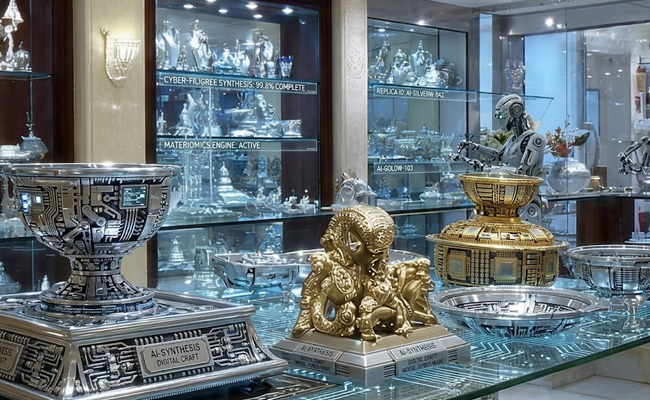
Bengaluru (PTI): Unidentified miscreants allegedly broke into a jewellery shop here and decamped with approximately 70 kg of silver articles worth crores of rupees, police said on Friday.
The incident was reported at a jewellery shop near 8th Mile, Havanur, on April 28, they said.
According to police, the accused are suspected to have entered the premises from the rear after breaking open the lock and drilling a hole through the wall of the shop.
The incident came to light at around 7 am on April 28 when shop staff opened the premises and discovered signs of forced entry and extensive damage to the rear section of the building, following which they alerted police authorities.
Preliminary estimates indicate that around 70 kg of silver articles, worth crores, were stolen. Most of the silver items displayed in the cupboards were taken, while valuables kept in the locker remained intact, a senior police officer said.
Police said CCTV cameras inside the shop were not functioning. Efforts are underway to identify the suspects using footage from cameras installed in the vicinity.
The miscreants also allegedly took away the Digital Video Recorder (of CCTV) of an adjacent shop, the officer added.
Investigators are also examining the tools and techniques used to gain access to the shop, suspecting the involvement of a professional gang with prior knowledge of the store layout.
A case has been registered at Bagalagunte Police Station, and further investigation is underway to identify and apprehend the accused, police said.