Dawood Ibrahim aide Jabir Moti's extradition trial set for March 2019 in UK
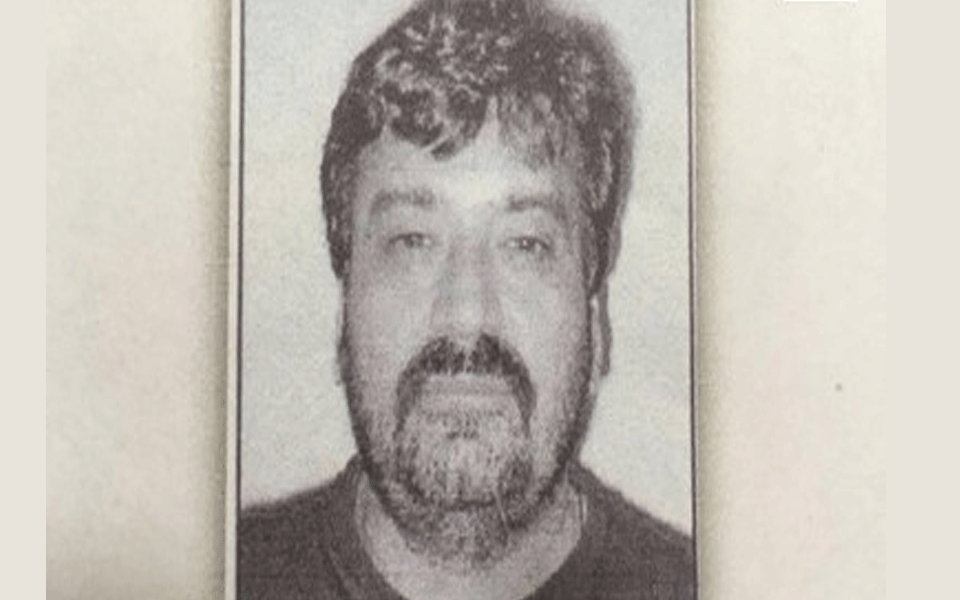
London, Nov 12: Jabir Moti, an alleged "top lieutenant" in underworld don Dawood Ibrahim's organised crime syndicate, will stand trial in March next year in his extradition case on money laundering and extortion charges brought by the US authorities, a Westminster Magistrates' Court judge in London said on Monday.
Judge Tan Ikram remanded Pakistani national Jabir Moti, aka Jabir Motiwala and Jabir Siddiq, in further custody to appear for a case management hearing on December 10, before a three-day trial scheduled for March 13-15 in 2019.
The 51-year-old appeared before the court via routine procedure of video link from Wandsworth Prison in south-west London on Monday, when a previously set date for the trial in February 2019 was delayed due to scheduling reasons.
"Due to non-availability of counsel, the trial will now take place in March. I am mindful of the delay but the delay is very small," said Judge Ikram.
Moti, who has made an application to the court to have his name changed on the case documents to Jabir Siddiq, was arrested by Scotland Yard officers from a London hotel in August following an FBI investigation dating back to 2005.
The Crown Prosecution Service (CPS), arguing on behalf of the US authorities, has told the court that he is a "senior member" of D Company, a crime syndicate associated with Dawood Ibrahim, a key accused in the 1993 Mumbai bomb blasts case.
Prosecutor Ben Lloyd told the court at a hearing in September that the summary of the US charges against Moti cover allegations of laundering USD 1.4-million of purported proceeds from narcotics smuggling and "conspiracy to collect credit extensions by extortionate means", amounting to around USD 80,000.
The charges relate to a period between December 2011 and September 2012, which carry a maximum sentence of 25 years behind bars in the US.
"For a fee, D Company uses the power of violence for debt collection and has a reputation of intimidating members of the family of its debtors in India and Pakistan," the prosecution said in its case summary.
Moti's defence team has disputed allegations of him being a key aide of D Company as "obvious nonsense", describing their client as a "man of exemplary character" who is a tax paying, prominent businessman based in Karachi and accredited as a stock broker, with a family stock-broking business dating back to the 1950s in Pakistan.
At a previous hearing, the Pakistan government had also vouched for Moti's "good character" but the court ruled that it remained unconvinced that Moti did not pose a "flight risk" and denied him bail.
Moti's defence, led by Toby Cadman of Guernica law firm, has said it intends to depose a number of legal experts as witnesses in the case, with the key issues being "abuse of process and entrapment" by the authorities.
While Dawood Ibrahim's name has not come up specifically during the UK court proceedings, Westminster Magistrates' Court has been told that D Company is "named after the leader of the company based in Pakistan", associated with trafficking and money laundering through international smuggling routes across South Asia that were also linked to terrorist funding.
Let the Truth be known. If you read VB and like VB, please be a VB Supporter and Help us deliver the Truth to one and all.
NIA court to complete framing of charges against 2010 hand-chopping case accused on May 15

Kochi (PTI): A special court here will complete proceedings for framing charges against the prime accused in the 2010 hand-chopping case involving professor T J Joseph, in which PFI activists were accused of attacking him at Muvattupuzha.
Ernakulam Special Court for NIA cases judge P K Mohandas, on April 30, heard the arguments of counsel for accused Savad and Shafeer C and decided to proceed with framing charges against the duo.
A group chopped off Thodupuzha Newman College professor Joseph's right hand in July 2010, accusing him of religious blasphemy in a question paper he had prepared.
The case, later taken over by the National Investigation Agency (NIA), resulted in the conviction of 19 accused.
The first accused, Savad, who allegedly chopped off Joseph’s palm, was arrested in Berram in Mattannur, Kannur, in January 2024, where he had allegedly been hiding under the pseudonym Shajahan.
The NIA also arrested Shafeer, who allegedly arranged shelter and provided logistical support to Savad at Chakkad and Mattannur in Kannur since 2020.
On April 30, the court heard the counsel for the accused and the NIA prosecutor on framing charges against the duo.
"On going through the documents and evidence in the case and on hearing the counsel for the accused and the prosecutor, I am of the opinion that there are grounds for presuming that the first accused has committed offences punishable under provisions of the IPC, the Explosive Substances Act and the Unlawful Activities (Prevention) Act, and that the second accused has committed offences punishable under the IPC and the UAPA, and there are materials for framing charges under these provisions against the accused," the court said.
The court directed that Savad be produced and Shafeer, who is on bail, appear before it on May 15 for recording their pleas as part of the charge-framing process.
After framing the charges, the court will schedule the trial in the case.