Deadly earthquake exacerbates suffering of displaced Syrians
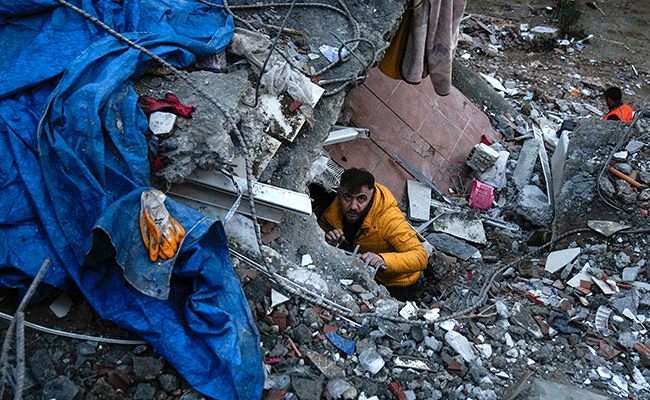
Darkush (Syria) (AP): A steady stream of injured flowed into an overwhelmed hospital in the town of Darkush, in rebel-held northwestern Syria on Monday, after a deadly earthquake struck the region.
Mothers hovered over crying children.
Amid the chaos, one man sat with a dazed expression, his face covered with abrasions.
The man, Osama Abdul Hamid, barely made it out alive with his wife and four children from his apartment building in the nearby village of Azmarin.
Many of their neighbours were not so lucky.
"The building is four stories, and from three of them, no one made it out," Abdul Hamid said, breaking down in tears.
"God gave me a new lease on life."
At an equally overwhelmed hospital in Idlib city, Shajul Islam, a British doctor who works with several non-governmental organisations, was having the worst day of his seven years working in Syria.
"I'm literally taking a patient off a ventilator to give another patient a chance, having to decide which patient has more of a chance of surviving or not," Islam said.
The hospital, already struggling with weak health infrastructure and funding cuts, he said, was particularly overburdened after the earthquake because other hospitals in the area were out of commission.
"We've got quite a lot of hospitals that had been previously hit in the war. So they had already the foundations, everything had already been weakened," he said. With the added blow of the earthquake, he said, "We've had at least three or four hospitals that I know of that have been put out of service."
The powerful 7.8 magnitude quake that struck before dawn on Monday wreaked new damage and suffering in Syria's last rebel-held enclave after years of fighting and bombardment.
Hospitals and clinics were flooded with injured people.
The enclave, centered in Idlib province, houses millions of displaced Syrians who had fled their homes during the country's civil war.
Many of the displaced live in dire conditions in makeshift camps.
Many others there and in neighbouring government-held areas are housed in buildings weakened by past bombings, leaving them even more vulnerable to shocks from earthquakes.
The quake caused total or partial damage to buildings in at least 58 villages, towns and cities in northwestern Syria, according to the Syrian Observatory for Human Rights, a Britain-based war monitor.
More than 4,000 people were killed in Turkey and Syria, with the toll expected to climb.
In the opposition-held territory in Syria, at least 450 were reported dead, but hundreds more were believed be buried under the rubble of their homes.
"This disaster will worsen the suffering of Syrians already struggling with a severe humanitarian crisis," Carsten Hansen, the director for the Middle East at the Norwegian Refugee Council, said in a statement.
"Millions have already been forced to flee by war in the wider region and now many more will be displaced by disaster."
In the hospital in Darkush in western Idlib, Abdel Hamid said his family were sleeping in their apartment when they were roused by powerful, prolonged shaking.
They ran from the apartment, but "before we reached the door of the building, the whole building came down on us," he said.
A wooden door shielded them from the worst force of the collapse they all got out alive.
He and his wife and three of the children suffered head injuries, but are all in stable condition.
The scale of the casualties quickly overwhelmed the hospital's resources, said Majdi al-Ibrahim, a general surgeon at the hospital.
"We need urgent help. The danger is beyond our capacity," he said.
The Syrian American Medical Society, which runs hospitals in northern Syria and southern Turkey, said in a statement that its facilities are "overwhelmed with patients filling the hallways" and called urgently for "trauma supplies and a comprehensive emergency response to save lives and treat the injured."
The opposition territory in the northwest corner of Syria has held out for years even after Syrian government forces retook most rebel-held areas around the country.
Fighting still flares from time to time with Russian-backed Syrian forces nearby.
Parts of the territory are run by rebel groups, including a dominant al-Qaida-linked militant faction, while parts are under a Turkish-backed administration known as the Syrian Interim Government.
The disaster came on the heels of severe winter storms, further adding to the misery of those left without shelter.
"There is rain and the weather is very cold, there is snow in some of the areas," Abdel Hakim al-Masri, economy minister with the Turkish-backed regional administration, told The Associated Press.
He noted that some of the displacement camps in the area had been decimated by the quake.
Al-Masri said that efforts have begun to find temporary shelter for the people now doubly displaced by the earthquake, but that the magnitude of the response required is well beyond the local resources available.
"There is a huge amount of suffering, and this will increase it," he said.
"This matter calls for rapid action by all countries of the world."
Let the Truth be known. If you read VB and like VB, please be a VB Supporter and Help us deliver the Truth to one and all.
Iran offers to reopen Strait of Hormuz if US lifts its blockade and the war ends: officials
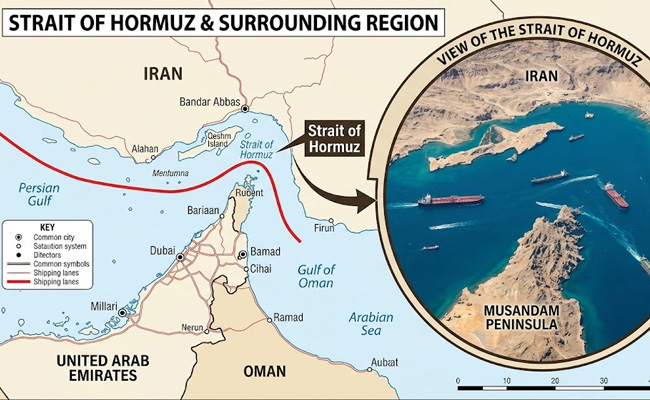
Cairo (AP): Iran has offered to end its chokehold on the Strait of Hormuz in exchange for the US lifting its blockade on the country and an end to the war, while proposing that discussions on the larger question of its nuclear programme would come in a later phase, two regional officials said Monday.
US President Donald Trump seems unlikely to accept the offer, which was passed to the Americans by Pakistan and would leave unresolved the disagreements that led the US and Israel to go to war on February 28.
With a fragile ceasefire in place, the US and Iran are locked in a standoff over the strait, through which a fifth of the world's traded oil and gas passes in peacetime. The US blockade is designed to prevent Iran from selling its oil, depriving it of crucial revenue while also potentially creating a situation where Tehran has to shut off production because it has nowhere to store the oil.
The strait's closure, meanwhile, has put pressure on Trump, as oil and gasoline prices have skyrocketed ahead of crucial midterm elections, and it has pressured his Gulf allies, which use the waterway to export their oil and gas.
The closure has also had far-reaching effects throughout the world economy, raising the price of fertilizer, food and other basic goods.
The proposal would push off negotiations on Iran's nuclear programme to a later date. Trump said one of the major reasons he went to war was to deny Iran the ability to develop nuclear weapons.
The two officials, who had knowledge of the proposal, spoke on condition of anonymity to discuss the closed-door negotiations between Iranian and Pakistani officials this weekend. The Axios news outlet first reported Iran's proposal.
It came as Iran's foreign minister visited Russia, which has long been a key backer of Tehran. It's unclear what, if any, assistance Moscow might offer now.
Strait of Hormuz remains blocked
===================
Iran's ability to choke off traffic in the Strait of Hormuz, the narrow mouth of the Persian Gulf, has proved one of its biggest strategic advantages in a war that has often boiled down to which side can take more pain.
Oil prices have risen steadily since the war began and tankers full of crude became stranded in the Persian Gulf, unable to safely transit through the strait and reach global distribution points.
On Monday, the spot price of Brent crude, the international standard, was trading at around $108 per barrel, nearly 50 per cent higher than when the war began.
Iranian foreign minister holds talks as negotiations with US stall
===============================
Trump last week indefinitely extended the ceasefire the US and Iran agreed to on April 7 that has largely halted fighting. But a permanent settlement remains elusive in the war that has killed thousands of people.
Iran's state-run IRNA news agency said Foreign Minister Abbas Araghchi landed in St. Petersburg on Monday morning ahead of a meeting with Russian President Vladimir Putin.
“It is a good opportunity for us to consult with our Russian friends about the developments that have occurred in relation to the war during this period and what is happening now,” Araghchi said in a video interview posted by IRNA.
It comes as Pakistan has been seeking to revive stalled talks between Iran and the US, and negotiations had been expected in Islamabad over the weekend. Instead, Trump called off a trip by his envoys and suggested the talks could take place by phone instead.
Over the weekend, Araghchi made two stops in Pakistan and a visit to Oman, which shares the strait with Iran. He also spoke by phone with counterparts in Qatar and Saudi Arabia on Sunday.
Iran wants to persuade Oman to support a mechanism to collect tolls from vessels passing through the strait, according to a regional official who spoke on condition of anonymity because he was not authorised to discuss the matter.
Oman's response wasn't immediately clear.
The official, who is involved in mediation efforts, also said Iran insisted on ending the US blockade before new talks and that Pakistan-led mediators are trying to bridge significant gaps between the countries.
Trump says Iran has offered a much better proposal
===========================
Trump told journalists Saturday that after he called off a trip by his envoys to Pakistan, Iran sent a “much better” proposal.
He did not elaborate but stressed that one of his conditions is that Iran “will not have a nuclear weapon”.
Iran insists its programme is peaceful, but the US wants to remove Tehran's stockpile of highly enriched uranium, which could be used to build a bomb, should Tehran choose to pursue one.
Since the war began, at least 3,375 people have been killed in Iran and at least 2,509 people in Lebanon, where fighting between Israel and the Iran-backed Hezbollah militant group resumed two days after the Iran war started. Another 23 people have been killed in Israel and more than a dozen in Gulf Arab states. Fifteen Israeli soldiers in Lebanon, 13 US service members in the region and six UN peacekeepers in southern Lebanon have been killed.
The ceasefire between Israel and Hezbollah has been extended by three weeks. Hezbollah has not participated in the Washington-brokered diplomacy.