Death toll from Pakistan floods near 1,100 as international aid trickles in
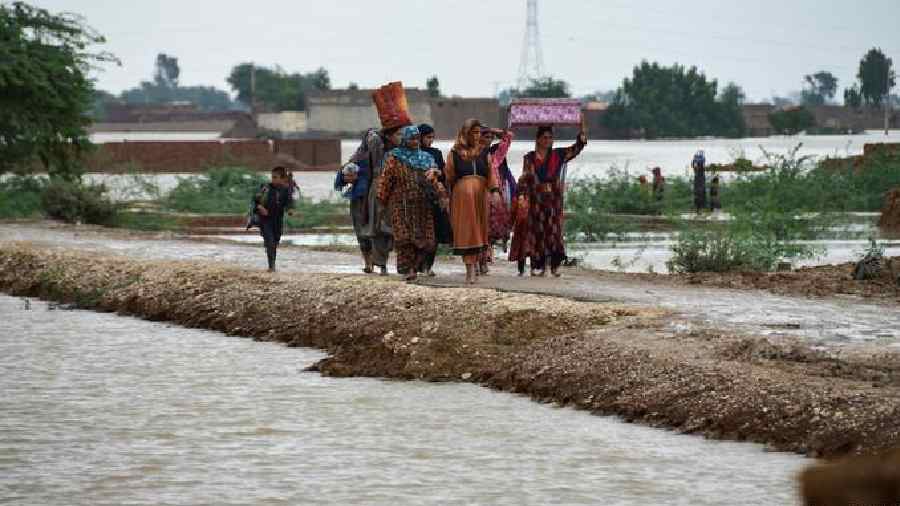
Islamabad, Aug 29: The death toll from the devastating floods in Pakistan neared 1,100 on Monday, as international aid began trickling in following Prime Minister Shehbaz Sharif-led cash-strapped government's desperate appeal for aid to deal with the crisis that has displaced 33 million or one-seventh of the country's population.
Pakistan's Climate Change Minister Sherry Rehman called it the "monster monsoon of the decade," while Finance Minister Miftah Ismail said the floods have impacted Pakistan's economy by USD 10 billion.
At least 1,061 are dead and 1,575 injured, according to the latest data issued on Monday by the National Disaster Management Authority, the chief national organisation tasked to deal with natural calamities.
It said that about 992,871 houses were totally or partially damaged, leaving millions without access to food, clean drinking water and shelter.
Around 7,19,558 livestock are also dead, as millions of acres of fertile farmlands have been inundated by weeks of constant rains.
At least 11 people, including women and a child, were drowned and several others remained missing when a boat carrying 30 flood victims capsized in the swollen Indus river in Sindh's Sehwan on Monday. The incident happened when the people affected by the floods were migrating from submerged villages to a safer location.
A senior police official said that Sindh police officials along with the Pakistan Navy rescued seven people while the search for the remaining missing victims is underway.
Officials said the final death toll due to floods could be much higher, a grim forecast as thousands of villages in Khyber Pakhtunkhwa province remain cut off from the rest of the country as swollen rivers destroyed roads and bridges, the Express Tribune newspaper reported.
Pakistan's Energy Ministry said that restoration of power in Sindh and Balochistan provinces remained top priority, Geo TV reported.
Unable to cope with one of the worst catastrophes, Pakistan sought international help and the world has responded, with humanitarian assistance and solidarity messages coming from several countries.
Citing an aide to Pakistani Prime Minister Sharif, the BBC said the country was desperate for international support.
"Pakistan has been grappling with economic issues, but now just when we were about to overcome them the monsoon disaster hit," Salman Sufi said, adding that funding from a lot of development projects had been rerouted to the affected people.
The US, UK, UAE and others have contributed to a disaster appeal, but more funds are needed, officials here say.
Prime Minister Narendra Modi on Monday said he was saddened to see the devastation caused by the floods in Pakistan and hoped for an early restoration of normalcy.
"Saddened to see the devastation caused by the floods in Pakistan. We extend our heartfelt condolences to the families of the victims, the injured and all those affected by this natural calamity and hope for an early restoration of normalcy," Modi said in a tweet.
Chinese President Xi Jinping on Monday sent a message of condolence to his Pakistani counterpart Arif Alvi. Separately, Chinese Premier Li Keqiang sent a message of condolence to Pakistani Prime Minister Sharif.
After the floods struck, China responded immediately, and will continue to provide urgently needed assistance to Pakistan and support the country in its disaster relief work, Xi said.
Britain's Queen Elizabeth said she was deeply saddened by the loss of lives and property in Pakistan due to the floods, asserting that the UK stands in solidarity with the country.
British Prime Minister Boris Johnson said it's heartbreaking to see the continuing devastation wrought by the floods in Pakistan. "My thoughts go to the victims and those helping with an heroic relief effort. The United Kingdom is sending support and continues to stand by the people of Pakistan in their hour of need," he tweeted.
Pope Francis on Sunday exhorted the international community to help Pakistan, adding that he was praying for the victims.
Last week, the UN said it had earmarked 2.6 million pounds for relief measures in the country.
The first Turkish plane with relief goods for flood victims arrived on Sunday.
Similarly, the Turkish Red Crescent Society is providing cash assistance of Rs 16,000 and 300 kits, 600 jerry cans, and 1,500 mosquito nets to 300 families in Jafferabad.
Moreover, 100 tents and 1,000 blankets will be sent by air cargo along with humanitarian aid by the Ministry of Interior, Disaster and Emergency Management Presidency of Turkiye said.
The first flight from the UAE, carrying over 3,000 tonnes of relief goods arrived at the PAF Base Nur Khan on Sunday.
At least 15 planeloads of relief goods from the UAE would land in the country in the coming days.
Qatar Charity, a humanitarian and development non-governmental organisation, has delivered aid to flood-affected Afghan refugees and the underprivileged members of the host community in Balochistan, in collaboration with the Provincial Disaster Management Authority.
The aid has benefited more than 9,000 Afghan refugees and individuals from the host community.
The Canadian government allocated USD 20,000 to the International Federation of Red Cross and Red Crescent Societies for flood relief operations in Pakistan, Canada's International Development Minister Harjit Sajjan said.
Canada is also a donor to the United Nations Central Emergency Response Fund, which has allocated USD 3 million for flood response.
France Foreign Minister Catherine Colonna on Sunday offered condolences on the devastation caused by floods in Pakistan and offered assistance during a telephone call with her counterpart Bilawal Bhutto-Zardari.
According to a statement issued by the Foreign Office, Bilawal thanked her for France's expression of solidarity and offer of assistance to Pakistani people in this hour of need".
The Pakistan government had been trying to reach out to the affected people by providing essential food items and shelters.
Prime Minister Sharif plans to visit affected areas in Khyber Pakhtunkhwa province.
Army chief General Qamar Javed Bajwa visited flood-hit areas in Sindh's Khairpur Qambar-Shadadkot areas.
The annual monsoon, which began on June 14, is essential for irrigating crops and replenishing lakes and dams across the Indian subcontinent, but it can also bring destruction.
This year more than double than usual rainfall has been recorded, according to official estimates.
Let the Truth be known. If you read VB and like VB, please be a VB Supporter and Help us deliver the Truth to one and all.
Four children drown in lake while trying to catch ducks in Chikkamagaluru

Chikkamagaluru: Four children drowned in a lake in Aralaguppe village after reportedly going to catch ducks, police said.
The deceased have been identified as Mahdia, Arunus, Nayus, and Abdul Rehman. The children were aged between 5 and 14 years. Another child, Armaan (4), escaped unhurt.
Police said the incident occurred at Karanji Lake in Aralaguppe village. Rural police visited the spot and are investigating the case. A case has been registered at the local rural police station.