Death toll in China's coronavirus goes up to 9; total cases rise to 440
Beijing: The death toll in China's novel coronavirus virus has gone up to nine with the confirmed infection cases sharply rising to 440, the health authorities said on Wednesday, warning that the disease could spread further in the ongoing Chinese holiday season during which millions travel at home and abroad.
The coronavirus is a large family of viruses that causes illnesses ranging from the common cold to acute respiratory syndromes, but the virus that has killed people in China is a novel strain and not seen before. Common symptoms of the novel coronavirus strain include respiratory symptoms such as fever, cough, shortness of breath and breathing difficulties, according to the WHO.
The Chinese health authorities announced on Wednesday that 440 confirmed cases of pneumonia caused by a novel coronavirus (2019-nCoV) had been reported in 13 provincial-level regions in the country by the end of Tuesday.
The cases had resulted in nine deaths, all in central China's Hubei Province, Li Bin, deputy director of the National Health Commission told at a press conference here on Wednesday. Altogether 149 new confirmed cases were reported on Tuesday, Li added.
Li said China was now at the "most critical stage" of prevention and control following confirmation that that human-to-human transmission of the virus had taken place. The official said there was evidence that the disease was "mainly transmitted through the respiratory tract".
Overseas, one case has been confirmed in Japan, three in Thailand, and one in Korea. The first case of the virus has now been reported in US with official confirmation that a person arrived from the Chinese city of Wuhan, the epicentre of the virus.
The patient was hospitalised on Sunday, after arriving in Seattle from Wuhan on January 15, officials at the US Centres for Disease Control and Prevention (CDC) sad.
Li said the figures from the commission show a total of 2,197 close contacts have been traced. A total of 1,394 are under medical observation while 765 people have been discharged.
All of the deaths were reported in central Hubei province, where the virus first appeared in the city of Wuhan. China yet to confirm the exact source of the virus. "Though the transmission route of the virus is yet to be fully understood, there is a possibility of virus mutation and a risk of further spread of the epidemic," Li said.
The warning comes as millions of people across China are travelling within the country and abroad for the Lunar New Year week-long holiday. The holiday season began on January 10 and would last for 40 days. Officially, China will declare week-long holiday from January 24.
The Wuhan Health Commission said it would authorise medical institutions to quarantine all patients and people in close contact with them as a prevention and control measure, Li said.
On Tuesday, the National Health Commission (NHC) upgraded the coronavirus to a Class B infectious disease, but said it would use the stricter control measures for a Class A disease to handle the outbreak, meaning any infection nationwide must be reported within two hours and monitored.
Meanwhile, the World Health Organization (WHO), which is holding an emergency meeting on Wednesday, will consider declaring an international public health emergency over the virus - as it did with swine flu and Ebola.
Such a declaration, if made, will be seen as an urgent call for a coordinated international response in view of fears that millions of Chinese are travelling at home and abroad for the Chinese New Year and Spring Festival holidays starting from January 24.
The week-long festival triggers biggest mass migration, clogging road, rail and air networks every year.
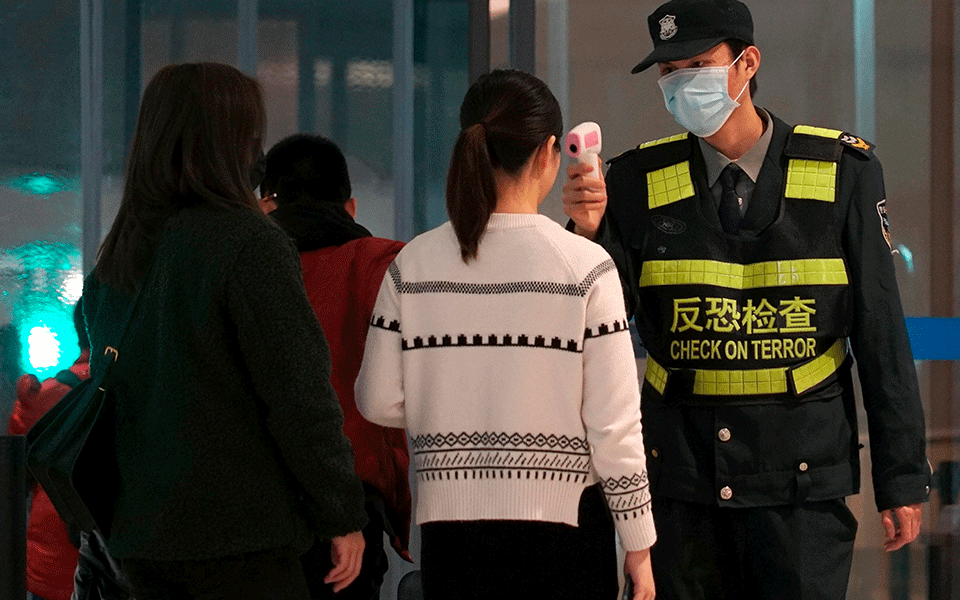
India has already issued a travel warning. Several countries started screening travellers coming from China, especially from Wuhan to detect symptoms like fever.
Chinese Foreign Ministry spokesman Geng Shuang confirmed on Monday about Chinese official's attendance at the emergency meeting of the International Health Regulation (IHR) called by the WHO.
Let the Truth be known. If you read VB and like VB, please be a VB Supporter and Help us deliver the Truth to one and all.
Miscreants decamp with 70 kg silver articles from jewellery shop in Bengaluru

Bengaluru (PTI): Unidentified miscreants allegedly broke into a jewellery shop here and decamped with approximately 70 kg of silver articles worth crores of rupees, police said on Friday.
The incident was reported at a jewellery shop near 8th Mile, Havanur, on April 28, they said.
According to police, the accused are suspected to have entered the premises from the rear after breaking open the lock and drilling a hole through the wall of the shop.
The incident came to light at around 7 am on April 28 when shop staff opened the premises and discovered signs of forced entry and extensive damage to the rear section of the building, following which they alerted police authorities.
Preliminary estimates indicate that around 70 kg of silver articles, worth crores, were stolen. Most of the silver items displayed in the cupboards were taken, while valuables kept in the locker remained intact, a senior police officer said.
Police said CCTV cameras inside the shop were not functioning. Efforts are underway to identify the suspects using footage from cameras installed in the vicinity.
The miscreants also allegedly took away the Digital Video Recorder (of CCTV) of an adjacent shop, the officer added.
Investigators are also examining the tools and techniques used to gain access to the shop, suspecting the involvement of a professional gang with prior knowledge of the store layout.
A case has been registered at Bagalagunte Police Station, and further investigation is underway to identify and apprehend the accused, police said.