Death toll in China's coronavirus soars to 132; confirmed infections about 6,000
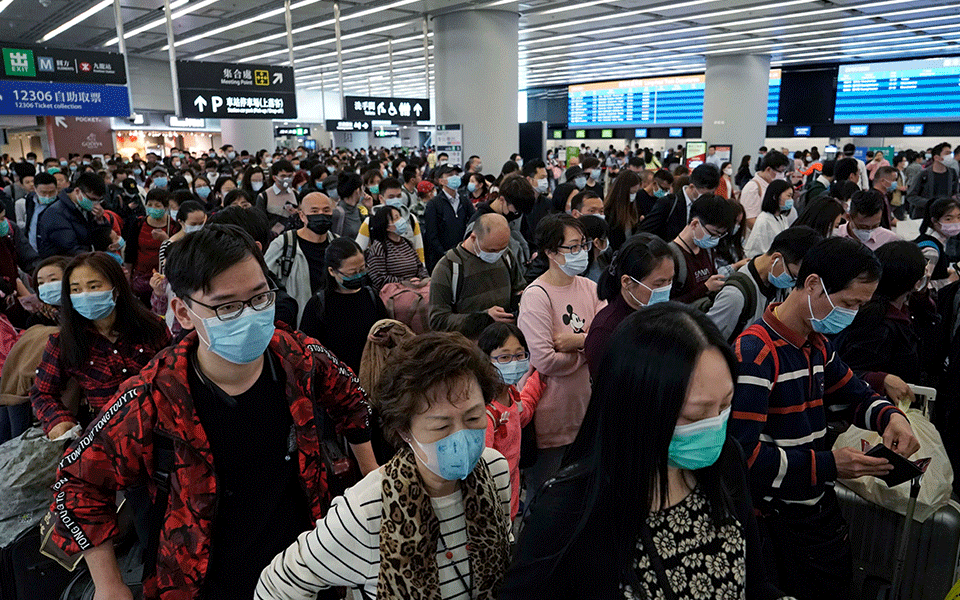
Beijing: The deadly coronavirus continues to wreak havoc in China with 25 new fatalities reported from central Hubei province taking the death toll to 132 and the confirmed infection cases to nearly 6,000, as health experts warned that the epidemic may reach its climax in the next 10 days resulting in large-scale casualties.
The Chinese health authorities announced on Wednesday that 5,974 confirmed cases of pneumonia caused by the novel coronavirus had been reported in 31 provincial-level regions by the end of Tuesday.
A total of 132 people have died from the disease, state-run Xinhua news agency reported.
In Hubei province, of which Wuhan is the provincial capital, 3,554 confirmed cases have been reported with 125 deaths as of Tuesday, it said.
Among the confirmed cases, 1,239 patients are in critical condition, official TV CGTN reported, adding that there are 9,239 suspected cases in the Chinese mainland.
The Hubei province has reported 840 newly confirmed cases, indicating that the virus continues to spread at a faster rate.
The death rate from the new coronavirus is not yet known, as more fatalities will likely be reported. Most patients who have died are above 60 and had pre-existing conditions, according to reports from local authorities.
The coronavirus can be passed between humans through close contact, Chinese medical experts say.
The novel coronavirus (2019-nCoV) outbreak may reach its peak in one week or around 10 days, Chinese respiratory expert Zhong Nanshan said.
"It is very difficult to definitely estimate when the outbreak reaches its peak. But I think in one week or about 10 days, it will reach the climax and then there will be large-scale increases," Zhong told state-run Xinhua news agency.
Zhong is the head of a national team of experts set up for the control and prevention of the novel coronavirus-caused pneumonia and an academician of the Chinese Academy of Engineering.
"There are two keys to tackling the epidemic: early detection and early isolation. They are the most primitive and most effective methods," he said.
Zhong said fever and weakness were the typical symptoms of the novel coronavirus infection found in the majority of patients.
Ten to 14 days is a sound period for isolation and observation. When the incubation period ends, those who fall sick will get timely treatment and those who do not will be just fine, he said.
He suggested that hospitals be staffed with not only infectious disease specialists, but also specialists in treating severe cases to better save patients.
Epidemiologically, the novel coronavirus is homologous to the virus discovered in a type of bat in 2017, said Zhong, adding that the 2019-nCoV probably has an intermediate host that may be a certain kind of wild animal.
"The SARS (Severe Acute Respiratory Syndrome) outbreak lasted about six months, but I don't believe the novel coronavirus outbreak would last that long," said Zhong.
The country has taken a series of powerful measures, especially early detection and early isolation.
"We have sufficient confidence in preventing a major outbreak or a recurrence as long as the two measures are in place, although we still need to conduct much scientific research," he said.
Noting that the key for Wuhan is how to reduce infections inside hospitals, Zhong said he supported the construction of makeshift hospitals in the city to control the infectious disease.
The activation of top-level public health emergency response was aimed at reducing the chance of infection, he said, adding that the vaccine development may need three to four months or even longer.
"Now scientists are speeding up research of neutralizing antibodies of the virus, but it takes time. With help from across the country, Wuhan, a heroic city, will pull through," Zhong said.
Chinese President Xi Jinping on Tuesday called the coronavirus a "demon" which should be brought under control.
China has ramped up efforts to contain the virus. The country has extended the New Year Festival holidays till February 2 to prevent reverse migration of millions of migrants works to return to their work from holidays.
Universities, primary and middle schools and kindergartens across the country will postpone the opening of the spring semester until further notice.
The government is focussing efforts to prevent mass gatherings and mass travel to ensure the virus is not spread fast.
Beijing has also launched temperature detection at 55 subway stations, including stops at railway stations and Beijing airport. Passengers with abnormal body temperatures will be sent to hospital.
Let the Truth be known. If you read VB and like VB, please be a VB Supporter and Help us deliver the Truth to one and all.
Cong slams Modi govt as 'anti-worker', calls for review of new Labour code
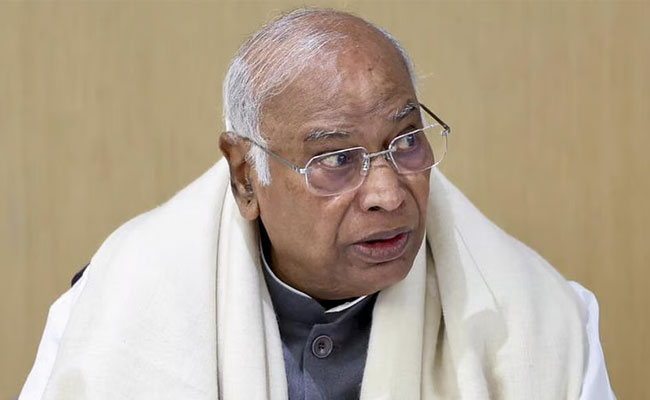
New Delhi (PTI): The Congress on Friday accused the Modi government of being "anti-worker" and demanded that the new labour code be reviewed, MGNREGA be revived as well as a national minimum wage of Rs 400 per day be established.
On International Labour Day, Congress president Mallikarjun Kharge took a swipe at the government and said unemployment in India today is a direct consequence of the 'Hum Do, Hamare Do' policies.
"Driven by the 'Hum Do, Hamare Do' policy, the Modi government implemented an anti-worker Labour Code. As a result, unrest has erupted everywhere - be it in Noida, at the IOCL facility in Panipat, Adani's factory in Raikheda, NTPC Patratu, or the Samsung factory in Sriperumbudur," Kharge said in a post in Hindi on X.
Instead of ensuring job security, this Code promotes policies such as contract labour and 'Hire & Fire' practices, Kharge said and called for a review of the new Labour Code.
The Modi government has effectively dismantled MGNREGA by forcibly pushing legislation through Parliament, he alleged.
"Mr. Modi has shifted 40% of the wage burden onto the State governments. State governments are unable to bear this financial strain and will eventually be forced to stop providing work," he claimed.
The Modi government has compelled workers into a state of unemployment and pushed them towards 'gig work', Kharge said.
Currently, 69% of the workforce is working for wages below the statutory minimum wage, he said.
The Modi government has engineered a crisis of stagnant wages, Kharge alleged.
"When adjusted for inflation, the wages of the majority of India's workers have grown by less than 1% annually over the last decade (from 2014-15 to 2022-23)," he said.
The Modi government has created a massive unemployment crisis among the educated workforce, specifically, among graduates, Kharge claimed and added that jobs have been eliminated through the sale of Public Sector Undertakings (PSUs).
"The government has refused to fill approximately 30 lakh vacant government positions. Furthermore, the government's policy blunders have led to the decimation of Micro, Small, and Medium Enterprises (MSMEs)," the Congress chief said.
The Congress reiterates its five demands for India's workers including revival of MGNREGA and its expansion to urban areas, Kharge said.
He said a national minimum wage of Rs 400 per day should be established, with MNREGA included within its scope.
Kharged demanded that a 'Right to Health' law must be enacted, providing Universal Health Coverage of up to Rs 25 lakh for laborers and workers.
"'Life Insurance and Accident Insurance' coverage must be provided for all unorganized workers. Preventing the contractualization of employment must be made a core priority of the government, and the new Labour Codes must be reviewed," Kharge asserted.