Death toll rises to more than 20,000, rescues dwindle in earthquake aftermath
Kahramanmaras (Turkiye) (AP): A teenager was pulled largely unscathed from beneath the rubble of a collapsed building in the Turkish city of Gaziantep early Friday, in a dramatic rescue that belied the reality that the chances of finding many more survivors four days after a catastrophic earthquake killed tens of thousands are shrinking fast.
The 7.8 magnitude earthquake hit the border region between Turkiye and Syria, an area home to more than 13.5 million people, killing more than 20,000 people. Bodies lay wrapped in blankets, rugs and tarps in the streets of some cities, with morgues and cemeteries overwhelmed.
Before dawn in Gaziantep, near the epicenter of the quake, rescuers pulled Adnan Muhammed Korkut from the basement where had been trapped since the temblor struck Monday. The 17-year-old beamed a smile at the crowd of friends and relatives who chanted "Adnan," "Adnan," clapping and crying tears of joy as he was carried out and put onto a stretcher.
"Thank God you arrived," he said, embracing his mother and others who leaned down to kiss and hug him as he was being loaded into an ambulance. "Thank you everyone."
Trapped for 94 hours, but not crushed, the teenager said he had been forced to drink his own urine to slake his thirst.
"I was able to survive that way," he said.
"I have a son just like you," a rescue worker, identified only as Yasemin, told him after giving him a warm hug. "I swear to you, I have not slept for four days. I swear I did not sleep; I was trying to get you out."
The death toll from the earthquake, which Turkish Turkish President Recep Tayyip Erdogan has called "the disaster of the century," has risen to nearly 21,000, eclipsing the more than 18,400 who died in the 2011 earthquake off Fukushima, Japan, that triggered a tsunami and the estimated 18,000 people who died in a temblor near the Turkish capital, Istanbul, in 1999.
The new figure, which is certain to rise, included over 17,600 people in Turkiye and more than 3,300 in civil war-torn Syria. Tens of thousands were also injured and many tens of thousands have been left homeless.
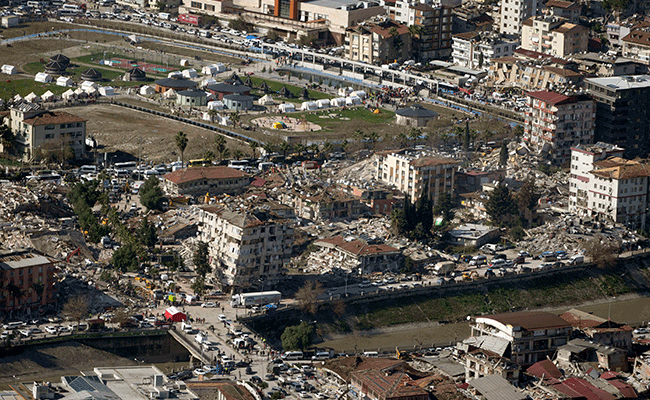
Aerial footage revealed the scope of devastation, with entire neighborhoods of high-rises reduced to twisted metal, pulverized concrete and exposed wires.
Even though experts say trapped people could survive for a week or more, the chances of finding survivors in the freezing temperatures are dimming. As emergency crews and panicked relatives dug through the rubble and occasionally found people alive the focus began to shift to demolishing dangerously unstable structures.
In Kahramanmaras, the city closest to the epicenter, a sports hall the size of a basketball court served as a makeshift morgue to accommodate and identify bodies.
Workers continued rescue operations in Kahramanmaras, but it was clear that many who were trapped in collapsed buildings had already died. One rescue worker was heard saying that his psychological state was declining and that the smell of death was becoming too much to bear.
In northwestern Syria, the first U.N. aid trucks since the quake to enter the rebel-controlled area from Turkiye arrived Thursday, underscoring the difficulty of getting help to people there.
In the Turkish city of Antakya, dozens scrambled for aid in front of a truck distributing children's coats and other supplies. One survivor, Ahmet Tokgoz, called for the government to evacuate people from the region. Many of those who have lost their homes found shelter in tents, stadiums and other temporary accommodation, but others have slept outdoors.
"Especially in this cold, it is not possible to live here," he said. "If people haven't died from being stuck under the rubble, they'll die from the cold."
The winter weather and damage to roads and airports have hampered the response. Some in Turkiye have complained that the government was slow to respond a perception that could hurt Erdogan at a time when he faces a tough battle for reelection in May.
Erdogan has been visiting affected cities over the last two days.
Turkiye's disaster-management agency said more than 110,000 rescue personnel were now taking part in the effort and more than 5,500 vehicles, including tractors, cranes, bulldozers and excavators had been shipped. The Foreign Ministry said 95 countries have offered help.
Let the Truth be known. If you read VB and like VB, please be a VB Supporter and Help us deliver the Truth to one and all.
NIA registers case to probe recovery of 79 crude bombs in poll-bound West Bengal

New Delhi (PTI): The National Investigation Agency (NIA) on Sunday registered a case to probe recovery of 79 crude bombs in poll-bound West Bengal, officials said.
The move came following a directive by the Union Home Ministry in this regard, they said.
In pursuance to the home ministry's order, the anti-terror agency on Sunday registered a case, which was originally filed at Uttar Kashi police station, Bhangar division, Kolkata on Saturday, and took up the investigation, an NIA spokesperson said in a late night statement.
"The case pertains to recovery of 79 crude bombs and other incriminating materials by Kolkata police, which were being stored at a spot, thereby endangering human life and property," the spokesperson said.
Earlier in the day, the Election Commission had directed the West Bengal Police to launch a special drive to arrest those involved in illegal manufacturing of crude bombs in the poll-bound state, an official said.
It asserted that all cases related to the making of any such explosive would be probed by the National Investigation Agency, the official said.
The directive came after the police recovered a large number of crude bombs from the house of a person, allegedly a TMC worker, at Bhangar in South 24 Parganas district, days ahead of the second and final phase of the assembly polls in the state.
The explosives were recovered during a search at the residence of Rafikul Islam following specific inputs, the official said.
The poll panel also issued a warning to senior police officers across the state over any lapse in maintaining law and order before the April 29 polling.
The first phase of the assembly elections in West Bengal was held on April 23, while the second phase will take place on April 29. Votes will be counted on May 4.
A record 93.19 per cent turnout has been recorded in the first round of polling. Bhangar will vote in the second phase.