Deeply concerned about safety of 7 Indians on Houthi-seized ship: India at UNSC
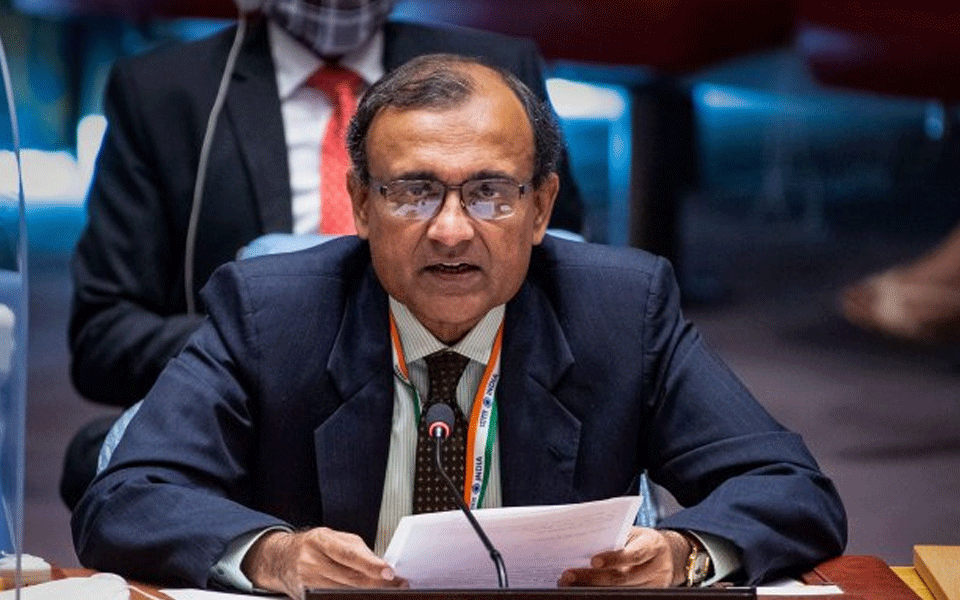
United Nations(PTI): India has voiced deep concern over the safety of seven Indian nationals on a Houthi-seized United Arab Emirates-flagged cargo vessel, calling for the immediate release of the crew and the ship.
The vessel named Rwabee was seized by Yemen's Houthi rebels off the port of Hodeidah on January 2.
We are extremely concerned by the continued intensification of military operations in Yemen. The fierce clashes in Sana'a, Ma'rib, and Shabwa in the last few weeks are jeopardising the prospects of peace, India's Permanent Representative to the UN Ambassador T S Tirumurti said.
Speaking at the UN Security Council briefing on Yemen on Wednesday, Tirumurti voiced concern that the seizure and detention of the UAE vessel Rawabi' off the coast of Hudaydah earlier this month has further exacerbated the ongoing tensions.
We express our grave concern at this act, which has the potential to deeply compromise the maritime security in the region. Seven Indian nationals are among the crew members onboard the ship and we are deeply concerned about their safety and well-being, Tirumurti said.
Urging the Houthis to immediately release the crew members and the vessel, Tirumurti said the Houthis also bear the responsibility of ensuring the safety of the crew members till their release.
On Tuesday, the Ministry of External Affairs (MEA) said in a statement that the Indian Government has been closely monitoring developments following the seizure of the UAE flagged ship Rwabee off the port of Hodeidah by the Houthis on January 2.
The government is in touch with the company operating the ship and has been informed that out of the 11 crew members onboard the ship, seven are from India. All Indian crew members are understood to be safe and the Government of India is making all efforts to secure their early release, the MEA said.
At the UNSC meeting, the UK and the US also voiced grave concern over the seizure of the vessel.
US Ambassador Linda Thomas-Greenfield condemned the Houthis' escalation in violence, which undermines the cause of peace. She condemned the Houthis' seizure of an Emirati-flagged merchant vessel last week. And we call on the Houthis to immediately release the ship and crew unharmed.
UK's envoy to the UN Ambassador Barbara Woodward said the Houthi seizure of the Emirati-flagged vessel brings worrying escalation at a time when ordinary Yemenis desperately need the parties to focus on the path to peace. The UK calls on all parties to resolve the issue quickly and for passage rights and freedom of navigation at sea to be respected.
Briefing the Council, UN Special Envoy Hans Grundberg said we appear to once more be entering an escalatory cycle with predictable devastating implications for civilians and for the immediate prospects of peace. I am worried that battles could intensify along other fronts. The recent seizure by Ansar Allah of an Emirati-flagged ship is another matter of concern.
Chinese Ambassador Dai Bing said that the UAE has reported on the seizure of the Emirati flagged cargo ship by the Houthis on the high seas of the Red Sea. China is deeply concerned about these reports.
China supports the Security Council in pronouncing on these developments and condemning all attacks against civilians and civilian infrastructures, he said, adding that Beijing hopes the relevant issues will be properly resolved as soon as possible, that the ship and its crew will be released, and that the maritime safety of the Red Sea and channels of international navigation will be maintained.
Tirumurti called upon all parties to the conflict to immediately cease fighting, de-escalate the situation and engage unconditionally with Grundberg in his efforts to commence discussions towards comprehensively ending the conflict in Yemen.
He reiterated India's call for an immediate and comprehensive ceasefire across Yemen followed by a robust and inclusive political process with the involvement of Yemeni women. Tirumurti underlined that such a process should also fully respect Yemen's unity, sovereignty, independence, and territorial integrity.
We believe that with effective Yemeni, regional, international and UN leadership, a lasting and inclusive political settlement in Yemen is achievable, he said, encouraging the Special Envoy to continue his engagement with all Yemeni parties and his coordination with the countries in the region to reach a durable solution to the conflict.
India also condemned the continued cross-border attacks into Saudi Arabia targeting civilians and civilian infrastructure. All parties must uphold their obligations under international humanitarian law by ensuring that civilians and civilian infrastructure are not targeted during military operations, he said.
New Delhi also took note of the developments surrounding FSO SAFER, whose current condition poses a potential environmental, economic, maritime, and humanitarian threat, and hoped for an early conclusion of the required agreements and arrangements.
The FSO SAFER is a floating storage and offloading unit and is located approximately 4.8 nautical miles off the coast of Yemen.
Tirumurti voiced concern that the conflict continues to have a devastating impact on the people of Yemen, especially on women and children, and extends well beyond the tragic loss of human life. The conflict has pushed millions into poverty, led to hunger and disease, disrupted education, deprived basic health and sanitation, and led to malnutrition among Yemeni children.
Given the economic decline and the COVID-19 pandemic, the dire situation has been further aggravated. Sustained international donor assistance and concrete short and long-term economic measures, as identified in the UN's economic framework for Yemen, are necessary to overcome the economic and humanitarian crisis in the country, he said.
Further, the brief suspension of humanitarian flights into and out of Sana'a airport in December is a matter of concern, Tirumurti said. Noting that the operation of these flights is critical, not only for the movement of aid workers and the delivery of humanitarian supplies into Yemen, but also for emergency medical transfers, India called on parties to the conflict to not impose any impediments or restrictions on the movement of humanitarian aid and humanitarian personnel. We also urge them to maintain the civilian character of Sana'a airport and other critical public infrastructure in Yemen, he said.
Let the Truth be known. If you read VB and like VB, please be a VB Supporter and Help us deliver the Truth to one and all.
Suvendu defeats Mamata in Bhabanipur by over 15,000 votes

Kolkata (PTI): BJP’s Suvendu Adhikari defeated West Bengal Chief Minister Mamata Banerjee in the prestigious Bhabanipur seat by a margin of 15,105 votes on Monday, the EC said.
While Adhikari bagged 73,917 votes, Banerjee secured 58,812 votes.
The result marks a virtual “action replay” of the 2021 Nandigram battle, where Adhikari had unseated Banerjee in a fiercely fought contest that redefined Bengal’s political narrative.