Delta variant cases rise by 50,824 in UK, hospitalisations remain low
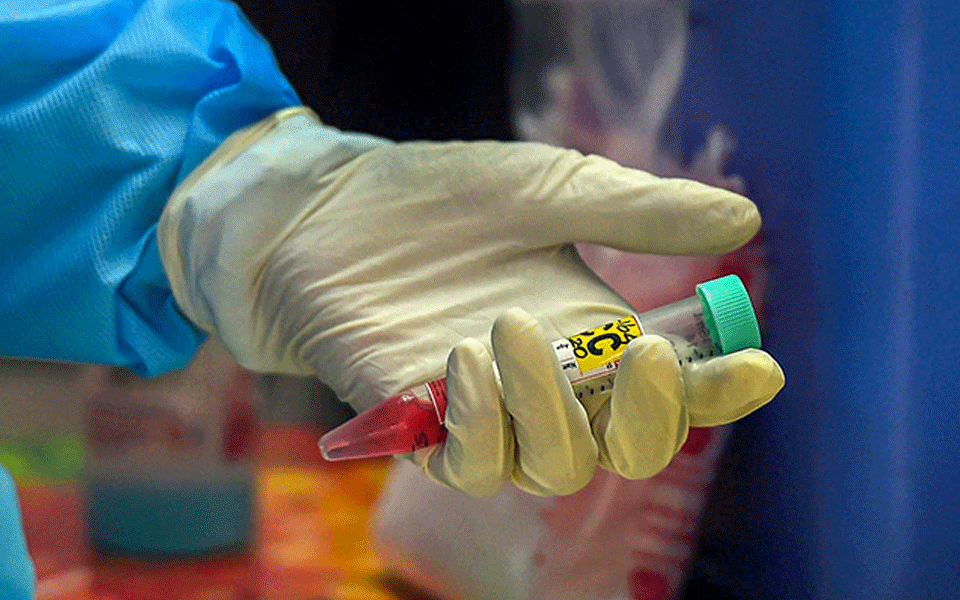
London: The Delta variant of COVID-19 continues to spread in the UK with a further 50,824 cases logged on Friday, marking a 46 per cent increase over the previous week, according to health officials.
While the infections are rising, there has not been a corresponding rise in the number of hospitalisations with COVID-19, indicating that the vaccinations are effective against the highly transmissible variant first identified in India, Public Health England (PHE) said.
Of the 50,824 cases of Delta B1.617.2 variant over the past week, 42 are from the Delta AY.1 sub lineage with the mutation K417N which is feared to be more vaccine resistant.
Cases across the UK continue to rise and it is incredibly important that we do not forget to be careful, said Dr Jenny Harries, Chief Executive of the UK Health Security Agency.
Although cases are rising, we are not seeing a proportional rise in the number of people who are being admitted to hospital. The data suggest this is testament to the success of the vaccination programme so far and clearly demonstrates the importance of getting both doses of the vaccine, she said, urging people to come forward for their vaccines.
It will help us to break the chain of transmission, and it will save lives, she said.
The genomic sequencing data released by PHE weekly on the variants of concern (VOCs) and variants under investigation (VUIs) show that the Alpha VOC, first identified in the English county of Kent, accounts for the second highest infections in the country.
An additional 823 COVID-19 cases were logged of the Alpha VOC, followed by 11 of the Beta VOC first detected in South Africa.
The latest data comes as the UK recorded 27,989 new daily cases of coronavirus on Thursday, with Prime Minister Boris Johnson indicating that extra precautions may have to stay in place as the country prepares to lift lockdown restrictions on July 19.
The government is also expected to review the travel list again this month, with only a few countries on the green list of free travel at the moment, while much of Europe remains on the amber list.
Meanwhile, India along with South America and Africa and most other countries remain on the travel ban red list, requiring compulsory hotel quarantine for British residents.
Let the Truth be known. If you read VB and like VB, please be a VB Supporter and Help us deliver the Truth to one and all.
Two injuries, one DNF, a DQ as India end messy World Relays campaign
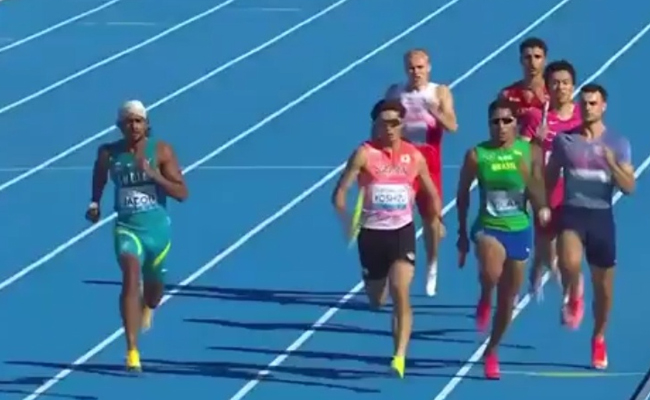
Gaborone (Botswana) (PTI): Amoj Jacob and Ragul Kumar got injured during the men's 4x400m and 4x100 races respectively as India ended their World Athletics Relays campaign in disappointment on the second day of competitions here on Sunday.
The Indian camp had high hopes of making the 2027 World Championships in the men's 4x400m relay but the team did not finish (DNF) the race as Jacob suffered cramps and pulled out of the race after taking the baton from the first leg runner Dharamveer Choudhary. Rajesh Ramesh and Vishal TK were to run in the third and fourth legs.
Those teams which could not qualify for the 2027 Beijing World Championships by reaching the final round of each of the six relay events on Saturday were given another chance in the second qualification round on Sunday.
The top two teams in each of the two heats (in all six relay events) booked the Beijing ticket on Sunday.
India will now have to try and qualify for the World Championships through the Top Lists of the World Athletics, which is a long and tedious process.
In the men's 4x100m race, third leg runner Ragul Kumar fell down the track after failing to hand over the baton inside the exchange zone to fourth leg runner Gurindervir Singh, which clearly showed the lack of coordination among the runners.
Harsh Santosh Raut and Animesh Kujur ran the first two legs.
The Indian quartet was disqualified and Kumar was seen being taken away from the Field of Play with the help of the volunteers.
It was a comedy of errors in the case of the women's 4x100m race, which saw the baton being dropped during an exchange between first leg runner Tamanna and second runner Nithya Gandhe, though the Indians finished the race in 53.09 seconds.
Gandhe started running quite a distance, but after realising that the baton was not in her hand, she turned and ran back to pick it up.
The only silver-lining for the Indian contingent was the national record time in the mixed 4x100m relay race, though the quartet of Ragul Kumar, Nithya Gandhe, Animesh Kujur and Sneha SS finished sixth in heat number two with a time of 41.35 seconds, bettering the previous national mark of 42.30 seconds set in March in Chandigarh.
The mixed 4x400m relay quartet of Theerthesh P Shetty, Kumari Saloni, Nihal William and Rashdeep Kaur ended at fifth in heat number one with a time of 3 minutes and 19.40 seconds.
On Saturday, all the five Indian relay teams had failed to make it to the respective final rounds and thus missed out on the 2027 World Championships berths.