Democracy ‘alien concept’ for Pak, must end rights abuses in occupied areas: India at UN
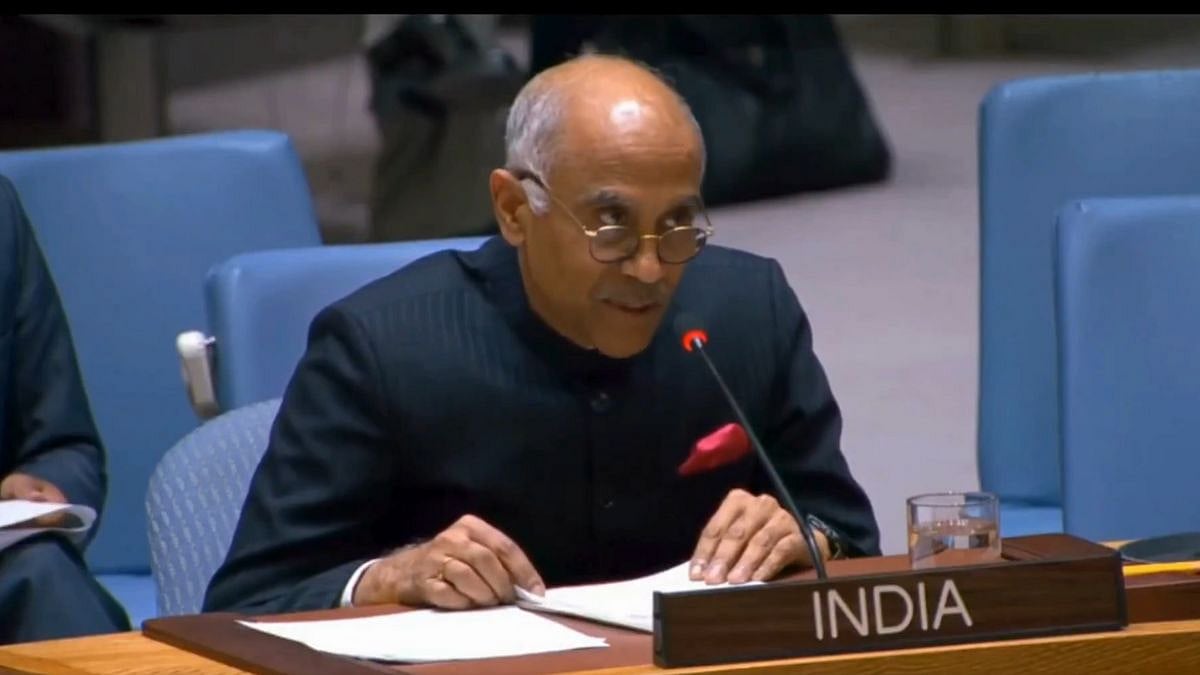
United Nations (PTI): Asserting that democracy is an "alien" concept for Pakistan, India has called upon Islamabad to end grave human rights violations in territories under its illegal occupation, where the population is in "open revolt" against military occupation, repression, brutality and exploitation.
Responding to references made by Pakistan's envoy at the UN Security Council's open debate on 'The United Nations Organisation: Looking into the Future' on Friday, India’s Permanent Representative to the UN, Ambassador Parvathaneni Harish, said,
"The people of Jammu and Kashmir exercise their fundamental rights in accordance with India’s time-tested democratic traditions and constitutional framework."
"We, of course, know that these are concepts alien to Pakistan," he said.
The envoy reiterated that Jammu and Kashmir “has been, is, and will always be” an integral and inalienable part of India.
Strongly rebuking Islamabad, Harish said, “We call upon Pakistan to end the grave and ongoing human rights violations in the areas illegally occupied by it, where the population is in open revolt against Pakistan’s military occupation, repression, brutality and illegal exploitation of resources.”
Harish also emphasised that the UN must undertake “real, comprehensive reforms,” saying that the 80-year-old Security Council architecture no longer reflects contemporary geopolitical realities.
“An outdated Council architecture that mirrors the geopolitical realities of 1945 is not equipped to handle the challenges of 2025,” he said, calling for expansion in both permanent and non-permanent categories through “time-bound" and "text-based negotiations”.
He underlined that the Global South must have a greater voice in global decision-making, adding that “postponing reforms indefinitely does immense disservice to our citizens, especially in the Global South”.
“This bloc of countries represents the overwhelming proportion of humanity and has its unique set of challenges, particularly in the areas of development, climate and financing,” Harish said, adding that global decision-making must be more democratic and inclusive.
Highlighting India's commitment to multilateralism, he said the world must move beyond “pennies and posts” to craft a new vision for the UN that is more agile and responsive to global challenges such as pandemics, terrorism, economic instability, and climate change.
Harish noted that the world’s largest multilateral body faces questions of “relevance, legitimacy, credibility, and efficacy”.
He cautioned that international cooperation is increasingly being viewed as charity and that prosperity is being “ring-fenced amid shrinking access to resources and technologies necessary for growth”. He said progress that is not universal is “neither sustainable nor tenable in moral terms or on a practical basis".
Harish also called for making UN mechanisms more agile, noting that peacekeepers face “newer challenges every day” and need realistic mandates, adequate resources, and technological support.
“Structural adjustments of different UN bodies are welcome, but not enough,” he said, urging that UN80, the 80th anniversary of the organisation, should aim for “real, comprehensive reforms of the UN and its principal organs.”
Harish further emphasised the need to revitalise the General Assembly as the UN's principal deliberative and policymaking body, enhancing coordination with other organs, particularly the Security Council, to realise the purposes and principles of the UN Charter.
He cautioned member states against using the UN as a “theatre for divisive politics and parochial purposes,” saying, “In a world fractured and fragmented along multiple fault lines, the United Nations... is the only vehicle we possess to harness our collective energies for global public good.”
Harish invoked India's civilisational ethos of Vasudhaiva Kutumbakam, “the world is one family”, and urged all member states to come together and join hands towards realising "this vision for making the UN fit for purpose for the new era”.
Let the Truth be known. If you read VB and like VB, please be a VB Supporter and Help us deliver the Truth to one and all.
4 workers die after being buried under coal slurry in Jharkhand's Dhanbad

Dhanbad (Jharkhand) (PTI): At least four workers died after being buried under coal slurry in Jharkhand's Dhanbad district on Saturday, a police official said.
The incident took place at Moonidih coal washery in the command area of Bharat Coking Coal Limited (BCCL).
"Bodies of all four workers were dug out of debris during a rescue operation," Putki police station in-charge Waqar Hussain told PTI.
The incident took place when coal slurry was being loaded into trucks by workers, during which a large chunk of slurry fell and trapped several workers underneath, officials said.
The deceased have been identified as Manik Bauri, Dinesh Bauri, Deepak Bauri, and Hemlal Gope.
Meanwhile, the family members of the deceased and local villagers placed the bodies in front of the washery gate and began a protest.
They demanded compensation, jobs for dependents and action against those responsible for the incident.
Police and administration officials are trying to pacify the protesters, an official said.