Desmond Tutu, S Africa's anti-apartheid icon and Nobel laureate, dies at 90
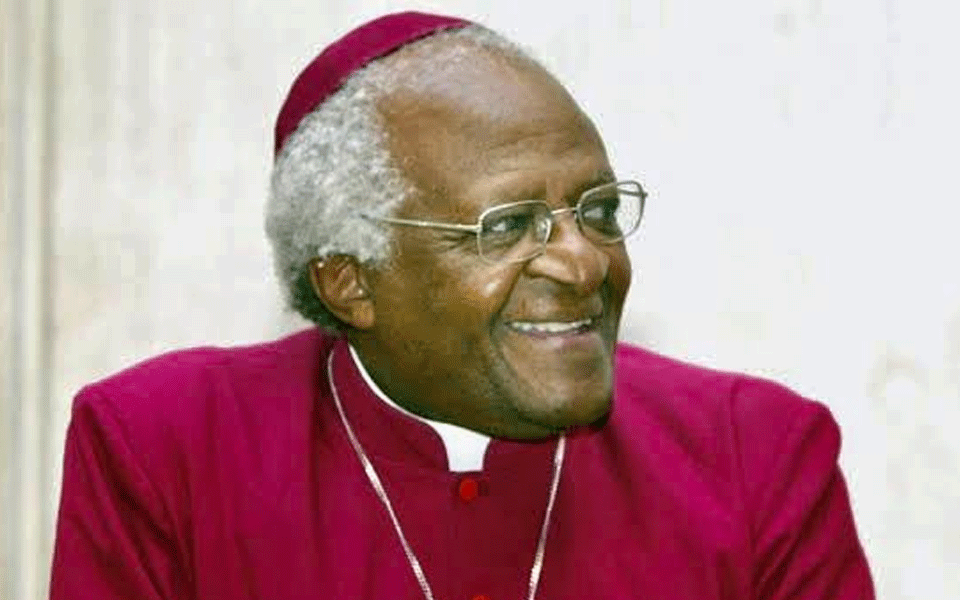
Johannesburg(PTI): Archbishop Desmond Tutu, South Africa's anti-apartheid icon who won the Nobel Peace Prize for fighting racial discrimination in the country, died on Sunday. He was 90.
President Cyril Ramaphosa announced that Tutu passed away in Cape Town in the early hours of Sunday. He was the last surviving South African laureate of the Nobel Peace Prize.
Tutu, who previously survived tuberculosis, had undergone a surgery for prostate cancer in 1997. He was also hospitalised several times in recent years for a various ailments.
The passing of Archbishop Emeritus Desmond Tutu is another chapter of bereavement in our nation's farewell to a generation of outstanding South Africans who have bequeathed us a liberated South Africa, Ramaphosa said as he shared condolence with the family and friends.
Desmond Tutu was a patriot without equal; a leader of principle and pragmatism who gave meaning to the biblical insight that faith without works is dead.
A man of extraordinary intellect, integrity and invincibility against the forces of apartheid, he was also tender and vulnerable in his compassion for those who had suffered oppression, injustice and violence under apartheid, and oppressed and downtrodden people around the world, Ramaphosa said.
The president also lauded Tutu for his role in the Truth and Reconciliation Commission, where he was often driven to tears as victims of apartheid shared their inhumane treatment at the hands of apartheid-ear security forces.
Then newly-elected president Nelson Mandela had appointed Tutu to lead the Commission in 1995.
As Chairperson of the Truth and Reconciliation Commission, he articulated the universal outrage at the ravages of apartheid and touchingly and profoundly demonstrated the depth of meaning of ubuntu, reconciliation and forgiveness.
We pray that Archbishop Tutu's soul will rest in peace but that his spirit will stand sentry over the future of our nation, Ramaphosa concluded in his statement.
Paying tributes to Tutu, Prime Minister Narendra Modi said that he was a guiding light for countless people globally and his emphasis on human dignity and equality will be forever remembered.
Modi said: "Archbishop Emeritus Desmond Tutu was a guiding light for countless people globally. His emphasis on human dignity and equality will be forever remembered. I am deeply saddened by his demise, and extend my heartfelt condolences to all his admirers. May his soul rest in peace."
Tutu received the Nobel Peace Prize in 1984 when he was still the Bishop of Johannesburg.
Referring to Tutu as Africa's Peace Bishop , the Norwegian Nobel Institute said Tutu's award was made "for his role as a unifying leader figure in the non-violent campaign to resolve the problem of apartheid in South Africa."
Tutu was saluted by the Nobel Committee for his clear views and his fearless stance, characteristics which had made him a unifying symbol for all African freedom fighters. Attention was once again directed at the nonviolent path to liberation.
Despite bloody violations committed against the black population, as in the Sharpeville massacre of 1961 and the Soweto rising in 1976, Tutu adhered to his nonviolent line, the Institute said on its website.
The Nelson Mandela Foundation (NMF) recalled Tutu's relationship with Mandela after the two first met at a debating competition in the early 1950s until they first met again only before Mandela's release from 27 years as a political prisoner on February 11, 1990.
The minority white apartheid government had thwarted all attempts by Tutu to meet Mandela again in the intervening four decades.
Mandela's first night as a free man was spent at the home of the Tutus in Bishopscourt, Cape Town, NMF Chief Executive Sello Hatang said in a statement.
From then until Mandela passed away in 2013 they were in regular contact and their friendship deepened over time.
Hatang said he was privileged to have worked on a number of projects with Tutu, whom he described as a friend to Madiba and to the Foundation.
It was Tutu who held aloft Madiba's hand on the balcony of Cape Town's City Hall on 9 May 1994 and presented him to the assembled throngs as the country's new out of the box President, Hatang said.
Hatang quoted Mandela's comments on Tutu: His most characteristic quality is his readiness to take unpopular positions without fear He speaks his mind on matters of public morality.
As a result, he annoyed many of the leaders of the apartheid system. Nor has he spared those that followed them - he has from time to time annoyed many of us who belong to the new order. But such independence of mind - however wrong and unstrategic it may at times be - is vital to a thriving democracy.
Tutu had in recent years also been an outspoken critic of the looting of state enterprises in what has been identified at the Commission of Inquiry into State Capture, not sparing the ruling African National Congress (ANC) of which he had been a proud member all his life.
Madiba and the Arch (the popular names by which the two leaders were affectionately known) were both founding members of The Elders, an international grouping of inspirational leaders which has done human rights work in countries around the world.
We owe it both to Madiba and to the Arch to continue working for the country and the world of their dreams. Their intersecting legacies are powerful resources for social justice work, said Hatang.
Let the Truth be known. If you read VB and like VB, please be a VB Supporter and Help us deliver the Truth to one and all.
Vartha Bharati–Sankalp predictions align closely with Karnataka bypoll results
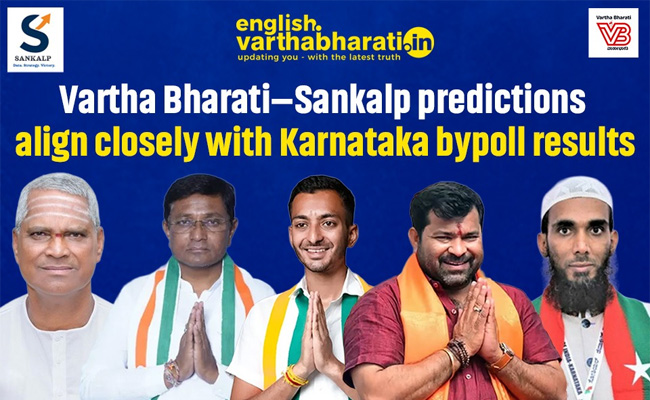
Bengaluru: The Vartha Bharati–Sankalp election analysis has shown a high level of accuracy in predicting the outcome of the recent Karnataka Assembly by-elections held in May 2026, correctly calling winners in both constituencies and closely estimating vote share trends.
The by-elections were held in Bagalkot and Davanagere South, drawing significant political attention as both seats were seen as key tests for the ruling Congress and opposition BJP.
According to the analysis, Vartha Bharati–Sankalp had made three major projections ahead of the results the winning party, vote share percentages, and margin of victory.
In both constituencies, the platform accurately predicted that the Congress would emerge victorious. The outcome matched the projections, with Congress candidates winning in Bagalkot and Davanagere South.
In terms of vote share, the predictions were largely in line with the final results. In Bagalkot, the BJP’s vote share was forecast in the range of 40 to 46 per cent, while the actual figure stood at 42.9 per cent. The Congress vote share, however, exceeded expectations, with the party securing 55.4 per cent against a projected range of 43 to 48 per cent.
The margin of victory in Bagalkot turned out to be significantly higher than anticipated. While the projection had placed the margin between 2,000 and 3,500 votes, the final margin was around 22,332 votes.
In Davanagere South, the predictions also remained largely accurate. The Congress vote share was projected between 43 and 51 per cent, and the final figure stood at 43.9 per cent. The BJP was expected to secure between 42 and 50 per cent but ended with 40.3 per cent.
The analysis had also identified the role of SDPI as a potential spoiler in the constituency. While its vote share was estimated around 6 per cent, the party eventually secured around 12 per cent of the vote.
The margin of victory in Davanagere South was predicted to be between 1,500 and 2,600 votes. The actual margin was higher at around 5,708 votes, though the contest remained relatively close as anticipated.
Overall, the performance of Vartha Bharati–Sankalp stood out for correctly identifying the winning parties in both seats and maintaining close accuracy in vote share estimates, with only limited deviations in specific cases.