Donald Trump pardons ex-strategist Steve Bannon, dozens of others
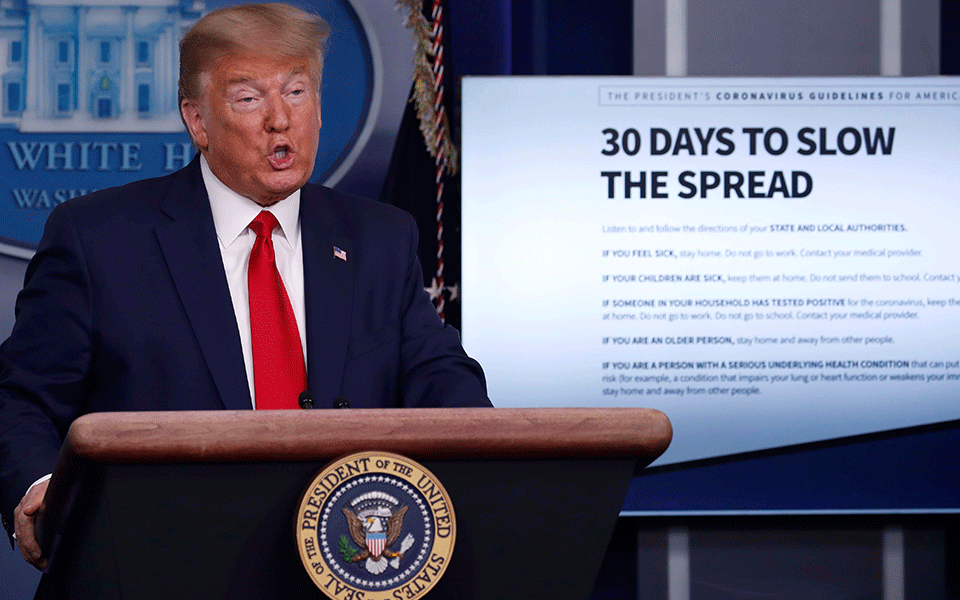
Washington: President Donald Trump has pardoned former chief strategist Steve Bannon as part of a late flurry of clemency action benefiting nearly 150 people, including rap stars and former members of Congress.
The pardons and commutations for 143 people, including Bannon, were announced after midnight Wednesday in the final hours of Trump's White House term.
The person, who spoke on condition of anonymity to discuss private deliberations, stressed that Trump has flip-flopped repeatedly as he mulls his final actions, and warned the decision could be reversed until it's formally unveiled.
Whereas pardon recipients are generally thought of as defendants who have faced justice, often by having served at least some prison time, a pardon for Bannon nullifies a prosecution that was still in its early stages and likely months away from trial in Manhattan, effectively eliminating any prospect for punishment.
Though other presidents have issued controversial pardons at the ends of their administration, perhaps no commander in chief has so enjoyed using the clemency authority to benefit not only friends and acquaintances but also celebrity defendants and those championed by allies. Critics say such decisions result in far more deserving applicants being passed over.
Steve Bannon is getting a pardon from Trump after defrauding Trump's own supporters into paying for a wall that Trump promised Mexico would pay for, Democratic Rep. Adam Schiff said on Twitter. And if that all sounds crazy, that's because it is. Thank God we have only 12 more hours of this den of thieves.
Bannon has been charged with duping thousands of investors who believed their money would be used to fulfill Trump's chief campaign promise to build a wall along the southern border. Instead, he allegedly diverted over a million dollars, paying a salary to one campaign official and personal expenses for himself.
Bannon did not respond to questions Tuesday.
Trump has already pardoned a slew of longtime associates and supporters, including his former campaign chairman, Paul Manafort; Charles Kushner, the father of his son-in-law; his longtime friend and adviser Roger Stone; and his former national security adviser Michael Flynn.
A voice of nationalist, outsider conservatism, Bannon who served in the Navy and worked at Goldman Sachs and as a Hollywood producer before turning to politics led the conservative Breitbart News before being tapped to serve as chief executive officer of Trump's 2016 campaign in its critical final months.
He later served as chief strategist to the president during the turbulent early days of Trump's administration and was at the forefront of many of its most contentious policies, including its travel ban on several majority-Muslim countries.
But Bannon, who clashed with other top advisers, was pushed out after less than a year. And his split with Trump deepened after he was quoted in a 2018 book making critical remarks about some of Trump's adult children.
Bannon apologised and soon stepped down as chairman of Breitbart. He and Trump have recently reconciled.
In August, he was pulled from a luxury yacht off the coast of Connecticut and brought before a judge in Manhattan, where he pleaded not guilty. When he emerged from the courthouse, Bannon tore off his mask, smiled and waved to news cameras. As he went to a waiting vehicle, he shouted, This entire fiasco is to stop people who want to build the wall.
The organisers of the We Build The Wall group portrayed themselves as eager to help the president build a big beautiful barrier along the US-Mexico border, as he promised during the 2016 campaign.
They raised more than 25 million from thousands of donors and pledged that 100% of the money would be used for the project.
But according to the criminal charges, much of the money never made it to the wall. Instead, it was used to line the pockets of group members, including Bannon.
Let the Truth be known. If you read VB and like VB, please be a VB Supporter and Help us deliver the Truth to one and all.
NCW chief condemns rape-murder of 4-year-old girl in Pune, calls for swift action
New Delhi (PTI): National Commission for Women (NCW) Chairperson Vijaya Rahatkar has condemned the alleged rape and murder of a four-year-old girl in Maharashtra's Pune, calling it "deeply distressing" and a "blot on humanity".
The girl was allegedly raped and killed by a 65-year-old labourer, who has a criminal record, in Bhor tehsil of Pune on Friday. The accused allegedly lured the child to a cattle enclosure on the pretext of giving her food. After raping her, he killed her by hitting her with a stone, according to police.
The accused has been arrested.
In a post on X on Saturday, Rahatkar said the incident in the Nasrapur area in Pune was heartbreaking and has shaken society.
"The brutal torture and murder of a four-year-old innocent girl in Nasrapur (Bhor, Pune) is deeply painful, heartbreaking, and shocking. It is a blot on humanity," she said.
She said Pune Rural police has arrested the accused and noted that Maharashtra Chief Minister Devendra Fadnavis and Deputy Chief Minister Sunetra Pawar have assured strict action in the case.
Rahatkar said the NCW has taken cognisance of the matter and written to the National Commission for Protection of Child Rights (NCPCR), requesting the body to ensure necessary and prompt action.
It has also been recommended that the case be pursued under stringent provisions of the Protection of Children from Sexual Offences (POCSO) Act and be closely monitored from the filing of the chargesheet to proceedings in a fast-track special court to ensure time-bound justice, she added.
Ensuring justice for the victim and stringent punishment for the accused is a collective responsibility, the NCW chairperson underlined.
In a post on X, the NCW said it has taken suo motu cognisance of the extremely "heinous" incident.
"This heinous crime causes profound pain and outrage, and it highlights serious concerns regarding the safety of young girls," it said.
Strongly condemning this grave "inhuman act", the NCW said such crimes constitute a serious violation of children's rights and raise questions about society's security system.