Donald Trump strikes dovish tone on North Korea, Iran
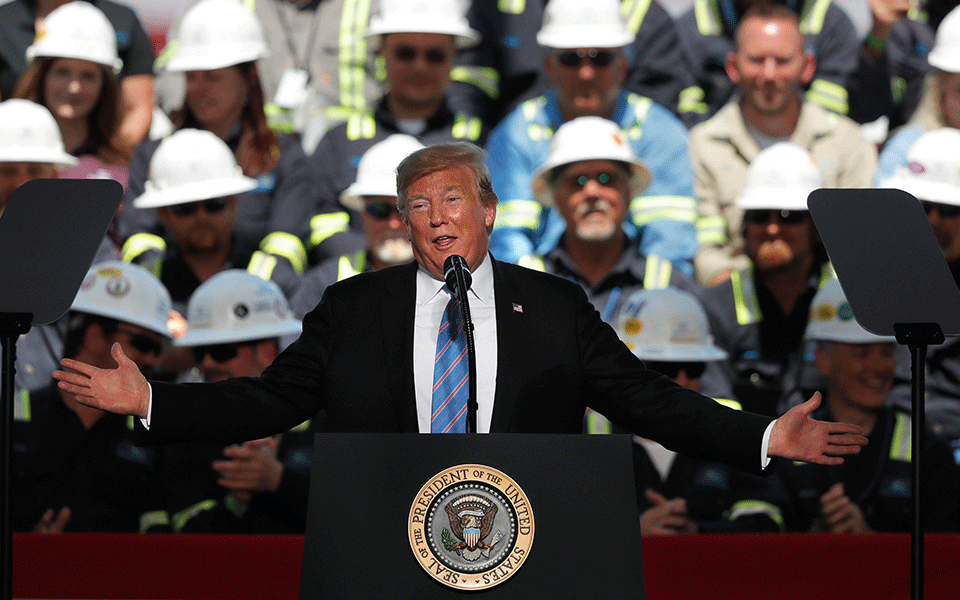
Tokyo: President Donald Trump Monday hailed a "great respect" between the US and nuclear-armed North Korea, as he also held out the possibility of talks with Iran, stressing he did not want "terrible things" to happen.
Ahead of summit talks with Japanese Prime Minister Shinzo Abe, Trump played down recent belligerence from Pyongyang, which last month fired short-range missiles that raised tensions in the region.
"I personally think that lots of good things will come with North Korea, I feel that. I may be right, I may be wrong, but I feel that," Trump told reporters at Abe's office.
"There's a good respect built, maybe a great respect built between... the United States and North Korea, but we will see what happens," added the president, whose failed talks with the North's leader Kim Jong Un in Hanoi sparked a fresh spike in tensions.
He noted that when he came to office, there was "testing all the time, nuclear testing at the highest level, and that seems to have stopped".
On Sunday, Trump dismissed the recent missile tests from the North as "some small weapons" and appeared to undercut his National Security Advisor John Bolton, who had said the day before that the launches contravened UN Security Council resolutions.
Trump said the recent tests had "disturbed some of my people, and others, but not me," which was widely seen as a reference to his hawkish advisor.
Trump also struck a relatively dovish tone on Iran, amid mounting tensions with the historic American foe. "I do believe that Iran would like to talk, and if they'd like to talk, we'd like to talk also," Trump said.
"We'll see what happens, but I know for a fact that the prime minister (Abe) is very close with the leadership of Iran... nobody wants to see terrible things happen, especially me." Abe is reportedly weighing a trip to Tehran in a bid to mediate in the Middle East crisis and Trump appeared to give the green light, saying "we'll see what happens, that would be fine".
Trump is in Japan as the first foreign leader to visit the country's newly enthroned Emperor Naruhito -- an honour Abe hopes will help charm the US president when it comes to thorny trade talks.
And while the US president again lashed out at what he called a "tremendous imbalance" in the trade relationship between the world's top and number-three economies, he said: "I'm sure that will work out over a period of time."
"I think we will be announcing some things, probably in August, that will be very good for both countries." On Sunday, Trump had already taken a softer note, saying that "much" of that deal would wait until Abe faces upper house elections likely in July -- as rumours swirl that the popular prime minister will combine that vote with a snap general election.
With his trade war against China getting bogged down, Trump won't want another dispute to rock the boat for his closest Asian ally.
Top Japanese and American trade negotiators spent more than two hours locked in talks on Saturday night but failed to achieve a breakthrough, although the Japanese side said there was more "understanding" between the two.
Monday marked the start of the official programme for the two leaders after a fun-filled weekend of sumo, golf and meals out. Trump said on Sunday he was having a "great time" with his friend and close ally Abe.
Trump said it was a "great honour" to be the first to meet Naruhito, who took the Chrysanthemum Throne only three weeks ago, after his father stepped down in the first abdication in two centuries.
In the morning, Trump, dressed in a dark suit and red tie, reviewed the Japanese honour guard and greeted dozens of Japanese and visiting US officials as a military band played.
Naruhito, wearing a light blue tie, and his wife Empress Masako, who was in a white hat and jacket, accompanied Trump and his wife Melania, who wore a summery white dress and tall red high heels.
Walking together through the palace, notable for its elegant, restrained decor, the two couples then sat down for a further chat where official translators found themselves with little to do -- Naruhito having gone to Oxford and Masako graduating from Harvard.
In the evening, Trump and Melania will be back at the palace for a banquet.
That will mark the lavish high point in a Japan visit laden with feel-good moments aimed at celebrating US-Japanese ties at a time of growing regional uncertainty due to US trade policies, a rising China and nuclear-armed North Korea.
Let the Truth be known. If you read VB and like VB, please be a VB Supporter and Help us deliver the Truth to one and all.
Udhayanidhi accuses BJP of not releasing funds for TN
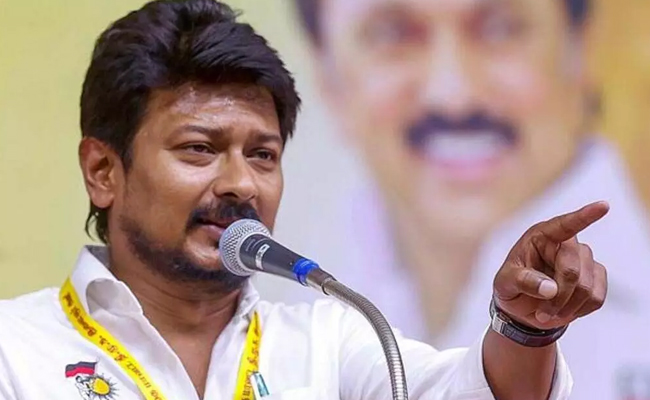
Gobichettipalayam (PTI): Tamil Nadu deputy chief minister Udhayanidhi Stalin on Saturday charged the BJP government at the Centre with not releasing funds to the state and accused it of "snatching" TN's rights.
Addressing a poll rally at Gobichettipalayam in the western Erode district, the DMK youth wing chief claimed the Centre has not released funds to the tune of Rs 3,000 crore for education.
"They (union government) have snatched all our rights," he charged.
With regard to the Centre's proposal for delimitation, he said chief minister M K Stalin was the first person in the country to raise the voice against the union government's move. He claimed that it was a "huge victory" for the INDIA alliance, as the bill was defeated for lack of majority after the opposition voted against it in the Lok Sabha.
Listing out various welfare measures implemented by the DMK government, he said the existing "Kalaignar Magalir Urimai Thogai" (monthly financial assistance for women) will be doubled to Rs 2,000 if DMK was voted to power again.
The deputy chief minister charged that the BJP and AIADMK have tried to stall it by moving the court. "At present more than 1.3 crore women have benefited from the scheme", he said.
"Similarly, the breakfast scheme for the government school students will be extended till Class VIII", he said adding "more than 35 lakh college students across the state will be getting free laptops once the DMK government is formed".
Udhayanidhi also pointed out at the "Illatharasi" poll promise, providing Rs 8,000 worth of coupons to non-income tax paying women where they could buy or replace any household appliances of their choice.
Elections to 234 Assembly seats in Tamil Nadu will be held on April 23 and the results declared on May 4 following counting of polled votes.