Donald Trump wins North Dakota Republican caucuses, adding to victories going into Super Tuesday
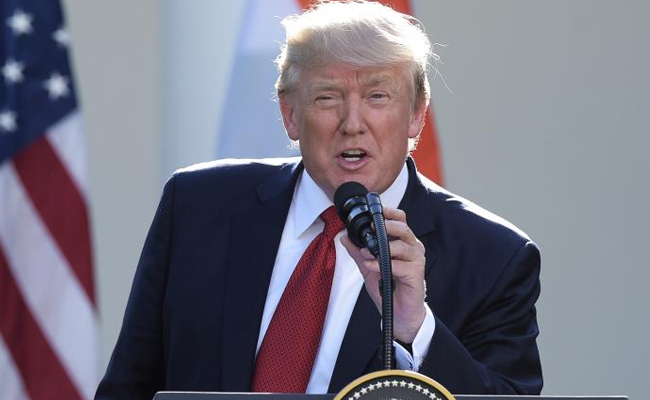
Bismarck (US), Mar 5 (AP): Donald Trump won the North Dakota Republican presidential caucuses on Monday, adding to his string of victories heading into Super Tuesday.
The former president finished first in voting conducted at 12 caucus sites, ahead of former UN Ambassador Nikki Haley. The result puts Trump back on the winning track, which was briefly interrupted on Sunday when Haley notched her first victory of the campaign in the District of Columbia's primary.
The White House hopefuls now turn their attention to Super Tuesday, when results will pour in from 16 states in contests that amount to the single biggest delegate haul of any day in the presidential primary. Trump and President Joe Biden, a Democrat, are dominating their races and are on track to winning their nominations later this month.
Under North Dakota's rules, candidates are eligible to win delegates if they finish with at least 20 per cent of the vote. However, a candidate who wins at least 60 per cent of the vote receives all of the state's 29 delegates.
Four candidates were on the ballot, including Trump and Nikki Haley. The other candidates, who have received little attention, were Florida businessman David Stuckenberg and Texas businessman and pastor Ryan Binkley, who recently ended his campaign.
ALSO READ: Nikki Haley beats Donald Trump in Washington DC for first primary victory
Retired music teacher and librarian Karen Groninger, of Almont, said Monday that she voted for Trump, calling him the best choice. The 76-year-old cited Trump's 2020 speech at the annual March for Life anti-abortion event in Washington, DC. the first by a sitting president and his border policies.
Longtime Republican state Sen. Dick Dever, of Bismarck, said he voted for Haley, but added she's unlikely to win. The retired factory representative, 72, said, "I hear an awful lot of people say that they really liked Trump's policies but they don't like the way he conducts himself, and I think he's gone overboard a bit."
Caucus voters were encouraged to be paying party members, but those who wouldn't pay USD 50 for annual membership were asked to sign a pledge to affiliate with the party, caucus Chair Robert Harms said.
North Dakota is the only state without voter registration. The caucuses followed official state voter identification protocols, such as providing a driver's license. Voting was done only in person and on printed ballots, which will be hand-counted.
In 2016, it was a North Dakota delegate who helped Trump secure the number needed for the Republican presidential nomination.
He swept North Dakota's three electoral college votes in 2016 and 2020, winning about 63 per cent and 65 per cent of those votes, respectively.
As president, Trump visited Bismarck and Mandan in 2017 to talk about tax cuts, and he campaigned twice in Fargo in 2018 for Kevin Cramer in the then-congressman's successful Senate bid against Democratic Sen. Heidi Heitkamp.
North Dakota's Democratic-NPL Party is holding a presidential primary almost entirely by mail, with mail-in voting from Feb. 20 to March 30, and limited in-person voting for residents of Indian reservations. President Joe Biden, Rep. Dean Phillips and six others are on the ballot.
A third party will count ballots in Fargo on March 30, with results available on the party's website afterward.
Sen. Bernie Sanders won the Democratic caucuses in 2016 and 2020. (AP)
Let the Truth be known. If you read VB and like VB, please be a VB Supporter and Help us deliver the Truth to one and all.
Telangana rains: Four farmers dead, three injured as sheds collapse in Mancherial
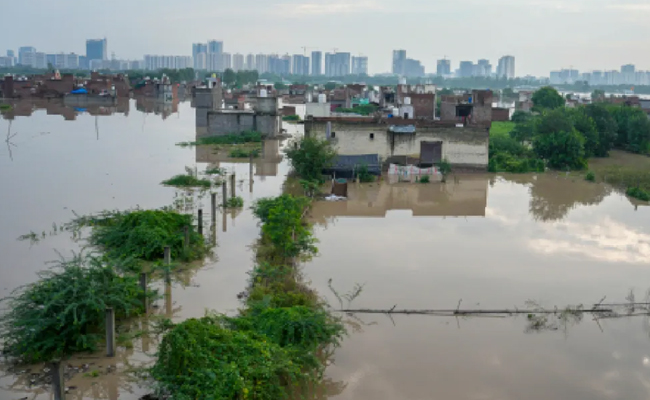
Karimnagar (Telangana) (PTI): Four farmers died, and three others were injured after tin-roofed sheds and dilapidated structures collapsed in two separate incidents in Mancherial district of Telangana, officials said on Wednesday.
The incidents occurred in two villages of Luxettipet mandal late on Tuesday night, when the farmers were taking shelter in the structures following heavy rain and strong winds.
According to officials, two people died when a shed caved in at Kothuru village.
In a separate incident in Gampalapalli village, two more persons died after another structure collapsed, police and district authorities said.
The three injured were shifted to a hospital in Karimnagar for treatment, police said.
Preliminary reports indicate that unseasonal rains accompanied by strong winds weakened the structures, leading to the collapses.
Authorities are assessing the situation, and further investigation is underway.