Dutch PM resigns because of deadlock on thorny issue of migration, paving way for new elections
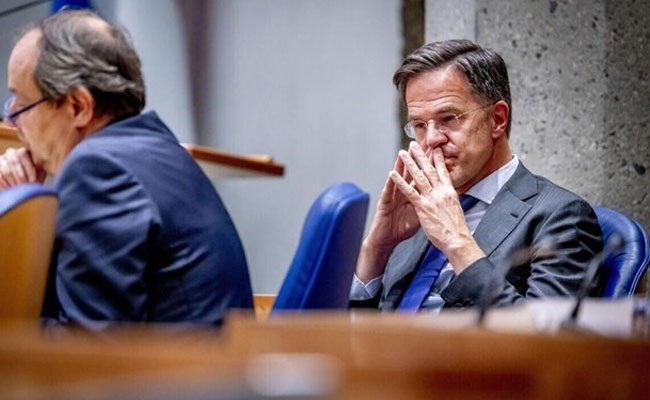
The Hague (AP): The Dutch government has collapsed because of irreconcilable differences within the four-party coalition about how to rein in migration, a divisive issue that has split nations across Europe.
The resignation of Prime Minister Mark Rutte, the longest-serving premier of the nation, on Friday means the country will face a general election later this year. Rutte and his government will remain in office in a caretaker capacity until a new ruling coalition is chosen.
"It is no secret that the coalition partners have very different views on migration policy," Rutte told reporters in The Hague. "And today, unfortunately, we have to draw the conclusion that those differences are irreconcilable. That is why I will immediately ... offer the resignation of the entire Cabinet to the king in writing."
Opposition lawmakers wasted no time in calling for fresh elections even before Rutte formally confirmed his resignation.
Geert Wilders, leader of the anti-immigration Party for Freedom, tweeted, "Quick elections now." Across the political spectrum, Green Left leader Jesse Klaver also called for elections and told Dutch broadcaster NOS: "This country needs a change of direction."
Rutte had presided over late-night meetings Wednesday and Thursday that failed to result in a deal on migration policy. At one final round of talks Friday evening, the parties decided unanimously that they could not agree and, as a result, could not remain together in the coalition.
The decision underscored ideological divisions that existed from the day the coalition was sworn in just over 18 months ago between parties that do not support a strict crackdown on migration D66 and fellow centrist party ChristenUnie, or Christian Union and the two that favour tougher measures Rutte's conservative People's Party for Freedom and Democracy and the Christian Democrats.
Similar discussions are going on across political divides elsewhere in Europe as migrants fleeing conflict or seeking a better life make perilous sea crossings from northern Africa to reach the continent. Hundreds of thousands of people have also fled the grinding war in Ukraine.
Migration is set to be an essential theme of European Union parliamentary elections next year, but the issue hit early in the Netherlands, a nation that has long been torn between a welcoming international outreach and increasing resistance to foreign influences.
Rutte's coalition tried for months to hash out a deal to reduce the flow of new migrants arriving in the country of nearly 18 million people. Proposals reportedly included creating two classes of asylum a temporary one for people fleeing conflicts and a permanent one for people trying to escape persecution and reducing the number of family members who are allowed to join asylum-seekers in the Netherlands.
Last year, hundreds of asylum-seekers were forced to sleep outdoors in squalid conditions near an overcrowded reception centre as the number of people arriving in the Netherlands outstripped the available beds. Dutch aid agencies provided assistance.
Just over 21,500 people from outside Europe sought asylum in the Netherlands in 2022, according to the country's statistics office. Tens of thousands more moved to the Netherlands to work and study.
The numbers have put a strain on housing that already was in short supply in the densely populated country.
Rutte's government worked for a law that could compel municipalities to provide accommodations for newly arrived asylum-seekers, but the legislation has yet to pass through both houses of parliament.
The prime minister also promoted European Union efforts to slow migration to the 27-nation bloc. Rutte visited Tunisia last month with his Italian counterpart and the president of the EU's executive commission to offer more than 1 billion euros in financial aid to rescue the North African nation's teetering economy and to stem migration from its shores to Europe.
Rutte's coalition government, the fourth he has led, took office in January 2022 following the longest coalition negotiations in Dutch political history.
The election for the lower house of the Dutch parliament later this year will take place in a polarised and splintered political landscape there are 20 parties in the 150-seat lower house.
During provincial elections earlier this year, a populist pro-farmer party put Rutte's party into second place. The defeat was seen as a possible incentive for Rutte to do his utmost to hold together his coalition until its term ends in 2025.
Let the Truth be known. If you read VB and like VB, please be a VB Supporter and Help us deliver the Truth to one and all.
Jawan found dead in CRPF camp in J-K's Shopian

Srinagar (PTI): A CRPF jawan died inside a camp in Shopian district of Jammu and Kashmir, officials said on Wednesday.
Head constable Surinder Singh, who hails form Hyderabad, fell unconscious late Tuesday night at the Zainapora Central Reserve Police Force (CRPF) camp in Shopian, the officials said.
Singh was shifted to Zainapora hospital where he was declared dead on arrival.
Police has taken cognizance of the incident and started proceeding to ascertain cause of Singh's death.