Earthquake in eastern Afghanistan destroys villages, kills 800 people, with 2,500 injured
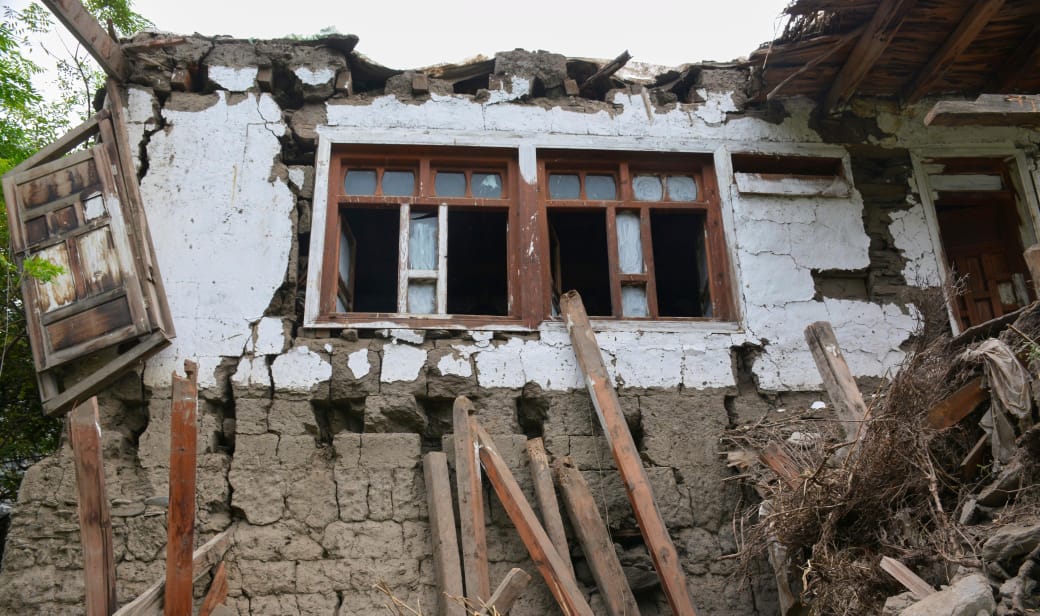
Kabul (AP): Desperate Afghans clawed through rubble in search of missing loved ones after a strong earthquake killed some 800 people and injured more than 2,500 in eastern Afghanistan, according to figures provided Monday by the Taliban government.
The 6.0 magnitude quake late Sunday hit towns in the province of Kunar, near the city of Jalalabad in neighbouring Nangarhar province, causing extensive damage.
One resident in Nurgal district, one of the worst-affected areas in Kunar, said nearly the entire village was destroyed.
“Children are under the rubble. The elderly are under the rubble. Young people are under the rubble,” said the villager, who did not give his name.
“We need help here,” he pleaded. “We need people to come here and join us. Let us pull out the people who are buried. There is no one who can come and remove dead bodies from under the rubble.”
The quake hit just before midnight and was centred 27 kilometres east-northeast of Jalalabad at a depth of 8 kilometres, the US Geological Survey said. Shallower quakes tend to cause more damage. Several aftershocks followed.
Footage showed rescuers taking injured people on stretchers from collapsed buildings and into helicopters as people frantically dug through rubble with their hands.
The Taliban government's chief spokesman, Zabihullah Mujahid, told a press conference on Monday that the death toll had risen to at least 800 with more than 2,500 injured. He said most of the casualties were in Kunar.
The quake was felt in parts of Pakistan, including the capital Islamabad. There were no reports of casualties or damage.
Homes collapsed and people screamed for help
Eastern Afghanistan is mountainous, with remote areas and the quake has worsened communications. Blocked roads are forcing aid workers to walk four or five hours to reach survivors. Dozens of flights have operated in and out of Nangarhar Airport, transporting the injured to hospitals.
Buildings in Afghanistan tend to be low-rise constructions, mostly of concrete and brick, with homes in rural and outlying areas made from mud bricks and wood. Many are poorly built.
One survivor described seeing homes collapse before his eyes and people screaming for help.
Sadiqullah, who lives in the Maza Dara area of Nurgal, said he was woken by a deep boom that sounded like a storm approaching. Like many Afghans, he uses only one name.
He ran to where his children were sleeping and rescued three of them. He was about to return to grab the rest of his family when the room fell on top of him.
“I was half-buried and unable to get out,” he told The Associated Press by phone from Nangarhar Hospital. “My wife and two sons are dead, and my father is injured and in hospital with me. We were trapped for three to four hours until people from other areas arrived and pulled me out."
It felt like the whole mountain was shaking, he said.
'Numbers may increase'
Rescue operations were underway and medical teams from Kunar, Nangarhar and the capital, Kabul, have arrived in the area, said Sharafat Zaman, a health ministry spokesman.
Zaman said many areas had not been able to report casualty figures and that “the numbers were expected to change” as deaths and injuries are reported.
The chief spokesman, Mujahid, said helicopters had reached some areas but road travel was difficult. “There are some villages where the injured and dead haven't been recovered from the rubble, so that's why the numbers may increase,” he told journalists.
Filippo Grandi, the United Nations High Commissioner for Refugees, said the earthquake intensified existing humanitarian challenges in Afghanistan and urged international donors to support relief efforts.
“This adds death and destruction to other challenges including drought and the forced return of millions of Afghans from neighbouring countries,” Grandi wrote on X. “Hopefully the donor community will not hesitate to support relief efforts.”
Search and rescue support
Entire roads and communities have been cut off from accessing nearby towns or hospitals and 2,000 casualties were reported within the first 12 hours, said Sherine Ibrahim, the country director for the aid agency.
“Although we have been able to act fast, we are profoundly fearful for the additional strain this will have on the overall humanitarian response in Afghanistan," said Ibrahim. " Global funding cuts have dramatically hampered our ability to respond to the ongoing humanitarian crisis.”
The International Federation of Red Cross and Red Crescent Societies said in a statement that immediate needs include search and rescue support, emergency healthcare and medical supplies, food, clean water, and restoring road access to reach isolated communities.
Pakistani Prime Minister Shehbaz Sharif said he was deeply saddened by events in Afghanistan. “Our hearts go out to the victims and their families. We are ready to extend all possible support in this regard,” he said on X.
Pakistan has expelled tens of thousands of Afghans in the past year, many of them living in the country for decades as refugees. At least 1.2 million Afghans have been forced to return from Iran and Pakistan so far this year, according to a June report by UNHCR.
A magnitude 6.3 earthquake struck Afghanistan on October 7, 2023, followed by strong aftershocks. The Taliban government estimated at least 4,000 people perished in that quake.
The UN gave a lower death toll of about 1,500. It was the deadliest natural disaster to strike Afghanistan in recent memory.
Sunday's latest earthquake was likely to “dwarf the scale of the humanitarian needs” caused by the disaster of 2023, according to the International Rescue Committee.
Let the Truth be known. If you read VB and like VB, please be a VB Supporter and Help us deliver the Truth to one and all.
Two held for 'firing' at BJP leader's house in Bengal

Kolkata (PTI): A day before the counting of votes for the West Bengal assembly elections, two persons were arrested on Sunday for allegedly being involved in a firing incident outside the residence of a BJP leader in North 24 Parganas district, police said.
BJP leader Kundan Singh lodged a police complaint, alleging that a few gunmen fired at his house in the Noapara constituency around Saturday midnight.
Based on the CCTV footage, the two accused were apprehended, a senior officer said.
BJP's Noapara candidate Arjun Singh, in a post on social media, claimed that around 12.05 am, two armed miscreants arrived on a motorcycle at the residence of Kundan Singh, a BJP functionary and secretary of the Barrackpore organisational district, with an "intent to kill him".
According to the BJP leader, the accused are residents of Garulia and are known criminals.
Their names as offenders had been submitted to the Election Commission, he said.
The police officer did not specify whether the two arrested persons were the same individuals named by Arjun Singh.
According to the complaint, one round of firing took place outside Kundan Singh's house, triggering panic in the area.
The BJP candidate also questioned the role of the police, claiming that one of the accused had been detained by the police on the polling day but was later released in the evening.
The Noapara assembly seat went to the polls on April 29.
Several BJP leaders alleged that attempts were being made to create an atmosphere of fear ahead of the counting and weaken the organisation of the opposition parties.
The counting of votes will take place on May 4. Polling for the West Bengal assembly elections was held on April 23 and April 29.
The BJP urged the Election Commission to intervene immediately to ensure peaceful counting.
TMC candidate Somnath Shyam rubbished Arjun Singh’s allegation, claiming that the BJP nominee had orchestrated the firing incident to divert attention from imminent defeat.
“Arjun Singh knows all the gangsters in the Barrackpore belt. Everyone knows about his links with the underworld. Let the police investigate the incident,” Shyam said.