Earthquake off Indonesia topples buildings, kills 1, sets off small tsunami
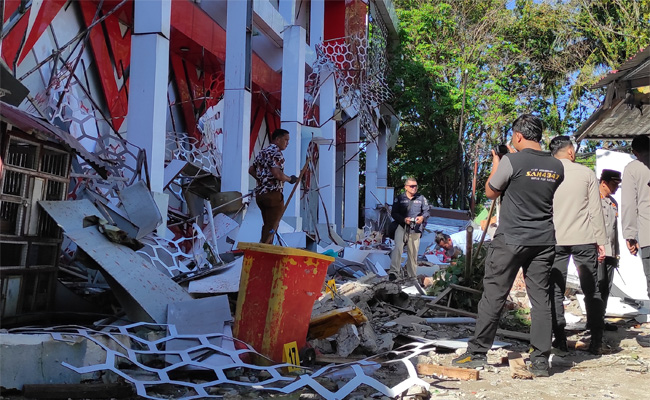
Manado (Indonesia) (AP): An undersea earthquake of 7.4 magnitude toppled buildings in parts of northern Indonesia, sent people fleeing from their homes, killed at least one person and generated a small tsunami Thursday.
Waves up to 75 cm (30 inches) above normal tides were recorded at several monitoring stations about a half-hour after the earthquake, which was centred in the Molucca Sea.
Indonesia's meteorological agency lifted its tsunami warning hours after the quake, and the Philippine Institute of Volcanology and Seismology said there was no destructive threat to the country, which is north of the quake's epicentre.
Strong shaking lasting 10 to 20 seconds was felt in Bitung in North Sulawesi province as well as in Ternate city in neighbouring North Maluku province, according to Indonesia's Disaster Management Agency.
Initial assessments showed light to severe damage in parts of Ternate, including a church and two houses. In Bitung, damage assessments were still underway, the agency said.
Indonesia's Search and Rescue Agency reported a 70-year-old woman died in a building collapse in North Sulawesi's Manado city and another resident was injured. At least three injured people were hospitalised in Ternate.
Videos released by the rescue agency showed damaged structures and flattened houses, while television stations broadcast scenes of people rushing outside and gathering in streets to avoid the risk of collapsing buildings.
Nearly 50 aftershocks were felt in nearby areas.
“We had just woken up and suddenly the earthquake hit... we all ran out of the house,” Bitung resident Marten Mandagi said. “The shaking was very strong.”
Indonesia, a vast archipelago of more than 280 million people, sits on major seismic faults and is frequently hit by earthquakes and volcanic eruptions.
Let the Truth be known. If you read VB and like VB, please be a VB Supporter and Help us deliver the Truth to one and all.
Mumbai nurse loses Rs 1 lakh trying to buy Rs 299 dress online

Mumbai (PTI): A nurse working at a private hospital in Mumbai was allegedly cheated of Rs 1 lakh after she tried to purchase a dress online for Rs 299, police said.
As per preliminary investigation, the fraud was orchestrated using a Facebook advertisement, a WhatsApp number and a fake delivery agent, an official from Deonar police station said on Saturday.
The nurse, who lives in a hostel here, in her complaint said she came across an advertisement on Facebook offering dresses at just Rs 299. She then tried to buy one piece.
The person at the other end initially sought payment for the dress, but later “continued to extract money under various pretexts such as shipping charges, GPS charges, tracking fees, verification codes and address confirmation,” the official said.
The nurse told the police that she paid Rs 1 lakh over five days between April 16 and 20, and was repeatedly assured that most of the money would be refunded and the order would be delivered.
When nothing happened, she realised that she had been scammed. She then contacted the Cyber Crime Helpline 1930 and lodged a complaint. The Deonar police have registered a case and launched a probe into it, the official said.