ED attaches gems, bank deposits worth over Rs 253 cr of Nirav Modi group in Hong Kong
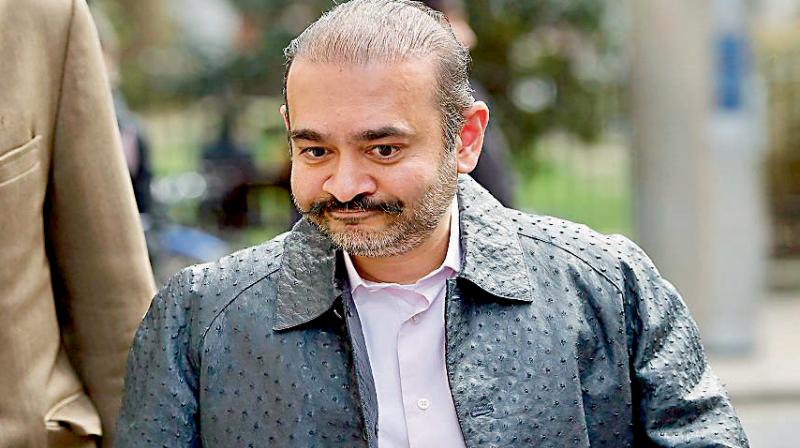
New Delhi, Jul 22: The Enforcement Directorate Friday said it has attached gems, jewellery and bank deposits worth Rs 253.62 crore of some Hong Kong-based companies of fugitive diamond merchant Nirav Modi as part of a money laundering probe.
Some assets of Nirav Modi group of companies in Hong Kong were identified in the form of gems and jewelleries lying in private vaults and bank balances in accounts maintained there and these have been provisionally attached under sections of the Prevention of Money Laundering Act (PMLA), the federal probe agency said in a statement.
The amount kept in banks amounts to USD 30.98 million and Hong Kong dollars 5.75 million, which is equivalent to Rs 253.62 crore (as on July 22, 2022), it said.
Nirav Modi, 51, is presently lodged in a UK jail and has lost his extradition plea to India in connection with the USD 2-billion PNB fraud case that is also being investigated by the CBI.
The ED said the extradition proceedings are at "final stage in London, UK."
It said that with the latest attachment, the total seizure of assets against Nirav Modi stands at Rs 2,650.07 crore.
"Also, movable and immovable assets of Nirav Modi and his associates amounting to Rs 1,389 crore have been confiscated under provisions of the Fugitive Economic Offenders Act, 2018 on the orders of a special court in Mumbai," it said.
Some of the confiscated properties have already been physically handed over to victim banks, the agency added.
Nirav Modi and his uncle Mehul Choksi, both prime accused in the case, along with others are being probed by the ED on money laundering charges for allegedly perpetrating a fraud in connivance with bank officials and by issuance of fraudulent Letters of Undertaking (LoUs) at the Brady House Punjab National Bank (PNB) branch in Mumbai.
He (Modi) was declared a fugitive economic offender by a Mumbai PMLA court in December 2019. He was arrested the same year in London.
Let the Truth be known. If you read VB and like VB, please be a VB Supporter and Help us deliver the Truth to one and all.
Delhi: Teenager slashes boy for refusing money for drugs; held

New Delhi (PTI): A 16-year-old boy has been apprehended for allegedly attacking a teenager with a paper cutter near the Red Fort area last month after the victim refused to give him money for drugs, an official said on Tuesday.
The juvenile, who had been absconding after the incident, was also found to be involved in another attempt to murder case registered at Jama Masjid police station, they said.
The case came to light on April 5 when police received information from LNJP Hospital about a 17-year-old boy, a resident of Nangloi, who had been admitted with serious injuries.
The victim had sustained sharp wounds on his neck and abdomen and was unfit to give a statement, the police said.
Preliminary inquiry revealed that the victim quarrelled with an unidentified boy at Parade Ground near the Red Fort, following which he was attacked. A case under relevant sections of the BNS was registered.
A team was constituted to trace the accused, which analysed CCTV footage from the area and identified a suspect seen fleeing the spot. The boy was later identified with the help of local intelligence as a vagabond frequenting the Chandni Chowk area, police said.
Despite multiple raids in Delhi and adjoining areas, the accused remained untraceable. Subsequently, his mobile number was tracked, and technical surveillance led police to Haridwar in Uttarakhand.
On April 29, the police team conducted a raid in a village in Haridwar and apprehended the juvenile after sustained efforts, an officer said.
During questioning, the accused disclosed that he had been living in the Chandni Chowk area for the past two years and was addicted to drugs. On the night of April 4, he allegedly got into an argument with the victim after the latter refused to give him money and slapped him. Enraged, he attacked the boy with a paper cutter, inflicting multiple injuries.
The police said the accused later attacked another person near the Jama Masjid Metro Station on the same night before fleeing to Haridwar.
He also disposed of the weapon and clothes by throwing them from a moving train to evade arrest, they said.
Further investigation is underway, they added.