Elderly Sikh woman detained by immigration authorities in US, family calls for her release

New York (PTI): A 73-year old Sikh woman has been detained by immigration authorities in California after she went for a routine check-in with the US agency, sparking protests and concerns among her family and members of the community.
Harjit Kaur, who has lived in the East Bay in Northern California for more than 30 years, was detained by Immigration and Customs Enforcement (ICE) officials during a routine check-in earlier this week, a report in Berkeleyside, a nonprofit news portal, said.
The report added that her family along with hundreds of members from the community organised a protest Friday, calling for the immediate release of Kaur, who was detained on Monday after ICE asked her to come to the San Francisco office to turn in additional paperwork.
“She was taken to a detention centre in Bakersfield,” the report said.
Harjit Kaur was undocumented, according to a report in ABC7News. She came to the United States in 1992 from India as a single mother with two sons. Her asylum case was denied in 2012, but since then she has “faithfully reported” to ICE in San Francisco every six months for more than 13 years, her daughter-in-law Manji Kaur said.
The Berkeleyside report said that “ICE assured her she could remain in the United States under supervision with work permits until they could receive her travel documents.”
The protest on Friday was organised by Kaur’s family, Indivisible West Contra Costa County and the Sikh Centre. Members of US Rep John Garamendi’s staff, local elected officials and other political leaders also attended, the report said.
KTVU Fox 2 news portal quoted Congressman Garamendi as saying that his office has sent an inquiry to ICE requesting that Kaur be reunited with her family.
In a statement, Garamendi said: “President (Donald) Trump initially promised to go after the ‘worst of the worst’ in his immigration policy. Yet this administration’s decision to detain a 73-year-old woman — a respected member of the community with no criminal record who has faithfully reported to ICE every six months for more than 13 years — is one more example of the misplaced priorities of Trump’s immigration enforcement.”
“Our office will do everything possible to support her case and her family,” he said. Local Council member Dilli Bhattarai said, according to The Berkeleyside report, that he is looking into how his city can put pressure on the federal government to release Kaur.
“She is not doing any harm to the community. She is an abiding [constituent] just like us,” Bhattarai said. “She has all the rights to be here as a community member and we should all support her immediate release.”
Kaur, who has two grandsons and three granddaughters among other relatives, had worked for over two decades at a local Indian clothing store, the report said.
Her granddaughter Sukhdeep Kaur described Kaur as an “independent, selfless, hard-working” and termed her as a “mother figure” [to the community].
“We are all just in a state of shock,” Sukhdeep Kaur said.
Her family voiced concern over her health, claiming that being detained at her age with serious health issues such as thyroid disease, migraine, knee pain, and anxiety, her life could be at risk, the report added.
Let the Truth be known. If you read VB and like VB, please be a VB Supporter and Help us deliver the Truth to one and all.
SC to hear on May 4 PIL seeking stringent guidelines for issuing Aadhaar to adolescents, adults
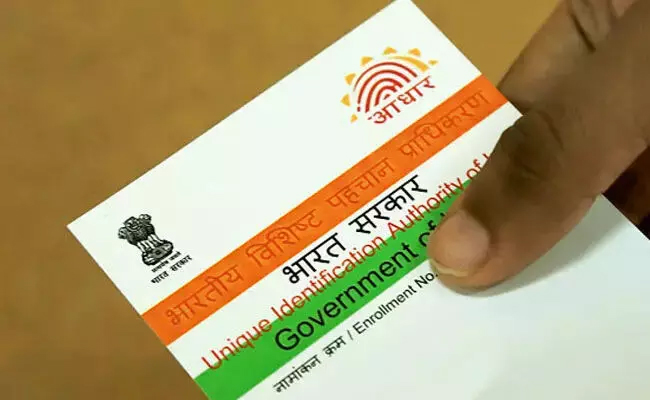
New Delhi (PTI): The Supreme Court is scheduled to hear on Monday a plea seeking a direction to the Unique Identification Authority of India to issue new Aadhaar cards only to citizens up to the age of six years, and frame stringent guidelines for its issuance to adolescents and adults to stop infiltrators from masquerading as Indian citizens.
As per the apex court's causelist of May 4, the plea would come up for hearing before a bench of Chief Justice Surya Kant and Justice Joymalya Bagchi.
The Public Interest Litigation (PIL) filed by lawyer Ashwini Upadhyay has also sought a direction to the authorities to install display boards at common service centres stating that the 12-digit unique identification number is only a "proof of identity" and not a proof of citizenship, address or date of birth.
Besides all the states and Union Territories, the plea has made the UIDAI -- which is the authority that issues Aadhaar -- and the Union ministries of home, law and justice, and electronics and information technology as parties.
The plea, filed through advocate Ashwani Dubey, said Aadhaar, originally intended as a proof of identity, has increasingly become a "foundational document" enabling individuals to obtain other identification documents, such as ration cards, domicile certificates and voter identity cards.
"The UIDAI has issued 144 crore Aadhaar and 99 percent Indians have been enrolled. Therefore, the petitioner is filing this writ petition as a PIL under Article 32, seeking a direction to UIDAI to issue new Aadhaar to children only and frame new stringent guidelines for adolescents and adults, so as to stop infiltrators from getting it and masquerading as Indian citizens," the plea said.
It said the need to file the plea arose when the petitioner came to know the manner in which infiltrators are able to procure Aadhaar through a verification process that is weak and can be easily manipulated.
"Foreigners apply for Aadhaar under the 'foreign' category. But infiltrators apply for Aadhaar under the 'Indian citizen' category and get it easily made. Thereafter, they obtain a ration card, birth and domicile certificate, driving licence, et cetera, essentially becoming indistinguishable from Indian citizens…," it said.
Besides seeking other directions, the plea has raised legal questions, including whether the Aadhaar Act 2016 has become "temporally unreasonable" for failing to keep up with the legislative intent of distinguishing foreigners from Indian citizens.
It said the alleged misuse of Aadhaar undermines targeted welfare delivery and leads to diversion of public resources.