Elon Musk listens while vilified, hailed as tweet trial ends
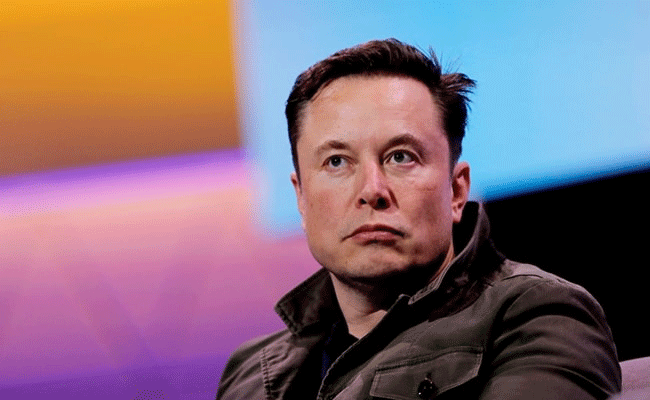
San Francisco (US) (AP): As he sat stoically in court, Elon Musk on Friday was both vilified as a rich narcissist whose reckless behaviour risks "anarchy" and hailed as a visionary looking out for the "little guy".
The contrasting portraits of the enigmatic billionaire came during closing arguments in a trial focused on whether Musk's tweeting in 2018 misled Tesla shareholders, steering them in a direction that they argue cost them billions of dollars.
The three-week trial has pitted Tesla investors represented in a class-action lawsuit against Musk, who is CEO of both the electric automaker and the Twitter service he bought for USD 44 billion a few months ago.
After three hours of arguments wrapped up Friday, a nine-person jury began its deliberations in the civil case centred on two tweets Musk posted August 7, 2018 about a Tesla buyout that never happened.
The first tweet, posted just before he boarded his private jet, Musk declared he had "funding secured" to take Tesla private. A few hours later, Musk sent another tweet indicating that the deal was imminent.
The tweets caused Twitter's stock to surge during a 10-day period covered by the lawsuit before falling back after Musk abandoned a deal in which he never had a firm financing commitment, based on evidence presented during the three-week trial.
Musk's decision to show up for the closing arguments even though his presence wasn't required underscores the importance of the trial's outcome to him.
If the jurors decide the tweets duped investors, Musk and Tesla could be on the hook for billions of dollars in damages.
Nicholas Porritt, a lawyer for the Tesla shareholders, urged the jurors to rebuke Musk for his "loose relationship with the truth".
"Our society is based on rules," Porritt said. "We need rules to save us from anarchy. Rules should apply to Elon Musk like everyone else."
Alex Spiro, Musk's attorney, conceded the 2018 tweets were "technically inaccurate." But he told the jurors, "Just because it's a bad tweet doesn't make it a fraud."
US District Judge Edward Chen, who presided over the trial, decided last year that Musk's 2018 tweets were false and has instructed the jury to view them that way.
During roughly eight hours on the stand earlier in the trial, Musk insisted he believed he had lined up the funds from Saudi Arabia's Public Investment Fund to take Tesla private after eight years as a publicly held company. He defended his initial August 2018 tweet as well-intentioned and aimed at ensuring all Tesla investors knew the automaker might be on its way to ending its run as a publicly held company.
"I had no ill motive," Musk testified. "My intent was to do the right thing for all shareholders."
Spiro echoed that theme in his closing argument.
"He was trying to include the retail shareholder, the mom and pop, the little guy, and not seize more power for himself," Spiro said.
Porritt, meanwhile, scoffed at the notion that Musk could have concluded he had a firm commitment after a 45-minute meeting at a Tesla factory on July 31, 2018, with Yasir al-Rumayyan, governor of Saudi Arabia's wealth fund, given there was no written documentation.
A text message that al-Rumayyan sent later in August that is part of the trial evidence also indicated that the Saudi fund was only interested in learning more about Musk's proposal to take Tesla private at a time the company was valued at about USD 60 billion.
"Apparently a USD 60 billion financing commitment was obtained and no one wrote down a single word," Porritt said, while asserting that amount was larger than the combined economic output of Nicaragua, Honduras and El Salvador.
"Elon Musk apparently thinks it is easier to get billions of dollars in financing than an auto loan or a mortgage," Pollitt added.
Spiro, though, pointed to Musk's track record helping to start and run a list of companies that include digital payment pioneer PayPal and rocket ship maker SpaceX, in addition to Tesla.
The automaker based in Austin, Texas, is now worth nearly USD 600 billion, despite a steep decline in its stock price last year amid concerns that Musk's purchase of Twitter would distract him from Tesla.
Recalling Musk's roots as a South African immigrant who came to Silicon Valley to create revolutionary tech companies, Spiro described his client "as the kind of person who believes the impossible is possible."
Porritt put a different twist on Musk's mindset during his presentation. "To Elon Musk, if he believes it, or just thinks about it, it's true."
In his concluding remarks, Porritt told jurors their decision will boil down to their answer to one question: "Do the rules apply to everyone, or can Elon Musk do whatever he wants and not face the consequences?"
Let the Truth be known. If you read VB and like VB, please be a VB Supporter and Help us deliver the Truth to one and all.
Putin meets Iran's FM Araghchi, says Russia ready to do its best to help bring peace to West Asia
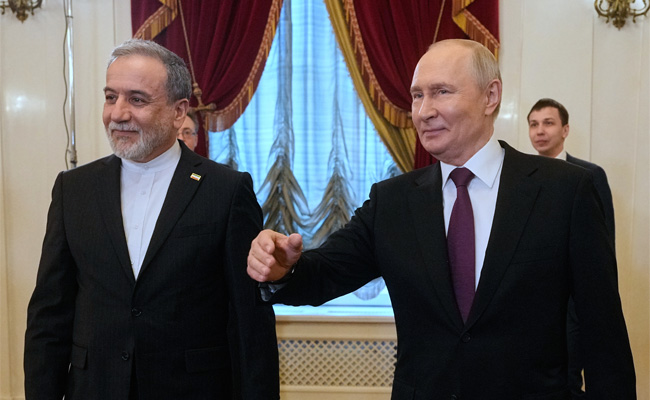
Moscow (PTI): Iran's Foreign Minister Abbas Araghchi on Monday met Russian President Vladimir Putin, who hailed the Iranian people for fighting bravely and heroically for their sovereignty and said Moscow is ready to do its best to help bring peace to West Asia as soon as possible.
Araghchi, who held talks with Omani and Pakistani leadership before arriving in Russia, met Putin in St. Petersburg and thanked him for supporting Iran, state-owned TASS news agency reported.
"Russia is ready to do everything in its power to ensure that peace in the Middle East is achieved as soon as possible," Putin said during his meeting with Araghchi, which was also attended by Russian Foreign Minister Sergey Lavrov.
Revealing that he received a message from Iranian Supreme Leader Mojtaba Khamenei last week, Putin asked Araghchi to convey his "gratitude for this message and best wishes for his health and well-being."
He praised the Iranian people for fighting "bravely and heroically" for their sovereignty, Iran's state-run PRESS TV reported.
"We really hope that, based on the courage and desire for independence, the Iranian people, under the guidance of the new leader, will weather this difficult period of trials and peace will come,” Putin said.
He also stressed that Russia “intends to maintain” its strategic relations with Iran.
Araghchi said that the world witnessed Iran’s strength in countering the US during the recent war, and that the Islamic Republic is a "stable and powerful establishment."
"With their courage, the Iranian people succeeded in resisting the US aggression and will be able to endure it,” he said.
He said that it became clear that Iran has “great friends and allies” like Russia, and conveyed “warmest greetings” from Supreme Leader Mojtaba Khamenei and President Masoud Pezeshkian to the Russian leader.
Araghchi said relations between Moscow and Tehran represent a “strategic partnership at the highest level” and will continue to develop "regardless of circumstances."
"We are grateful to you for the solid and strong positions in support of the Islamic Republic of Iran," he said.
Foreign Minister Lavrov said that the talks between President Putin and the Iranian Foreign Minister were "useful and constructive."
Kremlin Spokesman Dmitry Peskov later said that Russia is "ready to provide any good offices, any mediation services that are acceptable to the parties."
"We will be ready to do everything so that ultimately peace ensues, guaranteed peace, and that there is no return to hostilities," Peskov was quoted as saying by TASS.
He was asked how Moscow can assist in future negotiations on the Iranian settlement.
Araghchi arrived in Russia after his whirlwind trip to Islamabad, which, according to him, was “very productive” and involved “good consultations" with Pakistan's Army Chief Field Marshal Asim Munir, amid uncertainty over the second round of peace talks to resolve the war in West Asia.
"We held good consultations with our friends in Pakistan. The trip was successful. We assessed the outcome of our recent (meetings) and discussed in what direction and under what conditions talks can move on,” Araghchi said in a video posted on his Telegram channel upon his arrival in St Petersburg.
Referring to the second round of talks between the US and Iran to resolve the conflict in West Asia, Araghchi said: "Developments have taken place in the negotiations."
"Despite some progress in earlier rounds, the talks failed to reach their objectives due to the Americans' approach, the excessive demands they made, and the wrong approaches they adopted. Therefore, it was necessary to consult with our friends in Pakistan to review the latest situation,” Iran's official news agency IRNA quoted him as saying.
He said that the trip to Pakistan was a good opportunity to review developments related to the US-Israeli war against Iran, expressing confidence that “these consultations and coordination between the two countries will be highly significant.”
Araghchi arrived at St. Petersburg's Pulkovo Airport early Monday, where he was welcomed by Russian officials and Iran’s ambassador to Russia, Kazem Jalali, the report said.
The first round of peace talks between Iran and the US, held on April 11 and 12, failed to bring the desired result for the parties to the conflict.
The Iranian minister arrived in Islamabad for the second time on Sunday after a short visit to Oman, where he held talks with Sultan Haitham bin Tariq al-Said on security in the Strait of Hormuz and diplomatic efforts to end the Iran-US conflict.
After Araghchi left Pakistan for Oman on Saturday, President Donald Trump announced that US negotiators Steve Witkoff and Jared Kushner would no longer be going to Islamabad for talks with Iran, contending that Washington held all the cards on the matter.
Trump on Sunday reiterated that the US and Iranian officials can talk by phone for a peace solution to the conflict.
On Tuesday, Trump extended the two-week ceasefire with Iran indefinitely to give Tehran more time to prepare a unified proposal to end the war, just hours before the truce was set to expire.
The war began when the US and Israel jointly attacked Iran on February 28, killing Iranian Supreme Leader Ayatollah Ali Khamenei and several top commanders. The retaliation by the Islamic Republic extended the war to the entire Gulf region.