European Parliament postpones voting on joint motion against CAA
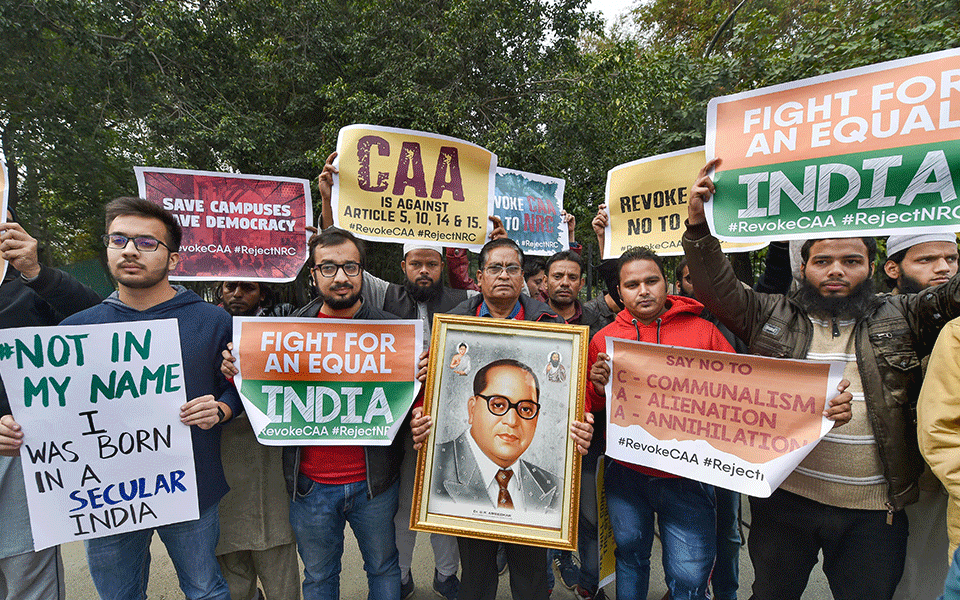
London, Jan 29: The European Parliament on Wednesday postponed voting on a joint motion tabled by its members against India's Citizenship Amendment Act (CAA), in a boost to the Indian government's efforts against such a move.
However, the joint motion, combining five different resolutions tabled by Members of the European Parliament (MEPs), has been placed on the final agenda for debate at the Plenary session in Brussels on Wednesday.
"Following a decision by MEPs at the opening of today's Plenary session in Brussels, the vote on the resolution on India's Citizenship (Amendment) Act 2019 has been postponed to the March session," the European Parliament said in a statement.
The debate on the motion is to go ahead as scheduled on Wednesday evening, it said.
One of the groups behind the motion, the Progressive Alliance of Socialists and Democrats in the European Parliament (S&D), said that the reason for the postponement was the legal process relating to the CAA in India.
"As the Supreme Court in India will rule in the coming days linked to this issue and, as such, the law may be adapted, it was considered better to vote on the resolution in the European Parliament when there is full clarity on the situation," a spokesperson said.
The motion takes note of the United Nations High Commissioner for Human Rights (UNHCR) statement last month, which described the CAA as "fundamentally discriminatory in nature", and also of other UN as well as the European Union (EU) guidelines on human rights as it calls on the Indian government to "repeal the discriminatory amendments".
The debate on CAA on Wednesday will follow the European Parliament's historic ratification of the Brexit bill, under which the UK is set to formally leave the economic bloc on Friday.
"While the CAA's stated goal of protecting persecuted groups is welcome, an effective national asylum and refugee policy should be just and holistic in nature and apply to all those in need," notes the motion, which describes the CAA as "discriminatory in nature and dangerously divisive".
The Indian government has maintained that the CAA, which was passed by the Indian Parliament last month, is an internal matter of the country and stressed that the goal is to protect the oppressed minorities of neighbouring countries. It has been extremely critical of the move in Brussels, which the European Commission the executive arm of the economic bloc has sought to distance itself from.
Lok Sabha Speaker Om Birla on Monday wrote to European Parliament President David Maria Sassoli over the resolutions, saying it is inappropriate for one legislature to pass judgement on another and the practice can be misused by vested interests.
"As members of Inter Parliamentary Union, we should respect sovereign processes of fellow legislatures, especially in democracies," Birla said in the letter.
The European Parliament motion is critical of any protection being denied to Muslims and that even though India also shares a border with Bhutan, Burma, Nepal and Sri Lanka, the CAA does not bring Sri Lankan Tamils under its purview, who form the largest refugee group in India and who have been resident in the country for over 30 years.
"Amnesty International India has pointed out that the CAA does not bring under its purview other persecuted minorities, including Muslim populations such as the Rohingya in Burma, Ahmadis in Pakistan, Hazaras in Afghanistan and Bihari Muslims in Bangladesh," it notes.
There is also a reference to the Indian government's "push" for a nationwide citizenship verification process, the National Register of Citizens (NRC), which it says "aims to strip Muslims of their citizenship rights while protecting those of Hindus and other non-Muslims".
The motion combines the separate resolutions tabled by the Group of the Progressive Alliance of Socialists and Democrats in the European Parliament (S&D), Group of the European People's Party (Christian Democrats) (PPE), Group of the Greens/European Free Alliance (Verts/ALE), Renew Europe Group (Renew) and European United Left/Nordic Green Left (GUE/NGL) Group, representing around 560 of a total 751 MEPs.
A sixth group, the European Conservatives and Reformists Group (ECR), had withdrawn its resolution and references to the revocation of Article 370 in Jammu and Kashmir in some of the resolutions have not found their way into the final motion.
Such a move, which has been characterised under the "Relations with Asian countries" section by the economic bloc, are used as a basis for engagement of EU member countries with specific nations. If it is passed during a vote, now scheduled in March, it will be formally sent to the Indian government and Parliament as well as to the European Commission chiefs.
While EU officials are keen to highlight that the motion reflects individual views of MEPs and does not reflect an EU-wide stance, the impact of the motion is likely to resonate with the EU-India relationship as the motion notes that the Strategic Partnership between the European Union and India is based on the shared values of democracy and respect for human rights.
Let the Truth be known. If you read VB and like VB, please be a VB Supporter and Help us deliver the Truth to one and all.
Unidentified men set fire to TVK campaign office near Srirangam
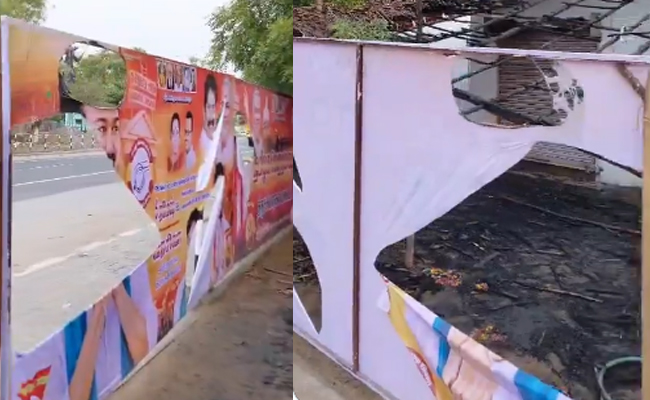
Tiruchirapalli (PTI): A campaign office of the actor Vijay-led TVK was allegedly torched by unidentified miscreants in Kamanayakkanpalayam village near Srirangam in the early hours of Friday, police said.
According to the police, the damage is minimal. Fire had engulfed the thatched roof providing shade at the entrance of the building that served as the party’s election office for the Srirangam constituency.
While on social media, a CCTV footage of two unidentified men fleeing on motorbike is being circulated as the culprits, police said the video footage is yet to be verified.
Based on a complaint lodged by TVK, the Pettaivaithalai Police have registered a case and initiated a search for the perpetrators.
திருவரங்கம் தொகுதியில் த.வெ.க வேட்பாளரின் தேர்தல் அலுவலகம் மர்ம நபர்களால் தீவைக்கப்பட்டு சேதப்படுத்தப்பட்டுள்ளது. @TNelectionsCEO @ECISVEEP#TVKVijay #தமிழகவெற்றிக்கழகம் pic.twitter.com/ImDZfTkuAq
— Thanjavur_District_Head (TVK) (@TVK_Thanjai) May 1, 2026