Everything you need to know about Zohran Mamdani’s Indian-origin parents
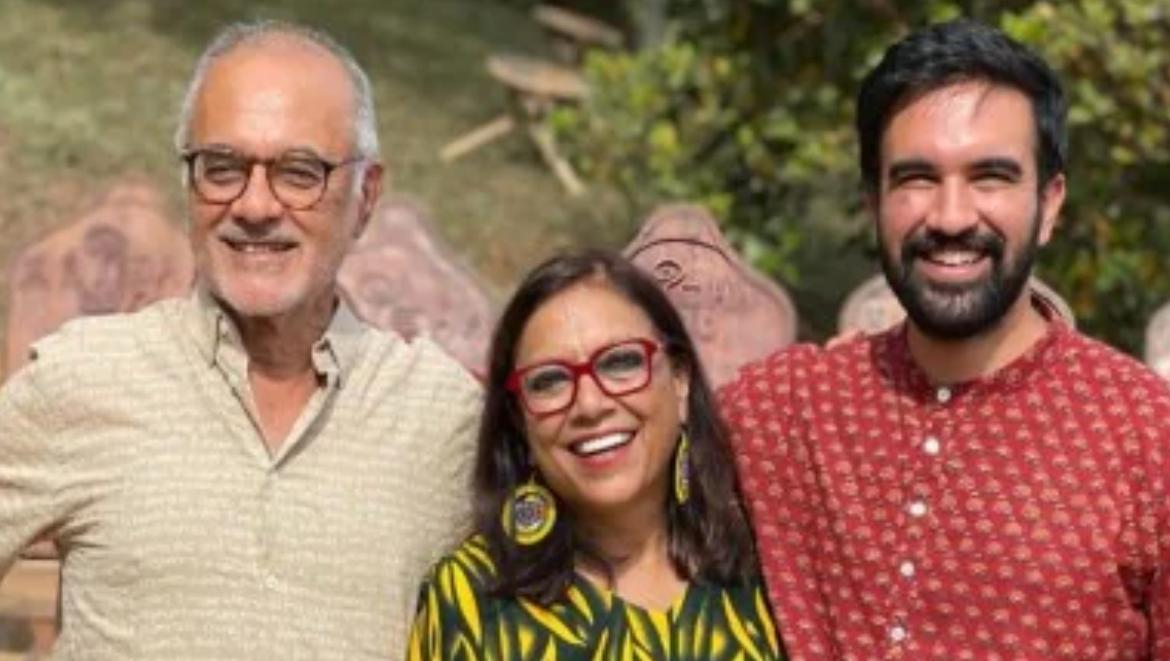
New York City — Newly elected Mayor Zohran Mamdani often credits his political beliefs and worldview to his parents — celebrated academic Mahmood Mamdani and acclaimed filmmaker Mira Nair. Their influence, rooted in activism, art, and academia, shaped his progressive vision long before he entered public life.
Born in 1991 in Kampala, Uganda, Zohran Mamdani grew up surrounded by social consciousness and storytelling. His father, Mahmood, was then a professor at Makerere University, while Mira Nair had already gained international attention for her 1988 directorial debut Salaam Bombay! — a film that earned her an Academy Award nomination for Best Foreign Language Film.
The couple met in Uganda in the late 1980s, united by a shared passion for social justice and cultural expression. Their only child, Zohran, spent his early years in Uganda and South Africa, where Mahmood served as the director of the African Studies Center at the University of Cape Town.
When Zohran was seven, Mahmood joined Columbia University in New York in 1999, prompting the family to move to the city that would later elect their son as mayor. They settled on the Upper West Side in a Columbia-subsidized apartment, while Mira also owned a condo in Chelsea.
Mamdani has often acknowledged the comfort of his upbringing. “I never had to want for something, and yet I knew that was not in any way the reality for most New Yorkers,” he told The New York Times in June 2025.
His childhood, however, was not insulated from activism. In an interview with City & State in April 2023, he recalled spending weekends at marches and protests alongside his parents. “When you’re the kid of two parents who are very involved in social justice, a lot of times what you remember as a playdate was you being at some rally or some march,” he said.
Those experiences — from protests against the Iraq War to Marxist lectures exposed him early to politics and grassroots movements. They also helped lay the foundation for his later identification as a democratic socialist.
Mira Nair, a Harvard graduate and one of India’s most internationally celebrated filmmakers, built a career telling South Asian and immigrant stories that challenged stereotypes and amplified unheard voices. Her notable films — Mississippi Masala (1991), Monsoon Wedding (2001), The Namesake (2006), and The Reluctant Fundamentalist (2012) — deeply influenced Zohran’s understanding of race, identity, and inequality.
Nair once recalled that actor Denzel Washington held baby Zohran at a red-carpet event for Mississippi Masala. Years later, her son would contribute musically to her 2016 film Queen of Katwe, producing its soundtrack and rapping under the name Young Cardamom.
“It’s truly a wild thing when your mother happens to be one of your favorite filmmakers,” Zohran said in City & State. “She has this mantra — if we don’t tell our own stories, no one else will.”
On Mother’s Day 2024, he described Nair in an Instagram post as his “dearest and darling Mama,” saying she “taught me to love mischief... taught me no box is big enough to accept… who taught me so much.”
Professor Mahmood Mamdani, a leading scholar of postcolonial and African studies, has spent most of his career at Columbia University, where he teaches international affairs, anthropology, and government. A Harvard Ph.D. graduate, he previously taught at the University of Dar-es-Salaam in Tanzania, Makerere University in Uganda, and the University of Cape Town in South Africa.
His writings on colonialism, genocide, and political identity have influenced generations of students and activists. Known for his unapologetic advocacy for Palestinian rights, he has faced criticism and accusations of anti-Semitism, which he has consistently denied.
Zohran, who shares many of his father’s views, has often expressed solidarity with the Palestinian cause. His critics have used that stance to portray him as radical, while his supporters see it as proof of moral conviction.
Mira Nair has frequently said her work reflects her family’s experiences and the social realities they witnessed together. Her film Mississippi Masala, a story of interracial love between an Indian woman and an African American man in Mississippi, was partly inspired by her relationship with Mahmood.
In a 2025 interview with The Hollywood Reporter, Nair said the film “holds a mirror up to people and what they might think.” Another of her works, The Reluctant Fundamentalist (2012), about a Pakistani man confronting suspicion in post-9/11 America, was born from the family’s own experiences after moving to New York just two years before the attacks.
“Suddenly this home and amazing place didn’t feel like home anymore,” Nair said. Zohran, then in college, urged her to tell that story. “He was my oxygen, my fuel,” she said.
Both Mahmood and Mira have said they did not advise Zohran on his political decisions. Yet their influence is evident in his worldview and campaign messaging.
“One thing that my parents have taught me, among many, is the necessity of addressing what is actually happening as opposed to pretending that it’s not,” Zohran told Bon Appétit in June 2025. “In politics, there is such an incentive to create an alternative world as opposed to the one that people are living through.”
He added that his campaign was built on “a politics of no translation a politics that is direct.” Mamdani has often said that his upbringing privileged, global, and rooted in immigrant experience drives his desire to make New York fairer for everyone.
“I have always been honest as to how I have grown up and the ways in which my parents’ successes in academia and film allowed me to have a childhood that every New Yorker should have,” he told The New York Times. “I am committed to ensuring this is a city for each and every New Yorker, not just one that serves the few that it’s serving today.”
Now, as the son of two of the world’s most respected thinkers takes charge of one of its greatest cities, Zohran Mamdani’s story comes full circle from a childhood in activism and art to the political stage his parents once only marched upon.
Let the Truth be known. If you read VB and like VB, please be a VB Supporter and Help us deliver the Truth to one and all.
4 workers die after being buried under coal slurry in Jharkhand's Dhanbad

Dhanbad (Jharkhand) (PTI): At least four workers died after being buried under coal slurry in Jharkhand's Dhanbad district on Saturday, a police official said.
The incident took place at Moonidih coal washery in the command area of Bharat Coking Coal Limited (BCCL).
"Bodies of all four workers were dug out of debris during a rescue operation," Putki police station in-charge Waqar Hussain told PTI.
The incident took place when coal slurry was being loaded into trucks by workers, during which a large chunk of slurry fell and trapped several workers underneath, officials said.
The deceased have been identified as Manik Bauri, Dinesh Bauri, Deepak Bauri, and Hemlal Gope.
Meanwhile, the family members of the deceased and local villagers placed the bodies in front of the washery gate and began a protest.
They demanded compensation, jobs for dependents and action against those responsible for the incident.
Police and administration officials are trying to pacify the protesters, an official said.