Ex-central banker Mark Carney wins race to replace Trudeau as Canada's prime minister
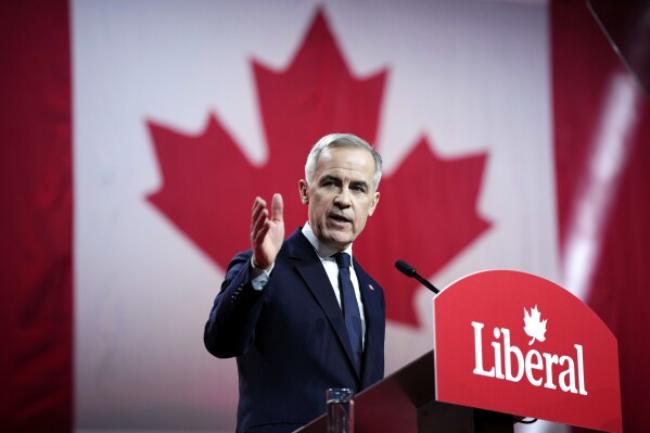
Toronto (AP): Former central banker Mark Carney will become Canada's next prime minister after the governing Liberal Party elected him its leader Sunday as the country deals with US President Donald Trump's trade war and annexation threat, and a federal election looms.
Carney, 59, replaces Prime Minister Justin Trudeau, who announced his resignation in January but remains prime minister until his successor is sworn in in the coming days. Carney won in a landslide, winning 85.9 per cent of the vote.
"There is someone who is trying to weaken our economy,” Carney said.
"Donald Trump, as we know, has put unjustified tariffs on what we build, on what we sell and how we make a living. He's attacking Canadian families, workers and businesses and we cannot let him succeed and we won't."
Carney said Canada will keep retaliatory tariffs in place until “the Americans show us respect.”
“We didn't ask for this fight. But Canadians are always ready when someone else drops the gloves,” Carney said. “The Americans, they should make no mistake, in trade, as in hockey, Canada will win."
Carney navigated crises when he was the head of the Bank of Canada and when in 2013 he became the first noncitizen to run the Bank of England since it was founded in 1694. His appointment won bipartisan praise in the U.K. after Canada recovered from the 2008 financial crisis faster than many other countries.
The opposition Conservatives hoped to make the election about Trudeau, whose popularity declined as food and housing prices rose and immigration surged.
Trump's trade war and his talk of making Canada the 51st U.S. state have infuriated Canadians, who are booing the American anthem at NHL and NBA games. Some are canceling trips south of the border, and many are avoiding buying American goods when they can.
The surge in Canadian nationalism has bolstered the Liberal Party's chances in a parliamentary election expected within days or weeks, and Liberal showings have been improving steadily in opinion polls.
“The Americans want our resources, our water, our land, our country. Think about it. If they succeed they would destroy our way of life,” Carney said. “In America health care is big business. In Canada it is a right.”
Carney said America is “a melting pot. Canada is mosaic," he said. “America is not Canada. And Canada will never, ever will be a part of America in any way, shape or form."
After decades of bilateral stability, the vote on Canada's next leader now is expected to focus on who is best equipped to deal with the United States.
“These are dark days, dark days brought on by a country we can no longer trust,” Carney said. “We are getting over the shock but let us never forget the lessons. We have to look after ourselves and we have to look out for each other. We need to pull together in the tough days ahead.”
Trump has postponed 25% tariffs on many goods from Canada and Mexico for a month, amid widespread fears of a broader trade war. But he has threatened other tariffs on steel, aluminum, dairy and other products.
Carney picked up one endorsement after another from Cabinet ministers and members of Parliament since declaring his candidacy in January. He is a highly educated economist with Wall Street experience who has long been interested in entering politics and becoming prime minister, but he lacks political experience.
In 2020, he began serving as the United Nations' special envoy for climate action and finance.
Carney is a former Goldman Sachs executive. He worked for 13 years in London, Tokyo, New York and Toronto, before being appointed deputy governor of the Bank of Canada in 2003.
The other top Liberal leadership candidate was former Deputy Prime Minister Chrystia Freeland, who received just eight percent of the vote. Trudeau told Freeland in December that he no longer wanted her as finance minister, but that she could remain deputy prime minister and the point person for U.S.-Canada relations. Freeland resigned shortly after, releasing a scathing letter about the government that proved to be the last straw for Trudeau.
Carney is expected to trigger an election shortly. Either he will call one, or the opposition parties in Parliament could force one with a no-confidence vote later this month.
Trudeau urged Liberals supporters to get involved.
“This is a nation-defining moment. Democracy is not a given. Freedom is not a given. Even Canada is not a given,” Trudeau said.
Let the Truth be known. If you read VB and like VB, please be a VB Supporter and Help us deliver the Truth to one and all.
Maharashtra sets up state vaccination task force to strengthen immunisation programme

Mumbai (PTI): The Maharashtra government has set up a State Vaccination Task Force to strengthen the regular immunisation programme and review the progress of related campaigns, a health department official said on Monday.
The State Vaccination Task Force will comprise at least 29 members and will be headed by the administrative head of the health department, he informed.
The government has also constituted separate district-level and municipal vaccination task forces to improve implementation and address challenges at the grassroots level, he said.
Municipal task forces, chaired by respective civic commissioners, have been constituted in view of the vast urban population in Maharashtra and the role of civic bodies in implementing different health programmes.
The district-level task forces will function under the chairmanship of collectors.
"Complete immunisation of children at the appropriate age is an extremely simple, cost-effective and highly effective measure to reduce child mortality and the prevalence of diseases among kids. Immunisation is a powerful tool for reducing illness in children," maintained the official.
To ensure full vaccination of all children, the state government implements various campaigns from time to time as per the central government guidelines, he pointed out.
"Active participation and cooperation of other relevant government departments are essential (in making these campaigns successful)," according to the official.
The state-level body will review the regular immunisation programme, associated campaigns and vaccine-preventable diseases in detail. It will also conduct focused assessments of high-risk districts and municipal corporations, including vacancies at district, municipal and sub-district levels, availability of cold chain equipment, resource gaps and training requirements, he noted.
The state task force will review allocation and utilisation of funds for immunisation and ensure timely action by officers concerned based on reports from district and municipal task forces and state-level monitoring mechanisms, the official said.
It will also ensure active coordination and participation of other government departments in immunisation drives, while district and municipal task forces will carry out similar functions at their respective levels, the official added.