Facebook profits rise amid revelations from leaked documents

Menlo Park (AP): Amid fallout from the Facebook Papers documents supporting claims that the social network has valued financial success over user safety, Facebook on Monday reported higher profit for the latest quarter.
The company's latest show of financial strength followed an avalanche of reports on the Facebook Papers a vast trove of redacted internal documents obtained by a consortium of news organisations, including The Associated Press as well as Facebook whistleblower Frances Haugen's Monday testimony to British lawmakers.
Facebook said its net income grew 17 per cent in the July-September period to USD 9.19 billion, buoyed by strong advertising revenue.
That's up from USD 7.85 billion a year earlier. Revenue grew 35 per cent to USD 29.01 billion. The results exceeded analyst expectations for Facebook's results.
The company's shares rose 2.5 per cent in after-hours trading after closing up 1 per cent for the day.
For now, the revenue picture for Facebook looks as good as can be expected, said eMarketer analyst Debra Aho Williamson. But she predicted more revelations and described the findings so far as unsettling and stomach-churning.
CEO Mark Zuckerberg made only a brief mention of what he called the recent debate around our company."
Largely repeating statements he made after Haugen's October 5 testimony before a US Senate subcommittee, he insisted that he welcomes good faith criticism but considers the current storm a coordinated effort by news organisations to criticise the company based on leaked documents.
Haugen, meanwhile, told a British parliamentary committee Monday that the social media giant stokes online hate and extremism, fails to protect children from harmful content and lacks any incentive to fix the problems, providing momentum for efforts by European governments working on stricter regulation of tech companies.
While her testimony echoed much of what she told the US Senate this month, her in-person appearance drew intense interest from a British parliamentary committee that is much further along in drawing up legislation to rein in the power of social media companies.
Haugen told the committee of United Kingdom lawmakers that Facebook Groups amplifies online hate, saying algorithms that prioritize engagement take people with mainstream interests and push them to the extremes.
The former Facebook data scientist said the company could add moderators to prevent groups over a certain size from being used to spread extremist views.
Unquestionably, it's making hate worse, she said.
Haugen said she was shocked to hear recently that Facebook wants to double down on the metaverse and that they're gonna hire 10,000 engineers in Europe to work on the metaverse, Haugen said, referring to the company's plans for an immersive online world it believes will be the next big internet trend.
I was like, Wow, do you know what we could have done with safety if we had 10,000 more engineers?' she said.
Facebook says it wants regulation for tech companies and was glad the UK was leading the way.
While we have rules against harmful content and publish regular transparency reports, we agree we need regulation for the whole industry so that businesses like ours aren't making these decisions on our own," Facebook said Monday.
It pointed to investing USD 13 billion (9.4 billion pounds) on safety and security since 2016 and asserted that it's almost halved the amount of hate speech over the last three quarters.
Haugen accused Facebook-owned Instagram of failing to keep children under 13 the minimum user age from opening accounts, saying it wasn't doing enough to protect kids from content that, for example, makes them feel bad about their bodies.
Facebook's own research describes it as an addict's narrative. Kids say, This makes me unhappy, I feel like I don't have the ability to control my usage of it, and I feel like if I left, I'd be ostracised, she said.
The company last month delayed plans for a kids' version of Instagram, geared toward those under 13, to address concerns about the vulnerability of younger users.
Haugen said she worried it may not be possible to make Instagram safe for a 14-year-old and that I sincerely doubt it's possible to make it safe for a 10-year-old.
She also said Facebook's moderation systems are worse at catching content in languages other than English, and that's a problem even in the UK because it's a diverse country.
Those people are also living in the UK and being fed misinformation that is dangerous, that radicalizes people, Haugen said.
And so language-based coverage is not just a good-for-individuals thing, it's a national security issue.
Pressed on whether she believes Facebook is fundamentally evil, Haugen demurred and said, I can't see into the hearts of men. Facebook is not evil, but negligent, she suggested.
It believes in a world of flatness, and it won't accept the consequences of its actions, pointing to its mammoth one-level, open-plan corporate office as an embodiment of the philosophy.
It was Haugen's second appearance before lawmakers after she testified in the US about the danger she says the company poses, from harming children to inciting political violence and fueling misinformation. Haugen cited internal research documents she secretly copied before leaving her job in Facebook's civic integrity unit.
The documents, which Haugen provided to the US Securities and Exchange Commission, allege Facebook prioritised profits over safety and hid its own research from investors and the public.
Some stories based on the files have already been published, exposing internal turmoil after Facebook was blindsided by the January 6 US Capitol riot and how it dithered over curbing divisive content in India. More is to come.
Representatives from Facebook and other social media companies plan to speak to the British committee Thursday.
UK lawmakers are drafting an online safety bill calling for setting up a regulator that would hold companies to account when it comes to removing harmful or illegal content from their platforms, such as terrorist material or child sex abuse images.
Haugen is scheduled to meet next month with European Union officials in Brussels, where the bloc's executive commission is updating its digital rulebook to better protect internet users by holding online companies more responsible for illegal or dangerous content.
Under the UK rules, expected to take effect next year, Silicon Valley giants face an ultimate penalty of up to 10 per cent of their global revenue for any violations. The EU is proposing a similar penalty.
Let the Truth be known. If you read VB and like VB, please be a VB Supporter and Help us deliver the Truth to one and all.
Focus on Vijay's poll promises; TVK assured 8 gm gold for women
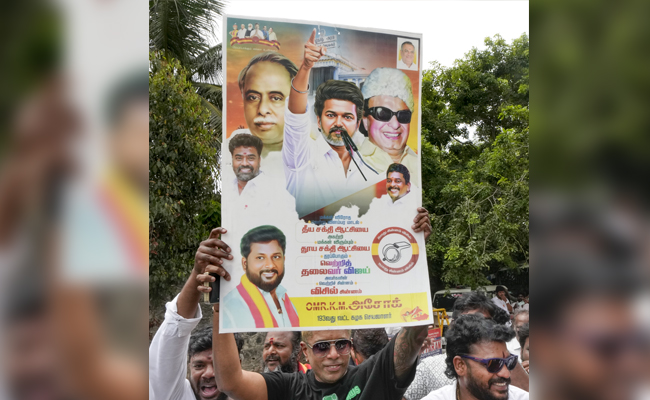
Chennai (PTI): As the new-entrant TVK appears likely to emerge as the single largest party and form the government, the focus has now turned into actor-politician Vijay's poll promises, including 8 gm gold for marriage, which is worth about Rs 14,000 per gram (22 carat).
Vijay's assurances in the party manifesto include Rs 2,500 monthly assistance for women below 60 years, 8 gm gold for marriage and six free cooking gas cylinders a year, per family.
By 3 PM, as per EC data, Vijay's party is leading in 105 constituencies and it falls short of a simple majority (118) in the Assembly.
The actor-turned-politician also assured a quality silk saree in addition to gold for indigent brides and interest-free loans up to Rs 5 lakh for women-run SHGs. He assured corruption-free good governance if voted to power in his maiden electoral fight.
The manifesto also laid importance on education. To prevent school dropouts, mothers or guardians of children studying in government and state-aided schools will receive Rs 15,000 annually.
Vijay promised 100 special residential schools named after iconic leader K Kamaraj, credited with revolutionising education in the state, and higher education loans of up to Rs 20 lakh. The TVK founder also assured AI Ministry, AI University and AI City.
The manifesto placed a strong emphasis on agrarian welfare, too.
The party promised a full waiver of agricultural cooperative crop loans for farmers owning less than five acres of land, while those holding more than five acres will receive a 50 per cent waiver. Additionally, the party promised a Minimum Support Price (MSP) of Rs 3,500 per quintal for paddy and Rs 4,500 per tonne for sugarcane.
Addressing youth unemployment, Vijay pledged to create five lakh new government jobs and offer as many stipendiary internships. Unemployed graduates will be provided a monthly aid of up to Rs 4,000. For government employees, the party assured consideration of the Old Pension Scheme and the regularisation of contract workers, including nurses.
On the health front, he promised a drug-free Tamil Nadu. Vijay also committed to modernising hospitals, providing free annual health checkups, and introducing a Rs 25 lakh family health insurance scheme.
The manifesto also included a Rs 3,000 monthly pension for the elderly and the differently-abled, 200 units of free power, patta (land deed) regularisation, and 100 per cent piped drinking water supply for all households.
Some of the policy intereventions promised by TVK include a legal guarantee to provide essential government services like community certificates, and land pattas, within a strictly specified timeframe.
Vijay also promised doorstep delivery of governance by implementing a system to deliver services, such as ration supplies, directly to the people. He also assured that ease of doing business will be paramount to his government and promised a strict guarantee that business licences will be issued within 21 days.
Elections to 234 Assembly seats in Tamil Nadu were held on April 23.