Fire breaks out at South African Parliament in Cape Town
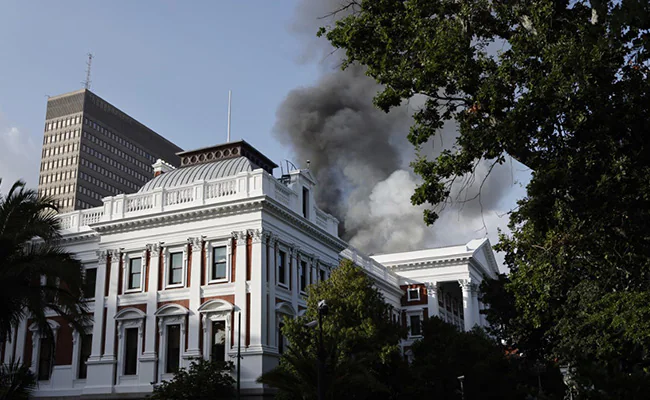
Cape Town, Jan 2: Firefighters battled a major blaze at South Africa's Parliament complex on Sunday that sent a dark plume of smoke and flames into the air above the centre of Cape Town and caused some ceilings of the building that houses the national legislature to collapse.
The fire started on the third floor of an old building that houses offices and spread to the National Assembly building, where South Africa's Parliament now sits, Minister of Public Works and Infrastructure Patricia de Lille said.
The fire is currently in the National Assembly chambers, De Lille told reporters at the scene.
This is a very sad day for democracy for Parliament is the home of our democracy.
City of Cape Town Fire and Rescue Service spokesman Jermaine Carelse said no injuries were reported.
Parliament was closed for the holidays.
Security guards first reported the fire at around 6 am, Carelse said, and 35 firefighters were on the scene.
Some of them were lifted into the Cape Town skyline on a crane to spray water on the blaze from above.
They were still fighting the fire more than six hours later.
South African President Cyril Ramaphosa was briefed on the fire, De Lille said, but it was too early to speculate on a cause. She said authorities were reviewing video camera footage.
The deputy minister of state security was also at the Parliament complex. Parliament speaker Nosiviwe Mapisa-Nqakula cautioned against speculation that it was a deliberate attack.
"Until such a time that a report has been furnished that there was arson, we have to be careful not to make suggestions that there was an attack, she said.
President Ramaphosa and many of South Africa's high-ranking politicians were in Cape Town for the funeral service of Archbishop Desmond Tutu, which took place on Saturday at the city's St. George's Cathedral, about a block away from the Parliament precinct.
The precinct has three main sections, the original Parliament building completed in the late 1800s and two newer parts built in the 20th century.
The fire initially was concentrated at the old Parliament building, which is located behind the National Assembly, De Lille told reporters in front of the Parliament complex gates.
During that briefing, she said firefighters have the situation under control," but the fire spread soon after and tore through the current Parliament building.
Authorities feared that other parts of the buildings in the precinct might collapse because of the heat while historical artefacts inside were likely to be damaged or destroyed.
The top part of the bright white National Assembly building had been burned black as smoke billowed out its roof.
The bitumen on the roof is even melting, an indication of the intense heat. There have been reports of some walls showing cracks, which could indicate a collapse, News24 website quoted Carelse as saying.
Police cordoned off the complex and closed roads.
Some of the blocked-off areas were near where people had left flowers and other tributes to Tutu.
A huge wildfire on the slopes Cape Town's famed Table Mountain last year spread to buildings below and destroyed part of a historic library at the University of Cape Town.
#BREAKING: Firefighters are battling a large fire that has ripped through the Houses of Parliament in Cape Town, South Africa
— Stefan Simanowitz (@StefSimanowitz) January 2, 2022
"There have been reports of some walls showing cracks, which could indicate a collapse” Jermaine Carelse, of CT fire servicepic.twitter.com/LZTNH0Dzmu
😱😱😱😱 South Africa Parliament is burning, what's happening? pic.twitter.com/zofBCsOoCR
— Judaeda Blanco (@Judaeda3) January 2, 2022
Let the Truth be known. If you read VB and like VB, please be a VB Supporter and Help us deliver the Truth to one and all.
Vartha Bharati–Sankalp predictions align closely with Karnataka bypoll results

Bengaluru: The Vartha Bharati–Sankalp election analysis has shown a high level of accuracy in predicting the outcome of the recent Karnataka Assembly by-elections held in May 2026, correctly calling winners in both constituencies and closely estimating vote share trends.
The by-elections were held in Bagalkot and Davanagere South, drawing significant political attention as both seats were seen as key tests for the ruling Congress and opposition BJP.
According to the analysis, Vartha Bharati–Sankalp had made three major projections ahead of the results the winning party, vote share percentages, and margin of victory.
In both constituencies, the platform accurately predicted that the Congress would emerge victorious. The outcome matched the projections, with Congress candidates winning in Bagalkot and Davanagere South.
In terms of vote share, the predictions were largely in line with the final results. In Bagalkot, the BJP’s vote share was forecast in the range of 40 to 46 per cent, while the actual figure stood at 42.9 per cent. The Congress vote share, however, exceeded expectations, with the party securing 55.4 per cent against a projected range of 43 to 48 per cent.
The margin of victory in Bagalkot turned out to be significantly higher than anticipated. While the projection had placed the margin between 2,000 and 3,500 votes, the final margin was around 22,332 votes.
In Davanagere South, the predictions also remained largely accurate. The Congress vote share was projected between 43 and 51 per cent, and the final figure stood at 43.9 per cent. The BJP was expected to secure between 42 and 50 per cent but ended with 40.3 per cent.
The analysis had also identified the role of SDPI as a potential spoiler in the constituency. While its vote share was estimated around 6 per cent, the party eventually secured around 12 per cent of the vote.
The margin of victory in Davanagere South was predicted to be between 1,500 and 2,600 votes. The actual margin was higher at around 5,708 votes, though the contest remained relatively close as anticipated.
Overall, the performance of Vartha Bharati–Sankalp stood out for correctly identifying the winning parties in both seats and maintaining close accuracy in vote share estimates, with only limited deviations in specific cases.