Fireworks, ammonium nitrate likely fuelled Beirut explosion
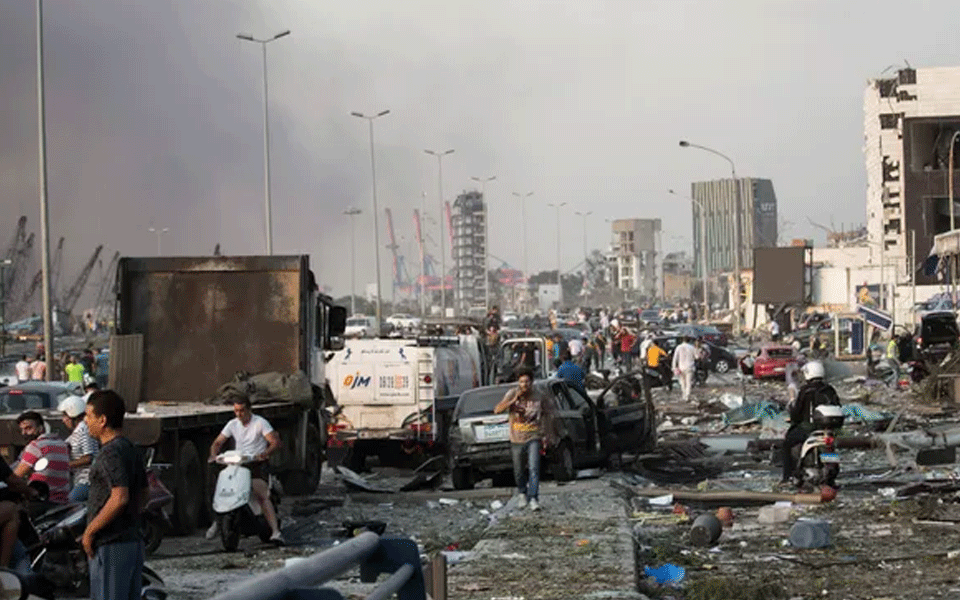
Beirut: Fireworks and ammonium nitrate appear to have been the fuel that ignited a massive explosion that rocked the Lebanese capital of Beirut, experts and videos of the blast suggest.
The scale of the damage from the epicentre of the explosion at the port of Beirut to the windows blown out kilometres (miles) away resembles other blasts involving the chemical compound commonly used as an agricultural fertilizer.
But the compound itself typically doesn't detonate on its own and requires another ignition source. That likely came from a fire that engulfed what initially appeared to be fireworks that were stored at the port.
Online videos of the disaster's initial moments show sparks and lights inside the smoke rising from the blaze, just prior to the massive blast.
That likely indicates that fireworks were involved, said Boaz Hayoun, owner of the Tamar Group, an Israeli firm that works closely with the Israeli government on safety and certification issues involving explosives.
Before the big explosion, you can see in the centre of the fire, you can see sparks, you can hear sounds like popcorn and you can hear whistles," Hayoun told The Associated Press.
"This is very specific behaviour of fireworks, the visuals, the sounds and the transformation from a slow burn to a massive explosion. Jeffrey Lewis, a missile expert at the Middlebury Institute of International Studies in Monterey, California, offered a similar assessment.
It looks like an accident, Lewis told the AP.First, there was a fire preceding the explosion, which is not an attack. And some of the videos show munitions what I could call popcorning, exploding like 'pop, pop, pop, pop.' He added that it's very common to see fires detonate explosives."
If you have a fire raging next to something explosive, and you don't put it out, it blows up," he said.
The white cloud that accompanied the massive blast appeared to be a condensation cloud, often common in massive explosions in humid conditions that can follow the shock waves of an explosion, Lewis said.Orange clouds also followed the blast, likely from toxic nitrogen dioxide gas that's released after an explosion involving nitrates.
Experts typically determine the power of the blast by measuring the crater left behind, which appeared massive in aerial footage shot on Wednesday morning by the AP.
The Beirut blast, based on the crater and glass windows being blown out a distance away, exploded with the force equivalent to detonating at least 2.2 kilotons of TNT, said Sim Tack, an analyst and weapons expert at the Texas-based private intelligence firm Stratfor.
What initially started the fire at the port remains unclear. Beirut was sunny before Tuesday's explosion, with a daily high of 30 degrees Celsius (86 degrees Fahrenheit).
Lebanese Interior Minister Mohammed Fahmi, in comments to a local TV station, made no mention of ignited fireworks but said it appeared the blast was caused by the detonation of more than 2,700 tons of ammonium nitrate that had been stored in a warehouse at the dock ever since it was confiscated from a cargo ship in 2014.That amount could cause the explosive force seen in the blast Tuesday, Tack said.
Based on the timeline and the size of the cargo, that ship could be the MV Rhosus. The ship was initially seized in Beirut in 2013 when it entered the port due to technical problems, according to lawyers involved in the case. It came from the nation of Georgia, and had been bound for Mozambique.
Let the Truth be known. If you read VB and like VB, please be a VB Supporter and Help us deliver the Truth to one and all.
Zubeen Garg's drowning in Singapore highlights vessel operators' responsibility: legal experts

Singapore (PTI): The drowning of Indian singer-composer Zubeen Garg has brought the spotlight on rules and regulations that concern responsibilities of vessel operators when dealing with intoxicated passengers, according to a media report that cited legal experts.
A cultural icon in India’s northeastern region, 52-year-old Garg travelled to Singapore in September 2025 to perform at a live event. A day before his performance, he went on a yacht trip with a group of people. He drowned while swimming in the sea near Lazarus Island, which is a popular diving spot.
His death shook his home state Assam, where millions came out on the streets mourning. Later, police cases were registered against the organiser of the event, his manager and some others.
Nico Lee, managing director of the Triangle Legal law firm, told The Straits Times that Singapore has Maritime and Port Authority of Singapore (Port) Regulations under which there are provisions to debar drunk passengers.
The owner, agent or captain of the vessel must not allow persons under the influence of alcohol or drugs onboard if they are intoxicated to a point where they endanger safety of the vessel, its crew or any person in it.
“In terms of civil liability, it could be argued that a yacht captain is negligent, as he owes a prima facie duty of care to guests on board under general negligence principles,” Lee was quoted as saying by the newspaper.
The singer and his entourage of about 15 individuals were partying on a chartered vessel, which they had boarded at Marina at Keppel Bay.
A death certificate issued by the Singapore General Hospital listed his cause of death as drowning.
An autopsy report suggested that Garg had 333 mg of alcohol per 100 ml of blood in his system, which was four times the legal limit for driving in Singapore and is likely to have impacted his coordination.
Citing Garg’s case, Lee said the circumstances were serious, as the controller of the vessel knew that the guest was intoxicated. Also, he may not have understood or processed a safety briefing for all passengers.
“That combination makes reliance on an ordinary briefing inadequate. If intoxication reaches a level that endangers the safety of the vessel or persons on board, the person in charge should not permit boarding at all,” he said.
According to Lee, the vessel’s operators could also have assigned a crew member to directly supervise him or ensure that he received a one-to-one explanation when he was capable of understanding.
Part of the responsibility could be attributed to the guest if he chose to enter the water and ignore instructions or behave dangerously despite the yacht owner or charterer’s best efforts, Lee said.
Vanessa Sandhu from Clifford Law LLP told The Straits Times that a key question is whether the yacht captain or operator owed a “duty of care” to the passenger and, if so, whether a breach of that duty caused the death.
“A yacht captain and operator generally owe passengers a duty to take reasonable care for their safety while on board, including swimming or water activities. This may include providing safety equipment and issuing appropriate safety instructions,” the daily quoted Sandhu as saying.
“However, the standard of care is an objective one, based on what a reasonable captain or operator would have done in the circumstances. It is not an absolute obligation to prevent all harm,” she said.
During the coroner’s inquiry, the operators of the vessel had said that no one had forced the singer to consume alcohol or enter the water, and that the entire entourage was informed on the yacht about the necessity of wearing life jackets before going for a swim.
A coroner’s inquiry on March 25 ruled Garg’s death as accidental drowning. On April 1, the police said that investigations into the singer's death had concluded, with no evidence of foul play.
However, in Assam, where seven persons were arrested in connection with Garg’s case, and some of them charged with murder, the matter is being heard in the court. All the suspects have denied any wrongdoing.