First round of ballots to be cast in UK PM race as Rishi Sunak holds on to lead
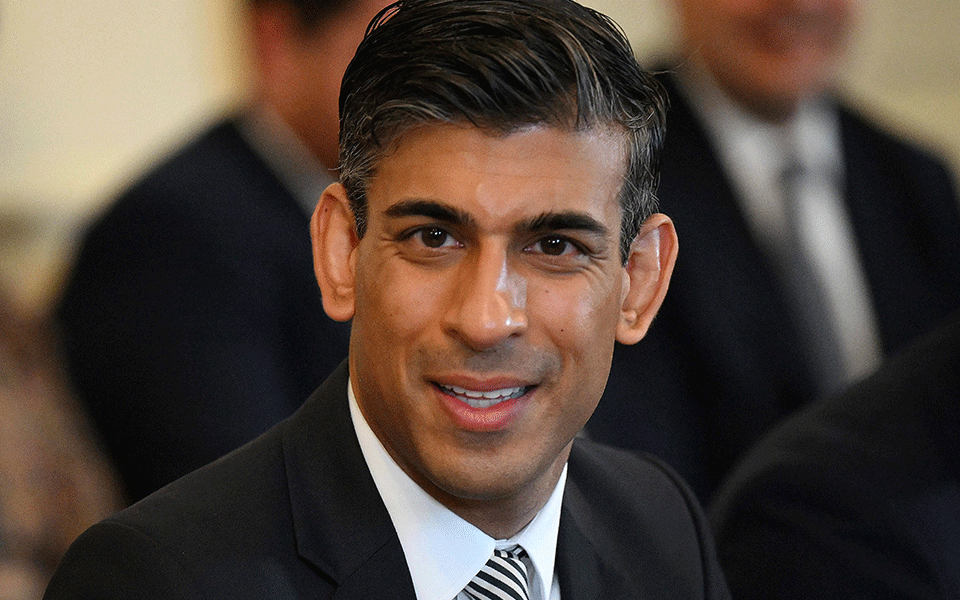
London(PTI): The first round of ballots will be cast on Wednesday in the race to elect a new Conservative Party leader who will succeed Boris Johnson as UK Prime Minister, with British Indian former finance minister Rishi Sunak holding on to his lead.
A shortlist of eight candidates on the first ballot paper includes Attorney General Suella Braverman, Foreign Secretary Liz Truss, Chancellor Nadhim Zahawi, Trade Minister Penny Mordaunt, former Cabinet ministers Kemi Badenoch and Jeremy Hunt and Tory backbencher Tom Tugendhat.
Each of the eight went head-to-head in the first closed-door hustings before fellow Conservative Party MPs to pitch for their support in speeches of 12 minutes each on Tuesday evening after nominations for the race closed.
The 358 Tory members of Parliament will cast the first set of votes for their favourites and the shortlisted candidates will progress to the next round only if they receive the backing of at least 30 of their colleagues. If all eight hit that figure, the candidate with the least votes will be eliminated from the second round of secret ballots scheduled for Thursday.
In an interview with The Daily Telegraph', Sunak said tackling inflation is his "number one economic priority", and claimed former Prime Minister Margaret Thatcher, an icon on the right of the Tory party, would have backed his approach.
I do believe I'm best placed to restore trust, rebuild the economy and reunite the country. I believe I can appeal in the broadest range of places, said the former Chancellor, whose Ready4Rishi campaign theme is made up of 3 Rs Restore Trust; Rebuild the Economy; Reunite the country.
I was brought up to believe that hard work was everything and it's core to who I am. It's what makes me a Conservative that I believe in the nobility of work, he said.
Even in the initial stages, the leadership race has become mired in allegations of dirty tricks with a so-called stop Rishi group of Johnson loyalists throwing their weight behind Liz Truss and accusing the Sunak camp of trying to fix the process.
Team Rishi want the candidate they know they can definitely beat in the final two and that is Jeremy Hunt, tweeted Culture Secretary Nadine Dorries, who is backing Truss.
The issue of tax for the low-tax favouring Tories has also been dominating the headlines, with another Johnson loyalist branding Sunak as a tax-hiking Chancellor.
"I think as a Chancellor he made decisions that were of the left rather than of the right. He was a tax-increasing Chancellor and I didn't support the decisions he made, said Cabinet minister Jacob Rees-Mogg, another Tory heavyweight backing Truss.
While Sunak and Truss seem the current frontrunners, Penny Mordaunt has strong support among the Conservative Party grassroots. The race will narrow down quickly after successive ballots knock out the candidates with the least support by next week.
Under the timetable set by the 1922 Committee of Tory backbenchers, the deadline to whittle down the shortlist to just two remaining candidates is July 21. The process will then be taken over by the Conservative Party headquarters to organise a series of hustings in different parts of the UK for the contenders to pitch their campaign pledges to the estimated 200,000 Conservative Party membership.
The candidate who receives the most votes will be elected the new Conservative Party leader and go on to take charge as the British Prime Minister.
It is expected that the new Tory leader will be announced on September 5 and go on to address his or her first Prime Minister's Questions (PMQs) in the House of Commons on September 7.
Let the Truth be known. If you read VB and like VB, please be a VB Supporter and Help us deliver the Truth to one and all.
3 women die after giant tree falls on them in Odisha’s Koraput

Koraput (PTI): Three women died and another was injured after a giant tree fell on them following thunderstorms in Odisha’s Koraput district, police said on Tuesday.
The incident took place on Monday evening when they were in a market at Pedabayalu in Nandapur block near the Andhra-Odisha border.
The tree was uprooted due to strong winds amid rain and thunderstorms, a police officer said.
Two women died on the spot and another in hospital, he said.
Nandapur BDO Durga Prasad Dora and MLA Rama Chandra Kadam visited the spot, and assured the victims’ families of government support.