Former Israeli security officials call to end the war in Gaza as Netanyahu hints at new stage
Jerusalem, Aug 5 (AP): Former Israeli army and intelligence chiefs called for an end to the war in Gaza as Prime Minister Benjamin Netanyahu hinted at further military action and Israel's government plotted its next move in the devastated territory.
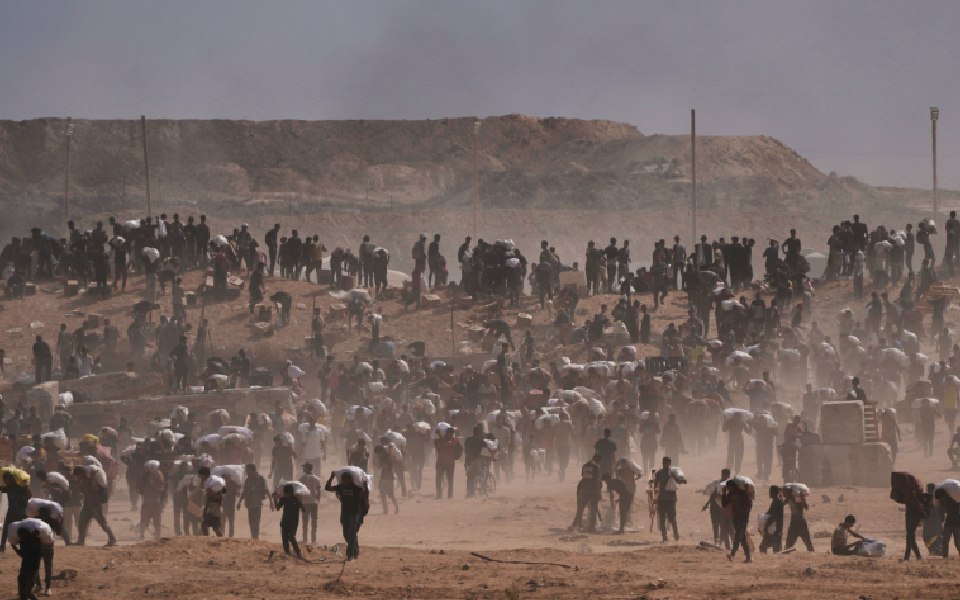
On the ground in Gaza, health officials reported new deaths Tuesday of Palestinians seeking food at distribution points. The Israeli defense body coordinating aid to Gaza announced a new deal with local merchants to improve aid deliveries as desperation mounts.
The former security officials speaking out included those who led Israel's Shin Bet internal security service, Mossad spy agency and the Israeli military. In a roughly three-minute video posted to social media this week, they demanded an end to the war and said the far-right members of the government are holding the country “hostage” in prolonging the conflict.
“This is leading the state of Israel to the loss of its security and its identity,” Ami Ayalon, former head of Shin Bet, said in the footage.
Yoram Cohen, former head of Shin Bet, called Netanyahu's objectives “a fantasy.”
“If anyone imagines that we can reach every terrorist and every pit and every weapon and in parallel bring our hostages home — I think it is impossible,” he said.
Next stage of the war
Netanyahu, meanwhile, announced Monday that he would convene his Security Cabinet in the coming days to direct the army on the next stage of the war, hinting that even tougher military action was an option in Gaza.
Netanyahu said he remained committed to achieving his war objectives, including defeating Hamas, releasing all hostages and ensuring Gaza never again threatens Israel.
Israeli media said the meeting was expected Tuesday, with disagreements between Netanyahu and the army chief, Lt Gen Eyal Zamir, on how to proceed.
The reports, citing anonymous officials in Netanyahu's office, said the prime minister was pushing the army, which already controls about three quarters of Gaza, to conquer the entire territory, a step that could endanger the hostages, deepen the humanitarian crisis in Gaza and further isolate Israel internationally.
Various reports have said Zamir opposes this step and could step down or be pushed out if it is approved.
Aid through local merchants
Several hundred Palestinians have been killed by Israeli fire since May while heading toward food distribution sites, airdropped parcels and aid convoys in the Gaza Strip, according to witnesses, local health officials and the United Nations human rights office.
The Israeli military says it only has fired warning shots and disputes the toll.
The Israeli defense body in charge of coordinating aid to Gaza, called COGAT, wrote on social platform X that there will be a “gradual and controlled renewal of the entry of goods through the private sector in Gaza.”
“This aims to increase the volume of aid entering the Gaza Strip, while reducing reliance on aid collection by the U.N. and international organisations,” it said Tuesday.
A limited number of local merchants were approved for the plan and will sell basic food products, baby food, fruits and vegetables and hygiene supplies through bank transfers, COGAT said.
Deaths while seeking aid
Local health officials said Israeli forces opened fire Tuesday morning toward Palestinians seeking desperately needed aid and in targeted attacks in the central and southern Gaza Strip, killing at least 25 people.
The Israeli military did not have an immediate comment.
The dead include 19 people who were killed in southern Gaza, 12 of them seeking aid near the Morag corridor and in Teina area, some 3 kilometres from the Israeli-backed Gaza Humanitarian Foundation hub east of Khan Younis, according to the Nasser hospital and the Ministry of Health.
The ministry doesn't distinguish between fighters and civilians and operates under the Hamas government. The UN and other international organizations see it as the most reliable source of data on casualties.
Elsewhere in central Gaza, Al-Awda hospital said it received the bodies of six Palestinians who were killed Tuesday after Israeli troops targeted crowds near an aid distribution site run by the GHF.
The GHF, however, said there were no incidents at their sites Tuesday.
Stained with humiliation and blood'
Mohammed Qassas from Khan Younis in southern Gaza said his children are so hungry that he is forced to storm aid trucks.
“I have young children, how am I supposed to feed them? No one has mercy. This resembles the end of the world,” he said Monday. “If we fight, we get the food. If we don't fight, we don't get anything.”
As the trucks drove away, men climbed onto them, scrambling for any remaining scraps.
“The conditions are very challenging and we are hoping for a system to be in place,” Qassas said. “Some people go home with some 200 kilograms (441 pounds), and others go home with only one kilogram (35 ounces). It is a mafia-like system.”
After relentless efforts to get food from the trucks, it has become a routine for men to be seen coming back carrying flour sacks on their back, as well as carrying wounded and dead bodies from near the aid sites.
Yusif Abu Mor from Khan Younis said the trucks' aid system is akin to a death trap.
“This aid is stained with humiliation and blood,” he said, adding that aid seekers run the risk of being killed by shootings or run over by aid trucks surrounded by crowds of hungry Palestinians.
Slide toward famine
Israel's blockade and military offensive have made it nearly impossible to safely deliver aid, contributing to the territory's slide toward famine nearly 22 months into the war with Hamas. Aid groups say Israel's week-old measures to allow more aid in are far from sufficient. Families of hostages in Gaza fear starvation affects them too, but blame Hamas.
As international alarm has mounted, several countries have airdropped aid over Gaza. The UN and aid groups call such drops costly and dangerous for residents, and say they deliver far less aid than trucks.
Let the Truth be known. If you read VB and like VB, please be a VB Supporter and Help us deliver the Truth to one and all.
Mangaluru: Man sentenced to 20 years rigorous imprisonment in POCSO case

Mangaluru: A court in Mangaluru has sentenced a 44-year-old man to 20 years of rigorous imprisonment in connection with a case under the Protection of Children from Sexual Offences (POCSO) Act.
According to Deccan Herald, the Additional District and Sessions Judge, FTSC-II (POCSO), Maanu K S, delivered the judgment.
The convict has been identified as Dayanand Moolya (44).
According to Special Public Prosecutor Sahana Devi Boloor, the incident occurred on November 16, 2025, when a seven-year-old girl was studying alone at home and the accused illegally entered the house and raped her. He threatened to kill her and throw her into a well if she revealed it to anyone.
The survivor later informed her mother, following which a complaint was registered at Mulki Police Station on November 22. Police Inspector Manjunath B S investigated the case and submitted the charge sheet to the court.
For the rape, under POCSO Section 6, along with Bharatiya Nyaya Sanhita (BNS) Act 65(2) and POCSO 4(2), the man has been sentenced to 20 years of rigorous imprisonment and a fine of Rs 30,000. For illegal entry into the house, under BNS Section 332(B), the convict has been sentenced to three years of simple imprisonment and a fine of Rs 5,000. For issuing death threats, under BNS Section 351(3), he has been sentenced to two years of simple imprisonment and a fine of Rs 5,000.
The court also directed payment of Rs 4 lakh as compensation to the survivor, including Rs 40,000 from the fine amount, and instructed the District Legal Services Authority to provide the remaining Rs 3.60 lakh.