Former police officer Derek Chauvin gets 22.5 years in prison for George Floyd's death
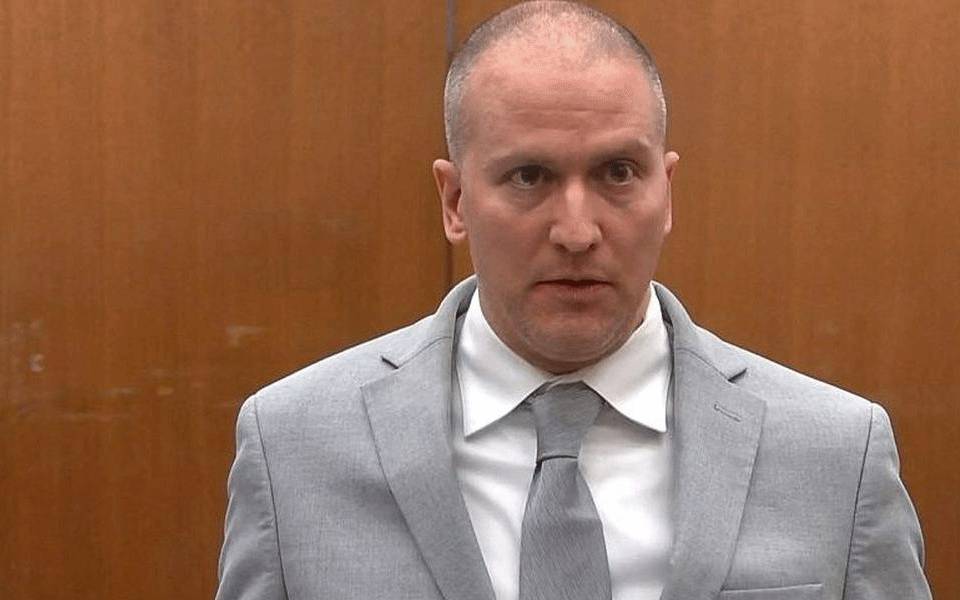
Minneapolis (US): Former Minneapolis police officer Derek Chauvin was sentenced to 22 1/2 years in prison for the murder of George Floyd, whose dying gasps under Chauvin's knee led to the biggest outcry against racial injustice in the US in generations.
The punishment — which fell short of the 30 years that prosecutors had requested — came after Chauvin broke his more than yearlong silence in court to offer condolences to the Floyd family and say he hopes more information coming out will eventually give them “some peace of mind.”
With good behavior, Chauvin, 45, could be paroled after serving two-thirds of his sentence, or about 15 years.
In imposing the punishment, Judge Peter Cahill went beyond the 12 1/2-year sentence prescribed under state guidelines, citing “your abuse of a position of trust and authority and also the particular cruelty” shown to Floyd.
Chauvin was immediately led back to prison. As with the verdicts in April, he showed little emotion when the judge pronounced the sentence. His eyes moved rapidly around the courtroom, his COVID-19 mask obscuring much of his face.
The fired white officer was convicted of second-degree unintentional murder, third-degree murder and second-degree manslaughter for pressing his knee against Floyd's neck for up to 9 1/2 minutes as the 46-year-old Black man gasped that he couldn't breathe and went limp on May 25, 2020.
Bystander video of Floyd's arrest on suspicion of passing a counterfeit USD 20 bill at a corner store prompted protests around the world and led to scattered violence in Minneapolis and beyond.
On Friday, Chauvin, who did not testify at his trial, removed his mask and turned toward the Floyd family, speaking only briefly because of what he called “some additional legal matters at hand” — an apparent reference to the federal civil rights trial he still faces.
“But very briefly, though, I do want to give my condolences to the Floyd family. There's going to be some other information in the future that would be of interest. And I hope things will give you some some peace of mind,” he said, without elaborating.
In asking that Chauvin be left off on probation, defense attorney Eric Nelson called Floyd's death “tragic” and said that Chauvin's “brain is littered with what-ifs” from that day: “What if I just did not agree to go in that day? What if things had gone differently? What if I never responded to that call? What if what if what if?”
Floyd's family members took the stand and expressed sorrow about his death. They asked for the maximum penalty.
“We don't want to see no more slaps on the wrist. We've been through that already," said a tearful Terrence Floyd, one of Floyd's brothers.
Floyd's nephew Brandon Williams said: “Our family is forever broken.” And Floyd's 7-year-old daughter, Gianna, in a video played in court, said that if she could say something to her father now, it would be: “I miss you and and I love you.”
Prosecutor Matthew Frank asked the judge to exceed sentencing guidelines and give Chauvin 30 years in prison, saying “tortured is the right word” for what the officer did to Floyd.
“This is not a momentary gunshot, punch to the face. This is 9½ minutes of cruelty to a man who was helpless and just begging for his life," Frank said.
Chauvin's mother, Carolyn Pawlenty, appeared in court to plead for mercy for son, saying his reputation has been unfairly reduced to that of “an aggressive, heartless and uncaring person” and a racist.
“I can tell you that is far from the truth,” she told the judge. “I want this court to know that none of these things are true and that my son is a good man."
She added: “Derek, I want you to know I have always believed in your innocence, and I will never waver from that.” “I will be here for you when you come home,” she said.
The concrete barricades, razor wire and National Guard patrols at the courthouse during Chauvin's three-week trial in the spring were gone Friday, reflecting an easing of tensions since the verdict in April.
Ahead of the sentencing, the judge agreed with prosecutors that there were aggravating circumstances that could justify a heavier punishment than the recommended 12 1/2 years — among them, that Chauvin treated Floyd with particular cruelty, abused his position of authority as a police officer and did it in front of children.
Before the sentencing, the judge denied Chauvin's request for a new trial. The defense had argued that the intense publicity tainted the jury pool and that the trial should have been moved away from Minneapolis.
The judge also rejected a defense request for a hearing into possible juror misconduct. Nelson had accused a juror of not being candid during jury selection because he didn't mention his participation in a march last summer to honor the Rev. Martin Luther King Jr. Prosecutors countered the juror had been open about his views.
Philip Stinson, a criminal justice professor at Bowling Green State University, said 11 non-federal law officers, including Chauvin, have been convicted of murder for on-duty deaths since 2005. The penalties for the nine who were sentenced before Chauvin ranged from from six years, nine months, to life behind bars, with the median being 15 years.
With Chauvin's sentencing, the Floyd family and Black America witnessed something of a rarity: In the small number of instances in which officers accused of brutality or other misconduct against Black people have gone to trial, the list of acquittals and mistrials is longer than the list of sentencings after conviction.
In recent years, the acquittals have included officers tried in the deaths of Philando Castile in suburban Minneapolis and Terence Crutcher in Tulsa, Oklahoma. Two mistrials were declared over the death of Samuel Dubose in Cincinnati.
“That's why the world has watched this trial, because it is a rare occurrence,” said Arizona-based civil rights attorney Benjamin Taylor, who has represented victims of police brutality. “Everybody knows that this doesn't happen every day.”
Chauvin has been held since his conviction at the state's maximum-security prison in Oak Park Heights, where he has been kept in a cell by himself for his own protection, his meals brought to him.
The three other officers involved in Floyd's arrest are scheduled for trial in March on state charges of aiding and abetting both murder and manslaughter. They will also stand trial with Floyd on the federal civil rights charges. No date has been set for that trial.
Let the Truth be known. If you read VB and like VB, please be a VB Supporter and Help us deliver the Truth to one and all.
Two injuries, one DNF, a DQ as India end messy World Relays campaign
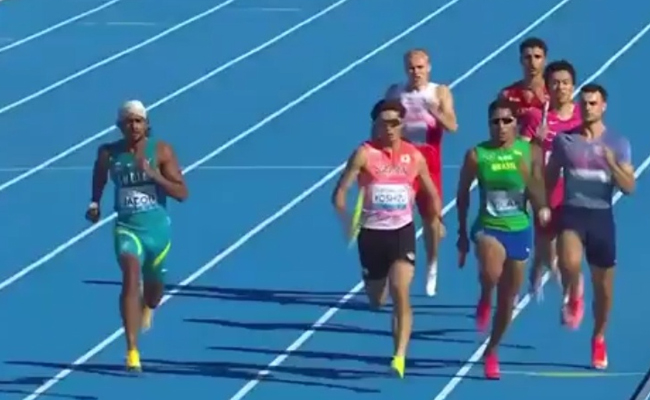
Gaborone (Botswana) (PTI): Amoj Jacob and Ragul Kumar got injured during the men's 4x400m and 4x100 races respectively as India ended their World Athletics Relays campaign in disappointment on the second day of competitions here on Sunday.
The Indian camp had high hopes of making the 2027 World Championships in the men's 4x400m relay but the team did not finish (DNF) the race as Jacob suffered cramps and pulled out of the race after taking the baton from the first leg runner Dharamveer Choudhary. Rajesh Ramesh and Vishal TK were to run in the third and fourth legs.
Those teams which could not qualify for the 2027 Beijing World Championships by reaching the final round of each of the six relay events on Saturday were given another chance in the second qualification round on Sunday.
The top two teams in each of the two heats (in all six relay events) booked the Beijing ticket on Sunday.
India will now have to try and qualify for the World Championships through the Top Lists of the World Athletics, which is a long and tedious process.
In the men's 4x100m race, third leg runner Ragul Kumar fell down the track after failing to hand over the baton inside the exchange zone to fourth leg runner Gurindervir Singh, which clearly showed the lack of coordination among the runners.
Harsh Santosh Raut and Animesh Kujur ran the first two legs.
The Indian quartet was disqualified and Kumar was seen being taken away from the Field of Play with the help of the volunteers.
It was a comedy of errors in the case of the women's 4x100m race, which saw the baton being dropped during an exchange between first leg runner Tamanna and second runner Nithya Gandhe, though the Indians finished the race in 53.09 seconds.
Gandhe started running quite a distance, but after realising that the baton was not in her hand, she turned and ran back to pick it up.
The only silver-lining for the Indian contingent was the national record time in the mixed 4x100m relay race, though the quartet of Ragul Kumar, Nithya Gandhe, Animesh Kujur and Sneha SS finished sixth in heat number two with a time of 41.35 seconds, bettering the previous national mark of 42.30 seconds set in March in Chandigarh.
The mixed 4x400m relay quartet of Theerthesh P Shetty, Kumari Saloni, Nihal William and Rashdeep Kaur ended at fifth in heat number one with a time of 3 minutes and 19.40 seconds.
On Saturday, all the five Indian relay teams had failed to make it to the respective final rounds and thus missed out on the 2027 World Championships berths.