Former South Korean President Yoon receives life sentence for imposing martial law
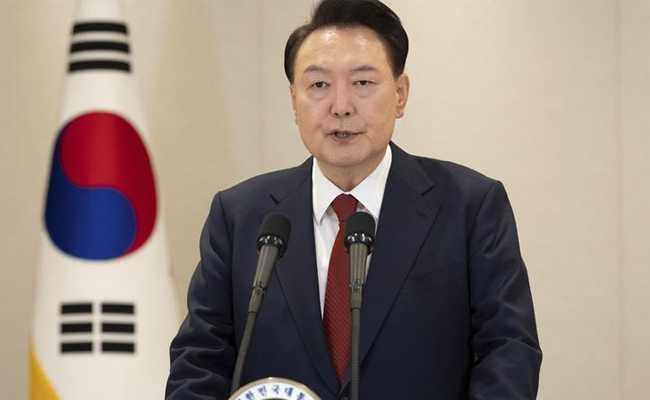
Seoul (AP): Former President Yoon Suk Yeol was sentenced to life in prison for his brief imposition of martial law in December 2024.
Judge Jee Kui-youn said he found Yoon guilty of rebellion for mobilizing military and police forces in an illegal attempt to seize the liberal-led National Assembly, arrest politicians and establish unchecked power for a “considerable” time.
Yoon is likely to appeal the verdict.
A special prosecutor had demanded the death penalty for Yoon, saying his actions posed a threat to the country's democracy and deserved the most serious punishment available, but most analysts expect a life sentence since the poorly-planned power grab did not result in casualties.
ALSO READ: IIT-Madras to establish applied AI innovation centre in Dubai
South Korea has not executed a death row inmate since 1997, in what is widely seen as a de facto moratorium on capital punishment amid calls for its abolition.
As Yoon arrived in court, hundreds of police officers watched closely as Yoon supporters rallied outside a judicial complex, their cries rising as the prison bus transporting him drove past. Yoon's critics gathered nearby, demanding the death penalty.
The court also convicted and sentenced several former military and police officials involved in enforcing Yoon's martial law decree, including ex-Defense Minister Kim Yong Hyun, who received a 30-year jail term for his central role in planning the measure and mobilizing the military.
Yoon, a staunch conservative, has defended his martial law decree as necessary to stop liberals, whom he described as “anti-state” forces, from obstructing his agenda with their legislative majority.
The decree lasted about six hours before being lifted after a quorum of lawmakers managed to break through a military blockade and unanimously voted to lift the measure.
Yoon was suspended from office on December 14, 2024, after being impeached by lawmakers and was formally removed by the Constitutional Court in April 2025. He has been under arrest since last July while facing multiple criminal trials, with the rebellion charge carrying the most severe punishment.
Last month, Yoon was sentenced to five years in prison for resisting arrest, fabricating the martial law proclamation and sidestepping a legally mandated full Cabinet meeting before declaring the measure.
The Seoul Central Court has also convicted two of Yoon's Cabinet members in other cases. That includes Prime Minister Han Duck-soo, who received a 23-year prison sentence for attempting to legitimize the decree by forcing it through a Cabinet Council meeting, falsifying records and lying under oath. Han has appealed the verdict.
Let the Truth be known. If you read VB and like VB, please be a VB Supporter and Help us deliver the Truth to one and all.
Karnataka School Edu Dept prohibits children from being made to dance to obscene songs
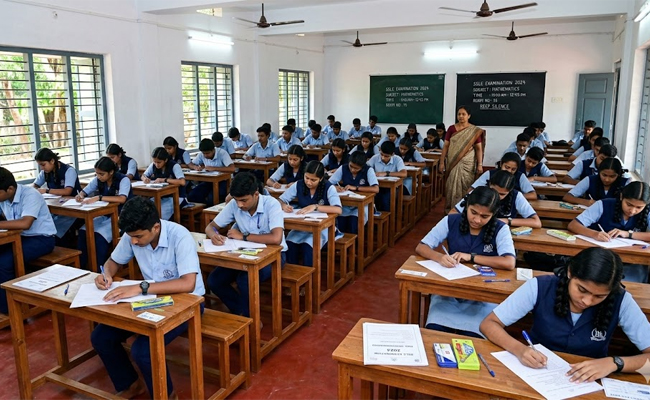
Bengaluru (PTI): The Karnataka School Education Department has issued a circular strictly prohibiting children from being made to dance to obscene songs in educational and cultural programmes.
It stated that such dances would negatively impact students' mental health and moral values. It will create indiscipline and harm the sanctity of education.
"All the Deputy Directors (Administration) of the state's School Education Department have been asked to take strict measures to prevent children or students from dancing to obscene songs in all government, aided and unaided schools in the state," the office of the commissioner of the School Education Department said in a recent circular.
"If it is found that children are being made to dance to obscene songs, appropriate action will be taken against the headmaster or management of such school," it added.
The department also listed certain measures in this regard, which include: strictly prohibiting children from being made to dance to obscene songs during educational and cultural programmes; selecting songs that are inspiring, positive, instilling national pride in children and reflecting the greatness, dignity, values, culture, and morality of the state.
Stating that the school headmaster and management are responsible for selecting songs and dances for cultural programmes, it said, they should also ensure that students wear decent clothes in dance or cultural programmes.