G7 Summit commits to promoting India-Middle East-Europe Economic Corridor
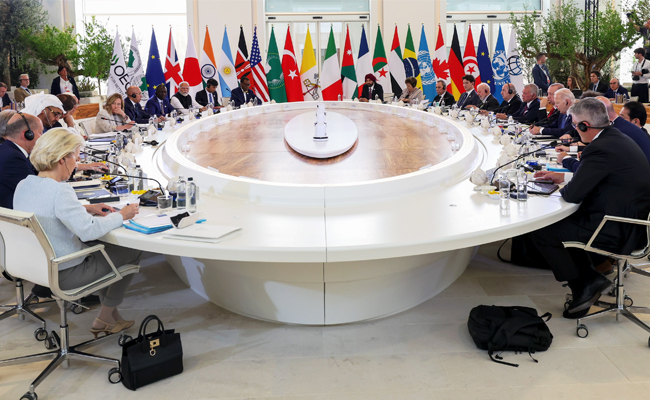
Bari (Italy) (PTI): The Group of Seven industrialised nations have committed to promoting concrete infrastructure initiatives such as the India-Middle East-Europe Economic Corridor (IMEC) in the G7 Summit Communique issued at the end of the three-day G7 Summit, attended by Prime Minister Narendra Modi.
The Communique was issued on Friday evening after the customary “family photo” at the luxury resort of Borgo Egnazia, where the G7 also reiterated a commitment to a “free and open Indo-Pacific” based on the rule of law.
Prime Minister Modi attended the G7 Summit at the invitation of Italian Prime Minister Giorgia Meloni, the host.
“We will further promote concrete G7 PGII (Partnership for Global Infrastructure and Investment) initiatives, flagship projects, and complementary initiatives to develop transformative economic corridors for quality infrastructure and investment, such as the deepening of our coordination and financing for the Lobito Corridor, the Luzon Corridor, the Middle Corridor, and the India-Middle East-Europe Economic Corridor, also building on the EU Global Gateway, the Great Green Wall Initiative, and the Mattei Plan for Africa launched by Italy,” reads the communique.
Billed as a path-breaking initiative, the IMEC envisages a vast road, railroad and shipping network among Saudi Arabia, India, the United States and Europe to ensure integration among Asia, the Middle East and the West.
The IMEC is also seen as an initiative by like-minded nations to gain strategic influence in the face of China's Belt and Road Initiative (BRI) which has faced increasing criticism over lack of transparency and disregard for sovereignty of the nations.
The BRI is a mega connectivity project that connects China with Southeast Asia, Central Asia, Russia and Europe.
The IMEC initiative was firmed up on the sidelines of the G20 Summit hosted by India in Delhi last year.
About the Outreach session on Friday on the topic of Artificial Intelligence, Energy, Africa and the Mediterranean addressed by Modi, the Communique reads: “In a spirit of shared responsibility, we warmly welcome the participation of the Leaders of Algeria, Argentina, Brazil, India, Jordan, Kenya, Mauritania, Tunisia, Turkiye, and the United Arab Emirates.
“We will step up our efforts to enhance interoperability amongst our AI governance approaches to promote greater certainty, transparency and accountability while recognizing that approaches and policy instruments may vary across G7 members. We will take a risk-based approach in these efforts as we seek to foster innovation and strong, inclusive, and sustainable growth.”
Among the other priorities of the summit’s agenda, the communique registers “unwavering support” for Ukraine in its ongoing conflict with Russia.
It notes: “With a view to supporting Ukraine’s current and future needs in the face of a prolonged defence against Russia, the G7 will launch Extraordinary Revenue Acceleration (ERA) Loans for Ukraine, in order to make available approximately USD 50 billion in additional funding to Ukraine by the end of the year.
“Therefore, without prejudice to possible other contributions and standing together, the G7 intends to provide financing that will be serviced and repaid by future flows of extraordinary revenues stemming from the immobilisation of Russian sovereign assets held in the European Union and other relevant jurisdictions. To enable this, we will work to obtain approval in these jurisdictions to use future flows of these extraordinary revenues to service and repay the loans.”
Pope Francis became the first pontiff to join the participants of the G7 hosted by Italy – US President Joe Biden, British Prime Minister Rishi Sunak, Canadian Prime Minister Justin Trudeau, German Chancellor Olaf Scholz, French President Emmanuel Macron, Japanese Prime Minister Fumio Kishida, European Commission President Ursula von der Leyen and European Council President Charles Michel.
Let the Truth be known. If you read VB and like VB, please be a VB Supporter and Help us deliver the Truth to one and all.
11-year-old dies by suicide after sexual assault in Bareilly; accused arrested

Bareilly (UP) (PTI): A 26-year-old man has been arrested for allegedly sexually assaulting an 11-year-old girl, who later died by suicide due to trauma, police said on Wednesday.
The post-mortem report confirmed sexual assault and multiple injuries on the minor's body, including bite marks and nail scratches. The cause of death was found to be hanging, they said.
According to ASP (South) Anshika Verma, the incident came to light on 27 April, when the girl, a Class 8 student, was found hanging at her home in Deoria Abdullaganj village under the Mirganj police station area. Initially, the family reported the death as suicide and was reluctant to pursue police action.
"The autopsy report changed the course of the investigation. It confirmed sexual assault and noted severe physical trauma. The cause of death was confirmed as hanging," Verma said.
A breakthrough in the case came from the statement of the victim's younger sister, who told police that the accused, Zeeshan (26), a resident of the same village, frequently loitered near the minor's school and allegedly gave her small sums of money to keep his interactions with her a secret, she said.
Police said that on the day of the incident, the accused allegedly lured the minor and assaulted her. Distressed by the incident, the child later took her own life while her mother was away, police said.
"Based on technical surveillance, CCTV footage, and statements from the family, we established Zeeshan's involvement. He was arrested near the Mirganj weekly market on Tuesday," they said.