Global pollution kills 9 million people a year, study finds
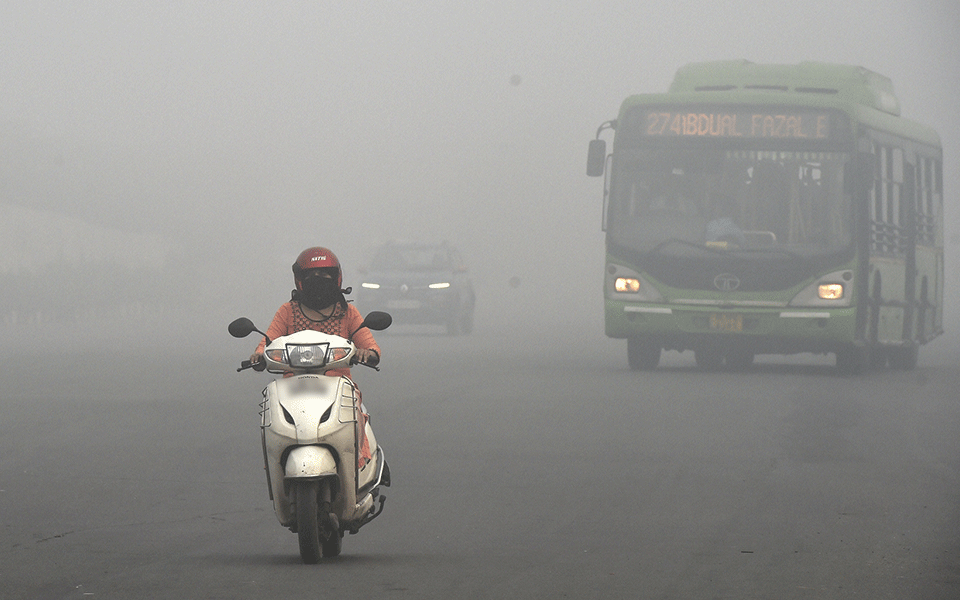
Washington(AP): A new study blames pollution of all types for 9 million deaths a year globally, with the death toll attributed to dirty air from cars, trucks, and industry rising 55 per cent since 2000.
That increase is offset by fewer pollution deaths from primitive indoor stoves and water contaminated with human and animal waste, so overall pollution deaths in 2019 are about the same as 2015.
The United States is the only fully industrialised country in the top 10 nations for total pollution deaths, ranking 7th with 142,883 deaths blamed on pollution in 2019, sandwiched between Bangladesh and Ethiopia, according to a new study in the journal The Lancet Planetary Health.
Tuesday's pre-pandemic study is based on calculations derived from the Global Burden of Disease database and the Institute for Health Metrics and Evaluation in Seattle.
India and China lead the world in pollution deaths with nearly 2.4 million and almost 2.2 million deaths a year, but the two nations also have the world's largest populations.
When deaths are put on a per population rate, the United States ranks 31st from the bottom at 43.6 pollution deaths per 100,000. Chad and the Central African Republic rank the highest with rates about 300 pollution deaths per 100,000, more than half of them due to tainted water, while Brunei, Qatar, and Iceland have the lowest pollution death rates ranging from 15 to 23. The global average is 117 pollution deaths per 100,000 people.
Pollution kills about the same number of people a year around the world as cigarette smoking and second-hand smoke combined, the study said.
9 million deaths is a lot of deaths, said Philip Landrigan, director of the Global Public Health Program and Global Pollution Observatory at Boston College.
The bad news is that it's not decreasing, Landrigan said. We're making gains in the easy stuff and we're seeing the more difficult stuff, which is the ambient (outdoor industrial) air pollution and the chemical pollution, still going up.
It doesn't have to be this way, researchers said.
They are preventable deaths. Each and every one of them is a death that is unnecessary, said Dr Lynn Goldman, dean of the George Washington University School of Public Health, who wasn't part of the study. She said the calculations made sense and if anything was so conservative about what it attributed to pollution, that the real death toll is likely higher.
The certificates for these deaths don't say pollution. They list heart disease, stroke, lung cancer, other lung issues and diabetes that are tightly correlated with pollution by numerous epidemiological studies, Landrigan said.
To then put these together with actual deaths, researchers look at the number of deaths by cause, exposure to pollution weighted for various factors, and then complicated exposure response calculations derived by large epidemiological studies based on thousands of people over decades of study, he said. It's the same way scientists can say cigarettes cause cancer and heart disease deaths.
That canon of information constitutes causality, Landrigan said. That's how we do it.
Five outside experts in public health and air pollution, including Goldman, told The Associated Press the study follows mainstream scientific thought.
Dr Renee Salas, an emergency room doctor and Harvard professor who wasn't part of the study, said the American Heart Association determined over a decade ago that exposure to (tiny pollution particles) like that generated from the burning of fossil fuels is causal for heart disease and death.
While people focus on decreasing their blood pressure and cholesterol, few recognise that the removal of air pollution is an important prescription to improve their heart health, Salas said.
Three-quarters of the overall pollution deaths came from air pollution and the overwhelming part of that is a combination of pollution from stationary sources like coal-fired power plants and steel mills on one hand and mobile sources like cars, trucks, and buses. And it's just a big global problem, said Landrigan, a public health physician. And it's getting worse around the world as countries develop and cities grow.
In New Delhi, India, air pollution peaks in the winter months and last year the city saw just two days when the air wasn't considered polluted. It was the first time in four years that the city experienced a clean air day during the winter months.
That air pollution remains the leading cause of death in South Asia reconfirms what is already known, but the increase in these deaths means that toxic emissions from vehicles and energy generation is increasing, said Anumita Roychowdhury, a director at the advocacy group Centre for Science and Environment in New Delhi.
This data is a reminder of what is going wrong but also that it is an opportunity to fix it, Roychowdhury said.
Pollution deaths are soaring in the poorest areas, experts said.
This problem is worst in areas of the world where population is most dense (e.g. Asia) and where financial and government resources to address the pollution problem are limited and stretched thin to address a host of challenges including health care availability and diet as well as pollution, said Dan Greenbaum, president of the Health Effects Institute, who wasn't part of the study. (AP)
Let the Truth be known. If you read VB and like VB, please be a VB Supporter and Help us deliver the Truth to one and all.
Rupee falls 20 paise to 95.43 against US dollar in early trade

Mumbai (PTI): The rupee depreciated 20 paise to 95.43 against US dollar in early trade on Tuesday as market sentiments remained fragile after renewed military exchanges between US and Iranian forces in the Gulf region.
Forex traders said investor anxiety due to instability in the Gulf is causing massive capital flight into safe-haven assets, with the US dollar acting as the primary beneficiary.
Moreover, Brent oil prices is hovering near USD 113 per barrel, maintaining pressure on oil-importing economies like India.
At the interbank foreign exchange market the rupee opened at 95.30 then lost ground to touch 95.43 against the US dollar, in initial trade, registering a fall of 20 paise over its previous close.
Rupee fell 39 paise to close at an all-time low of 95.23 against the US dollar on Monday.
"With oil boiling rupee on Monday fell to a closing low of 95.0875 and this morning the opening was still lower as it becomes more and more vulnerable when dollar index rises due to safe-haven buying and oil prices rise due to the continuous fighting in the Gulf Region," Anil Kumar Bhansali, Head of Treasury and Executive Director, Finrex Treasury Advisors LLP, said.
The higher oil prices will keep rupee sold off against the dollar as oil companies and FPIs intensify dollar buying, Bhansali added.
Meanwhile, the dollar index, which gauges the greenback's strength against a basket of six currencies, was trading at 98.51, up 0.15 per cent.
Brent crude, the global oil benchmark, was trading lower by 1.07 per cent at USD 113.22 per barrel in futures trade.
"Market sentiments remained fragile after renewed military exchanges between US and Iranian forces when Iranian forces launched fresh attacks in the Gulf as both sides sought to assert control over the strategic waterway," Bhansali said.
On the domestic equity market front, Sensex declined 361.62 points to 76,907.78 in early trade, while the Nifty dropped 134.90 points to 23,980.60.
Foreign Institutional Investors purchased equities worth Rs 2,835.62 crore on Monday, according to exchange data.