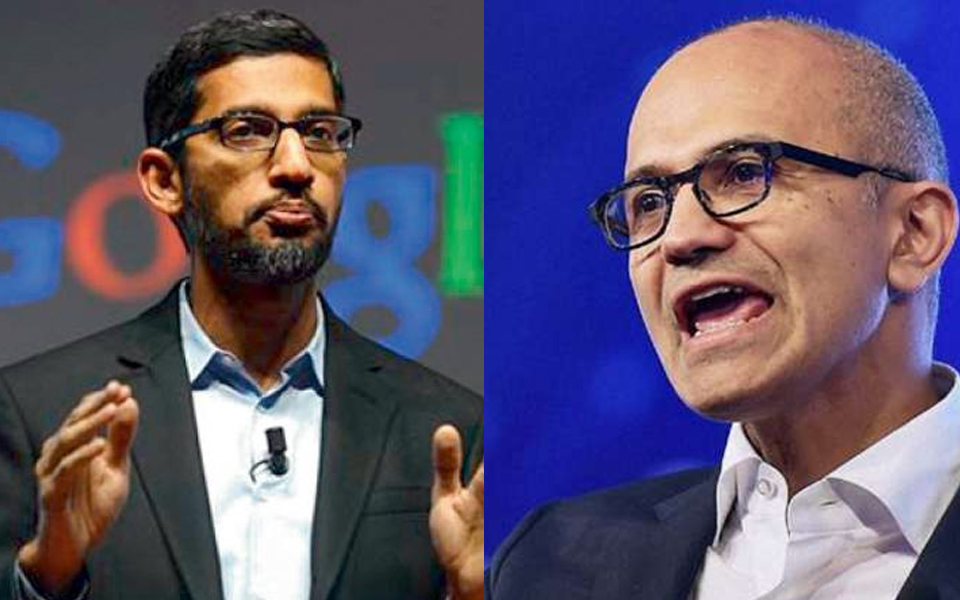
Houston: Google CEO Sundar Pichai and his Microsoft counterpart Satya Nadella have assured help to India as the country grapples with a ravaging coronavirus crisis that has put enormous pressure on its hospitals due to a shortage of beds, oxygen and medical supplies.
India logged a record of 3,52,991 new coronavirus infections in a day on Monday, taking its total tally of COVID-19 cases to 1,73,13,163. The death toll increased to 1,95,123 with a record 2,812 daily new fatalities, according to the Union Health Ministry data.
"Devastated to see the worsening Covid crisis in India. Google & Googlers are providing Rs 135 crore in funding to @GiveIndia, @UNICEF for medical supplies, orgs supporting high-risk communities, and grants to help spread critical information," Indian-origin Google CEO Pichai said in a tweet.
In another tweet, Microsoft's Indian-origin CEO Nadella said that his company will continue to use its resources and technology for relief efforts and support for buying oxygen devices.
Nadella said he was "heartbroken" by the current coronavirus situation in India.
"I am heartbroken by the current situation in India. I'm grateful the US government is mobilising to help. Microsoft will continue to use its voice, resources, and technology to aid relief efforts, and support the purchase of critical oxygen concentration devices," he said.
US President Joe Biden and Vice President Kamala Harris have assured India and its people of providing all assistance, including urgently sending necessary medical life-saving supplies and equipment, to help the country combat the deadly coronavirus crisis.
Just as India sent assistance to the United States as our hospitals were strained early in the pandemic, we are determined to help India in its time of need, Biden said in a tweet.
The US is working closely with the Indian government to rapidly deploy additional support and supplies during an alarming COVID-19 outbreak. As we provide assistance, we pray for the people of India including its courageous healthcare workers, Harris tweeted.
Indian-American venture capitalist Vinod Khosla also tweeted: I'm willing to fund hospitals in India that need funding to import bulk planeloads of oxygen or supplies into India to increase supply. Public hospitals/NGO's also pls reach out."
India is struggling with a second wave of the pandemic with more than 3,00,000 daily new coronavirus cases being reported in the past few days, and hospitals in several states are reeling under a shortage of medical oxygen and beds.
To combat the growing demand for oxygen in the country, India has reached out to various countries to procure containers and oxygen cylinders under operation 'Oxygen Maitri'.
The Indian Air Force on Saturday brought four cryogenic tanks, to be used for transporting oxygen, from Singapore. The containers were airlifted from Singapore by C17 heavy-lift aircraft of the IAF.
The aircraft "with 4 cryogenic containers for storage of liquid O2 from Singapore landed at Panagarh airbase" in West Bengal on Saturday, a home ministry spokesperson tweeted.
Saudi Arabia is shipping 80 metric tonnes of liquid oxygen to India as the country is running low on supplies due to an unprecedented spike in coronavirus cases.
"Embassy of India is proud to partner with Adani group and M/s Linde in shipping much-needed 80MT liquid oxygen to India. Our heartfelt thanks to the Ministry of Health Kingdom of Saudi Arabia for all their help, support, and cooperation, the Indian mission in Riyadh tweeted on Sunday.
President of the European Council Charles Michel said in a tweet, "The EU stands in solidarity with Indian people amidst resurgent COVID19 pandemic. The fight against the virus is a common fight. We will discuss our support and cooperation at EU-India Leaders' meeting on 8 May with @narendramodi and @antoniocostapm". French President Emmanuel Macron has also extended support to India.
In a tweet shared by the Indian embassy in France, Macron said, "I want to send a message of solidarity to the Indian people, facing a resurgence of COVID-19 cases. France is with you in this struggle, which spares no one. We stand ready to provide our support."
Let the Truth be known. If you read VB and like VB, please be a VB Supporter and Help us deliver the Truth to one and all.
Kathmandu (PTI): Rapper-turned-politician Balendra Shah's RSP is all set to form the next government in Nepal after securing sweeping victory in crucial general elections on Saturday, decimating the established parties in the politically fragile nation.
Popularly known as Balen, the 35-year-old prime ministerial candidate of the Rastriya Swatantra Party (RSP) defeated four-time prime minister KP Sharma Oli, the chair of Nepal's legacy party, the Communist Party of Nepal (Unified Marxist–Leninist) -- CPN-UML -- by a huge margin of about 50,000 votes in Jhapa-5 constituency.
Balen, 35, secured 68,348 votes against 74-year-old Oli's 18,734, the Election Commission (EC) said.
He is expected to be the next prime minister of Nepal, reflecting a public mood of rejection of established parties. The RSP, which was formed in 2022 by Ravi Lamichhane, has won 72 seats out of the 90 seats for which results were declared by 9:30 pm, according to the Election Commission (EC).
RSP's seats include a clean sweep in all 10 constituencies of Kathmandu district even as it is leading in 52 seats across the country, the EC data showed.
Legacy parties failed to convince voters for whom the major issues included fighting corruption and an end to nepotism apart from a generational change in political leadership of the Himalayan nation.
The Nepali Congress (NC) won 10 and was leading in eight seats; the CPN-(UML) won just four seats and is leading in eight; the Nepali Communist Party (NCP) won two seats and is leading in five, the Shrama Shakti Party (SSP) was leading in three seats, and the Rastriya Prajatantra Party (RPP) won one seat, the EC data showed. Among the winners is one independent.
Nepal witnessed about 60 per cent voter turnout during the March 5 elections to the House of Representatives. The counting of votes started late Thursday night and as of 9:30 pm Saturday, counting was in progress in the remaining of the total 165 constituencies, the Election Commission said.
The election was being closely watched by India, which is hoping for a stable government in the politically fragile Himalayan nation to take forward the developmental partnership between the two sides.
Prime Minister Narendra Modi on Saturday congratulated the people and government of Nepal for the successful conduct of elections. “It is heartening to see my Nepali sisters and brothers exercise their democratic rights so vibrantly. This historic milestone is a proud moment in Nepal's democratic journey,” Modi said in a post on X.
Modi also said that as a close friend and neighbour, India remains steadfast in its commitment to working closely with the people of Nepal and its new government to scale new heights of shared peace, progress and prosperity.
Oli, who too was projected as the PM face of the CPN-UML, wished Balen for a full five year tenure for his government in the Himalayan nation that has seen 14 governments in the last 18 years.
“Balen babu, congratulations for the victory. I wish your five year tenure be trouble free, successful and hearty congratulations,” Oli wrote in his social media post and attached a 2022 photo showing him gifting a tabla to Balen after the rapper-turned-politician won Kathmandu mayor's election as an independent.
The RSP, which projected Balendra Shah 'Balen' as its prime ministerial candidate and had organised its first election campaign in Janakpur in Madhesh, is heading towards a clean sweep of the province.
‘Balen’, as he is popularly known, projected himself as the “son of Madhesh” during the campaign, with the party launching the campaign with 'Ab ki bar Balendra Sarkar' (This time there will be Balendra’s government) tagline.
Of the total 32 seats in eight districts of Madhesh province, the RSP has won eight and is leading in 22 other constituencies, the EC said.
The party is also making a clean sweep in the Kathmandu Valley winning all 10 seats of Kathmandu district and two in Bhaktapur and two in Lalitpur district.
The party is also leading in the remaining one seat of the Kathmandu Valley with a huge margin, possibly as a result of a massive road show led by Balen in all 15 constituencies on the last day of the election campaign.
RSP chairman Lamichhane won with a huge margin from Chitwan-2 constituency, marking his third consecutive victory with 54,402 votes against his nearest rival NC's Mina Kumari Kharel, who received 14,564 votes.
According to the Election Commission, former prime minister and NCP leader Pushpa Kamal Dahal Prachanda won from Rukum Purba district by securing 10,240 votes against his rival Lilamani Gautam of CPN-(UML), who got 3,462 votes.
RPP's Gyanendra Shahi won from the Jumla constituency of Karnali province by defeating his closest rival Naresh Bhandari of the NCP and became the only candidate of the pro-monarchist RPP to have secured a seat in the House of Representatives.
The election also saw 10 women candidates win, nine of them from the RSP while one from NC.
Meanwhile, the RSP is also leading in proportional voting system with the party bagging 474,266 votes followed by Nepali Congress with 160,384. The CPN (UML) has received 127,841, Nepali Communist Party 65,363, the RPP 34,154, and Shrama Shakti Party 17,437 votes till now.
Out of a total of 275 members of the Parliament, 165 are being elected through direct voting, while the remaining 110 through a proportionate method.
Around 3,400 candidates were vying for 165 seats under direct voting, and 3,135 candidates for 110 seats through proportionate voting.
The Gen Z youth, through their two-day intensified protests on September 8 and 9 last year, ousted Prime Minister Oli of the CPN-(UML), who was heading a coalition government with the backing of Nepali Congress that enjoyed nearly two-thirds majority support.
Though Balen was a popular choice to lead the interim government after Oli's ouster, he declined to lead the interim administration, saying he would prefer to contest the parliamentary election for a full term.
In January, he joined the RSP and was soon declared the party's prime ministerial candidate.
The major issues raised by Gen Z before and during the election campaign were anti-corruption, good governance, an end to nepotism, generational change in political leadership, etc.
Sunil Babu Pant, former MP and a political analyst, said, “The victory of Rastriya Swatantra Party in the March 5 elections and the expectation that Balen Shah could emerge as Nepal's next Prime Minister reflects the people's deep rooted frustration with the old political order and their hope for a new direction.”
“As Balen assumes the country's leadership, his first responsibility must be to demonstrate that corruption will not be tolerated under any circumstances,” he said.
Balen will also face a complex geopolitical challenge, Pant said, adding, “He must prove that he is not a puppet of any external power, western or otherwise. Nepal's leadership must carefully balance relations with all global actors and pursue an independent foreign policy that prioritises the national interest.”