Google paid USD 45 million to its former India-born executive accused of sexual misconduct
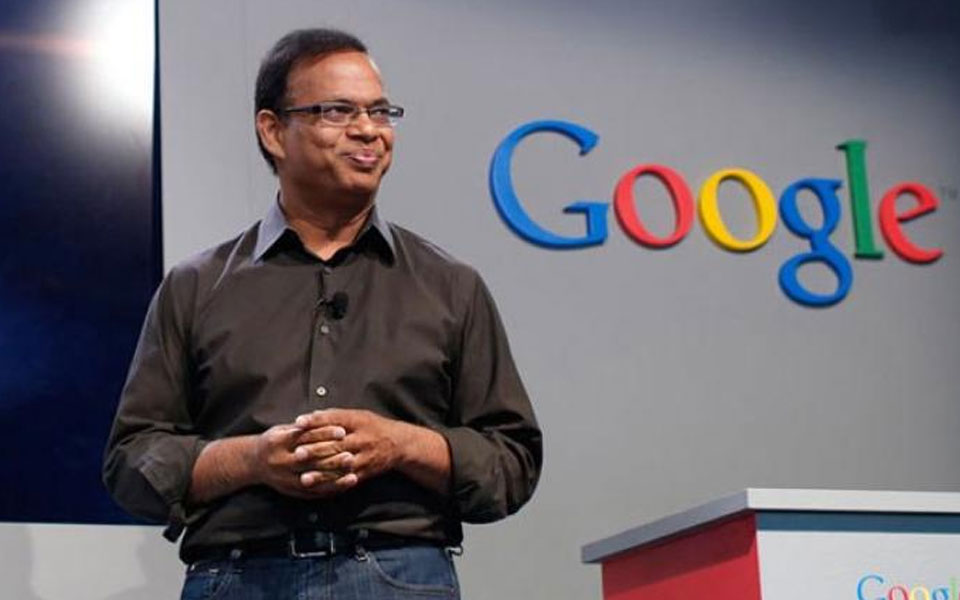
San Francisco:Tech titan Google agreed to pay its former India-born top executive Amit Singhal a whopping USD 45 million as an exit package when he resigned from the company in 2016 after being accused of sexual harassment, according to a media report.
The previously undisclosed amount was in the separation agreement for Singhal, a senior vice president who ran Google's search operations until early 2016.
The amount was revealed on Monday in a shareholder lawsuit accusing the board of directors of Alphabet, the parent company of Google, of shirking their responsibilities by agreeing to pay executives accused of misconduct instead of firing them for cause, the New York Times reported.
The lawsuit was part of the fallout over how Google has handled sexual harassment cases, it said.
The lawsuit was filed in January in California Superior Court with redactions in the passages referring to board discussions. An amended version was filed on Monday without the redactions.
According to the amended suit, Google agreed to pay Singhal USD 15 million a year for two years and between USD 5 million and USD 15 million in the third year as long as he was not employed by a competitor.
He agreed to take a job at Uber about a year after his departure, then resigned from the ride-hailing company a few weeks later when the sexual harassment claim at Google became public, the report said.
Frank Bottini, an attorney for the shareholders, said the board-approved payments were an "abdication of responsibility".
A Google spokeswoman said Monday that the company had "made many changes to our workplace and taken an increasingly hard line on inappropriate conduct by people in positions of authority".
"There are serious consequences for anyone who behaves inappropriately at Google," she said.
Singhal left Google after an employee said he had groped her at an off-site event. Google investigated the allegation and found that Singhal had been inebriated.
The company also concluded that the employee's account was credible. At the time, Singhal said he wanted to spend more time with his family and focus on his philanthropy, the report said.
Singhal did not respond to a request for comment, it said.
Born in Jhansi, Uttar Pradesh, Singhal received a Bachelor of Engineering degree in computer science from IIT Roorkee. He received an MS degree from University of Minnesota Duluth and was head of Google's core search team for 15 years.
Let the Truth be known. If you read VB and like VB, please be a VB Supporter and Help us deliver the Truth to one and all.
Transport Min. Ramalinga Reddy inaugurates redeveloped parking facility at KBS
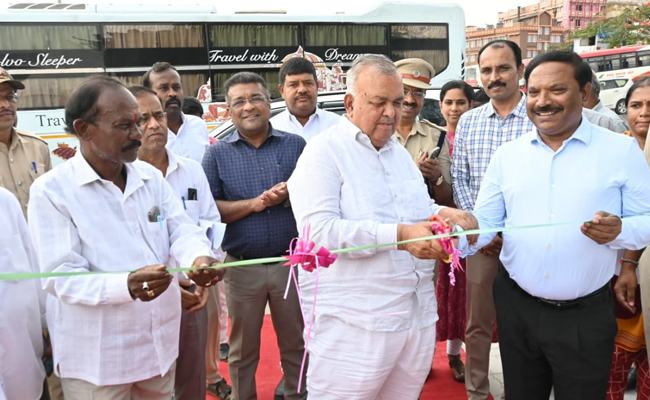
Bengaluru: Transport and Muzrai Minister Ramalinga Reddy inaugurated a redeveloped parking facility at Terminal-1 of Kempegowda Bus Station on Thursday, April 16.
The parking area has been developed at a cost of Rs 3.29 crore to facilitate smoother movement of vehicles and improve convenience for staff and passengers.
According to officials, the area adjacent to Terminal-1 near the rest house was earlier filled with potholes and prone to waterlogging during rains, causing inconvenience to commuters and staff.
The issue was brought to the notice of the minister, who visited the site and directed that the development be taken up on priority.
A tender was floated to develop around 2.5 acres of land into a structured parking facility.
According to KSRTC, the facility can accommodate around 100 buses and is equipped with 11 electric light poles. An electrical panel room has also been constructed as part of the project.
Parking space has been allocated for buses belonging to North Western (NWKRTC) and Kalyana Karnataka Road Transport Corporations (KKRTC).