Gotabaya Rajapaksa sworn in as Sri Lanka's 7th President
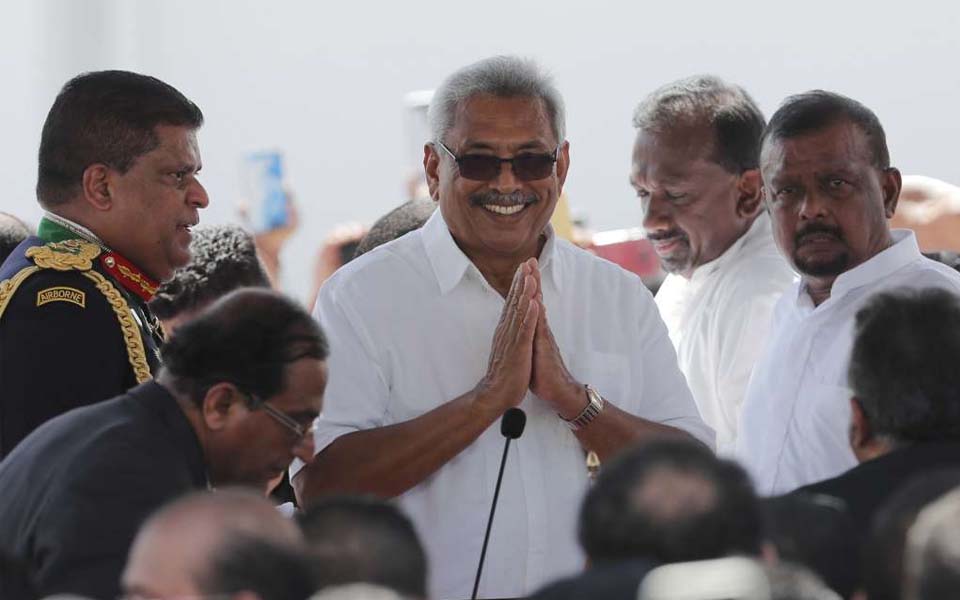
Colombo, Nov 18: Gotabaya Rajapaksa was on Monday sworn in as Sri Lanka's seventh President at an ancient Buddhist temple, a venue chosen to reflect the massive mandate he got from the Sinhalese majority, as he vowed to protect all communities while giving foremost priority to Buddhism.
The swearing-in ceremony took place at the Ruwanweli Seya, a stupa and a hemispherical structure containing relics and considered sacred to Buddhists all over the world, in the ancient north central town of Anuradhapura, around 200 kms from the national capital Colombo.
Rajapaksa is the first president to be sworn in outside Colombo.
Clad in immaculate white, Rajapaksa, 70, signed the official document in the presence of Chief Justice Jayantha Jayasuriya at the auspicious time of 11:49 am after being administered the oath by the president's secretary Udaya R Seneviratne.
In a short speech, he thanked the powerful Buddhist clergy in the country for backing his presidential bid.
He also thanked the Sinhala-majority people for electing him.
I knew I would win the presidency with support coming only from the Sinhala majority. I told the minorities to join me. I did not receive their support. But I will make sure that I will be president for everyone, he said.
Rajapaksa said he would protect all communities while giving foremost position to Buddhism.
His selection of the venue, the Ruwanwelisaya stupa and a hemispherical structure containing relics, is one of the eight most prominent Buddhist shrines and in line with the massive mandate he won form the island's Buddhist majority.
The stupa which is considered sacred to Buddhists all over the world was built by King Dutugemunu in the 140 B.C., who reigned over the country after defeating Tamil King Elara.
Rajapaksa was credited for ending the military campaign of the Liberation Tigers of Tamil Eelam (LTTE) who ran a 30-year war to create a separate Tamil homeland in the north and east of the island.
Rajapaksa is the younger brother of the former President Mahinda Rajapaksa who was a special guest at the ceremony.
Later today, he is expected to appoint Mahinda the new prime minister.
He was a colonel in the Sri Lankan Army before leaving it to migrate to the US in 1992. He was until then in the battlefield against the LTTE in the north.
Rajapaksa returned to Sri Lanka when older brother Mahinda was named the presidential candidate in 2005. With his brother's victory he was appointed to the powerful position of Secretary to the Defense Ministry.
His sharp leadership skills and incise decision makings were largely responsible for ending the LTTE's armed campaign. In 2006, he survived an assassination attempt carried out by the LTTE with minor injuries.
Rajapaksa is also the first civil servant to become president, only the first sibling of a president to win presidency, the first president in the history to be inducted in office without even spending a day as a parliamentarian.
Analysts said his large mandate on Saturday with over 1.3 million votes reflected the public confidence in his strong leadership and his ability for precise decision making.
Let the Truth be known. If you read VB and like VB, please be a VB Supporter and Help us deliver the Truth to one and all.
AIITA welcomes Karnataka’s ban on obscene songs in school events

Bhatkal: The Karnataka unit of the All India Ideal Teachers Association (AIITA) has welcomed the Karnataka government’s decision to strictly ban school children from dancing to obscene songs during educational and cultural programmes in government, aided, and private schools across the state.
AIITA Karnataka State President M. R. Manvi congratulated the government for taking what he termed an important step to preserve the sanctity of education.
“Such decisions to safeguard the dignity of school children and uphold the values of education are the need of the hour. This rule should not be limited to government schools alone but must be strictly implemented in all private educational institutions as well,” he said.
He further urged the government to address other concerns within school programmes.
“The government should not only prohibit obscene dances in the name of school anniversaries, but also ensure that plays and dialogues that incite religious hatred are avoided. Schools should be centres of harmony, not platforms for spreading hatred,” he added.
According to a recent circular issued by the Department of School Education and Literacy, obscene dances are adversely affecting the mental health and moral values of students.
In this regard, schools have been advised to use songs that promote nationalism, positive thinking, the greatness of Kannada culture, and value-based traditions instead of inappropriate content during programmes.
The circular also emphasises that students should be dressed in decent attire.
AIITA also backed the department’s warning that disciplinary action would be taken against head teachers if such guidelines are violated. The association has further demanded that district Deputy Directors of Public Instruction strictly monitor the implementation of these rules.