Gunmen kill at least 58 in attack on Niger market sellers

Niamey (Niger): Gunmen on motorcycles attacked a group of civilians returning from market day in a volatile corner of Niger, leaving at least 58 people dead and then burning granaries to the ground, the government has said.
There was no immediate claim of responsibility for Monday's massacres, though extremists belonging to the Islamic State in the Greater Sahara group are known to be active in the Tillaberi region where the villages were attacked.
The victims were returning home from a large livestock market in Banibangou, near Niger's troubled border with Mali. The suspected extremists also destroyed nearby granaries that held valuable food stores.
The announcement was read on Niger state television Tuesday evening by government spokesman Abdourahmane Zakaria , who declared three days of national mourning for the victims.
Monday's attacks underscore the enormous security challenges facing Niger's new president, Mohamed Bazoum, who won the election in late February to succeed outgoing leader Mahamadou Issoufou.
Not only are jihadis active in the Tillaberi region, but the counterterrorism offensives against those extremists have helped given rise to ethnic militias, analysts say. Intercommunal tensions have been exacerbated as a result, particularly near the border between Mali and Niger.
Monday's attack echoed a January massacre that left 100 people dead in two villages also in the Tillaberi region that hadn't been claimed by any extremist group or militia.
Extremists staged mass attacks on Niger's military in the Tillaberi region, killing more than 70 in December 2019 and more than 89 in January 2020. It's near the area where four U.S. Special Forces soldiers were killed along with five Nigerien colleagues in 2017. (AP)
Let the Truth be known. If you read VB and like VB, please be a VB Supporter and Help us deliver the Truth to one and all.
Indian startup's 'Drishti' satellite launched aboard SpaceX rocket
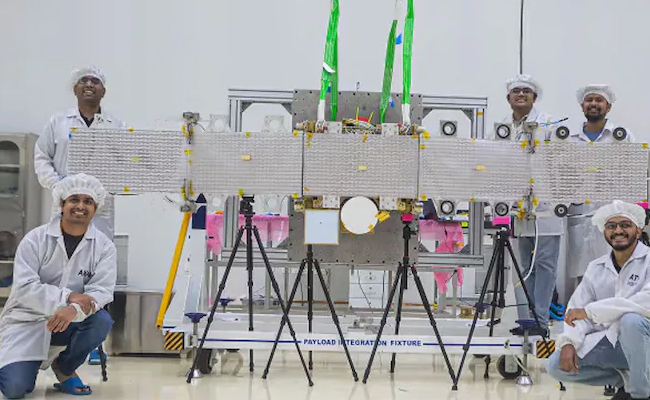
New Delhi (PTI): Bengaluru-based space start-up GalaxEye's Mission Drishti satellite was launched on Sunday aboard SpaceX's Falcon 9 rocket from California.
Mission Drishti is the world's first OptoSAR satellite, integrating electro-optical (EO) and synthetic aperture radar (SAR) sensors into a single operational platform, according to the company.
While EO sensors capture high-resolution images during sunlight and clear skies, SAR sensors provide all-weather and all-time images, using radar pulses.
In a statement, Suyash Singh, founder and CEO of GalaxEye, said, "With the satellite (Mission Drishti) now successfully in orbit, our immediate focus is on completing its commissioning. As we move through this phase, we are already witnessing strong global interest in the differentiated datasets enabled by our OptoSAR payload."
The satellite will help address long-standing limitations of conventional systems and enable more reliable and consistent data acquisition across diverse environmental conditions, the company said.
As a dual-use Earth observation satellite, the mission will support use cases across defence, agriculture, disaster management, maritime monitoring, and infrastructure planning.
The satellite is also expected to complement India's broader initiatives, including the 29 active Earth Observation satellites outlined in ISRO's recent annual report.
The launch came after five years of indigenous research and development, and extensive environmental testing and performance validation of the Mission Drishti.
In a statement, Lt Gen AK Bhatt (Retd), director general of Indian Space Association (ISpA), said, "GalaxEye has achieved what only a few global players have, which is seamlessly combining optical and SAR capabilities on a single platform to enable persistent, all-weather intelligence."
What stands out is not just the technology, but its broader impact on how downstream applications will increasingly define value in the space economy, particularly in Earth observation, where timely, decision-grade insights are critical," he added.
ISpA is the premier industry association of space and satellite companies in the country.
Union Minister Jitendra Singh also took note of the Mission Drishti launch, saying the development marked a significant milestone in India's space journey.
In a post on X, the minister said, "The successful launch of the world's first OptoSAR satellite, and the largest privately-built satellite in the country, reflects the immense potential of our young innovators driving nation-building."
GalaxEye aims to scale up Mission Drishti to a constellation of 10 satellites by 2030, developing a robust and sovereign Earth observation infrastructure for India.