Guterres defends his and Zeid's reports on Kashmir as 'voice of UN'
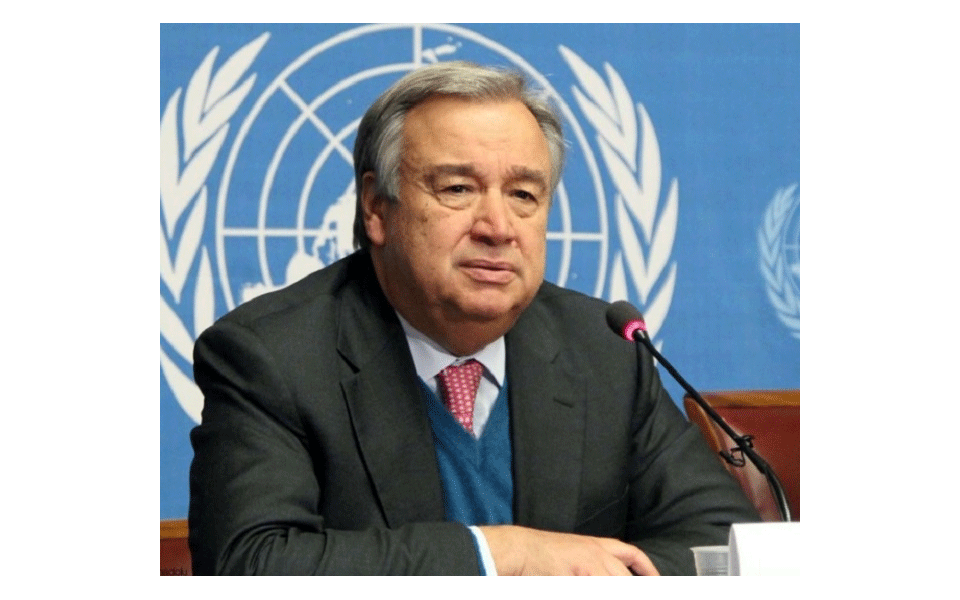
United Nations, July 12 : UN Secretary-General Antonio Guterres on Thursday mounted a strong defence of reports dealing with Kashmir issued recently by him and Human Rights High Commissioner Zeid Ra'ad Al Hussein, saying that they were covered by the "the general mandate of human rights instruments".
Guterres backed Zeid's call in his report for an investigation into the human rights situation in Kashmir, saying it represented the "voice of the UN."
India had objected to Guterres's report on children in armed conflict that referred to Kashmir, Chhattisgarh and Jharkhand and to Zeid's report on human rights in Kashmir that called for the setting up of an international investigation into the situation there.
India said that Zeid had no mandate for his report that showed a "clear bias" and that Guterres had overstepped him Security Council when he referred to India in his report.
Asked at his news conference if he fully backed the Zeid report, Guterres said: "As you can imagine all the action of the Human Rights High Commissioner is an action that represents the voice of the UN in relation to that issue."
Answering a question about the reports running counter to India's long-standing assertion that Kashmir was a part of India and any problem concerning it was a bilateral issue between India and Pakistan, Guterres said there was a distinction between political matters and human rights.
He said: "One thing is the definition of mechanisms for a political solution of a situation in the country and the other thing is the general mandate of human rights instruments in relation to human rights everywhere."
"What the Human Rights Commissioner did it was the use of his own competencies and capacities as it allows him (in) all other parts of the world to report on what he considers to be relevant human rights violations," Guterres explained.
"It doesn't mean that there is in that a preference for any kind of methodology for a political solution," he added.
As for India's saying that the situation in the three Indian states mentioned in Guterres's report not meeting "a definition of armed conflict or of threat to maintenance of international peace and security," he said that the same principles applied to it also.
His "report is a report about the situation in which the rights of children have been put into question," he said.
In his report last month on children in armed conflict, Guterres accused Jaish-e-Mohammed and Hizbul Mujahideen in Kashmir and Maoists in Chhattisgarh and Jharkhand of using children.
He also assigned blame to the Indian government saying, "children continued to be killed and injured in the context of operations of national security forces against armed groups."
His report added that "unverified reports" indicate national security forces use children as "informants and spies."
On Monday, India's Deputy Permanent Representative told the Security Council that Zeid's "so-called report" was "reflecting the clear bias of an official who was acting without any mandate whatsoever and relied on unverified sources of information."
As for Guterres's report, he said: "We are disappointed that the report of the Secretary General includes situations, which do not meet the definition of armed conflict or of threat to maintenance of international peace and security."
Let the Truth be known. If you read VB and like VB, please be a VB Supporter and Help us deliver the Truth to one and all.
Fire at mass marriage event attended by Dy CM Shivakumar, nobody affected

Raichur (Karnataka) (PTI): Fire broke out near the stage of the mass marriage event that was attended by Deputy Chief Minister D K Shivakumar here, police said on Sunday.
Nobody was affected, and the fire was immediately put out, they said.
The fire was noticed shortly after Shivakumar and other dignitaries left the stage, and Forest Minister Eshwaran Khandre was speaking to the media at the venue in Sindhanur, officials said.
According to officials, wires, speakers, and cloth materials near the stage caught fire, allegedly due to a short circuit.
Police personnel present at the spot quickly swung into action and extinguished the fire.
The programme was halted for some time and resumed later, they said.
Several ministers, legislators and political leaders from the region, and actor Sudeep had attended the event.