'Hidden' animal spreading deadly Chinese coronavirus: Lancet study

Beijing: While bats may be the original hosts of the novel Chinese coronavirus, an animal sold at a seafood market in Wuhan may be spreading the deadly virus to humans, a study published in The Lancet journal suggests.
The analysis of 10 gene sequences of the novel coronavirus (2019-nCoV) from nine patients in the central Chinese city of Wuhan found that the virus is most closely related to two bat-derived SARS-like coronaviruses.
The researchers, including those from the Shandong Academy of Medical Sciences in China, said that their analysis suggests that bats might be the original host of the virus.
However, an animal sold at the Huanan seafood market might represent an intermediate host that enables the emergence of the virus in humans, they said.
For this reason, the researchers noted, future evolution, adaptation and spread of this virus requires urgent investigation. Cell and secretion samples were taken from the lungs of the patients who were diagnosed with viral pneumonia of unidentified cause.
The harvested samples of the 2019-nCoV virus were then analysed to determine the origin of the virus, and how it enters human cells.
Eight of the patients had visited the Huanan seafood market. One patient had never visited the market, but had stayed in a hotel near the market before the onset of their illness.
The researchers found 2019-nCoV in all 10 genetic samples taken from the patients -- including eight complete genomes, and two partial genomes.
The genetic sequences of the samples were nearly identical, which indicates a very recent emergence of the virus into humans, according to the researchers.
"It is striking that the sequences of 2019-nCoV described here from different patients were almost identical," said one of lead authors, Weifeng Shi, from Shandong First Medical University, and Shandong Academy of Medical Sciences.
"This finding suggests that 2019-nCoV originated from one source within a very short period, and was detected relatively rapidly," Shi said.
As the virus transmits to more individuals, the researchers said, constant surveillance of mutations arising is needed.
Comparing the 2019-nCoV genetic sequence with a library of viruses, they found that the most closely related viruses were two SARS-like coronaviruses of bat origin, which shared 88 per cent of the genetic sequence.
2019-nCoV was more genetically distant to the human SARS virus -- which shared about 79 per cent of the genetic sequence -- and the Middle East respiratory syndrome (MERS) virus, which shared about 50 per cent of the genetic sequence.
Analysing how the virus binds, and then enters the human cells, the researchers found that 2019-nCoV and human SARS virus have similar structures, despite some small differences.
The researchers suggest that 2019-nCoV might use the same molecular doorway to enter the cells as SARS but noted that this will require confirmation.
Based on the data, they said, it seems likely that the 2019-nCoV causing the Wuhan outbreak might also be initially hosted by bats, and transmitted to humans via a currently unknown wild animal sold at the Huanan seafood market.
They said that it is more likely that bat coronaviruses are mutating, than 2019-nCoV -- meaning that the virus is unlikely to have emerged due to a chance mutation.
"These data are consistent with a bat reservoir for coronaviruses in general and 2019-nCoV in particular," said Professor Guizhen Wu, from the Chinese Center for Disease Control and Prevention.
"However, despite the importance of bats, it seems likely that another animal host is acting as an intermediate host between bats and humans," said Wu.
She explained that the outbreak was first reported in late December, 2019, when most bat species in Wuhan are hibernating. No bats were sold or found at the Huanan seafood market, whereas many non-aquatic animals (including mammals) were, Wu noted.
Also, the similarities in the genetic sequences between 2019-nCoV and its close relatives bat-SL-CoVZC45 and bat-SL-CoVZXC21 were less than 90 per cent, meaning these two bat-derived coronaviruses are not direct ancestors of 2019-nCoV, she said.
Let the Truth be known. If you read VB and like VB, please be a VB Supporter and Help us deliver the Truth to one and all.
Cong slams Modi govt as 'anti-worker', calls for review of new Labour code
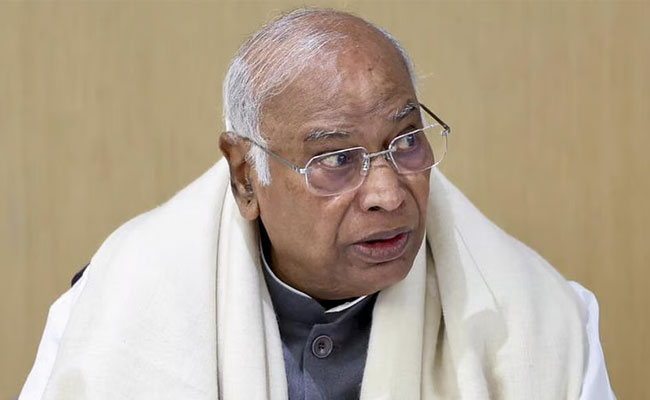
New Delhi (PTI): The Congress on Friday accused the Modi government of being "anti-worker" and demanded that the new labour code be reviewed, MGNREGA be revived as well as a national minimum wage of Rs 400 per day be established.
On International Labour Day, Congress president Mallikarjun Kharge took a swipe at the government and said unemployment in India today is a direct consequence of the 'Hum Do, Hamare Do' policies.
"Driven by the 'Hum Do, Hamare Do' policy, the Modi government implemented an anti-worker Labour Code. As a result, unrest has erupted everywhere - be it in Noida, at the IOCL facility in Panipat, Adani's factory in Raikheda, NTPC Patratu, or the Samsung factory in Sriperumbudur," Kharge said in a post in Hindi on X.
Instead of ensuring job security, this Code promotes policies such as contract labour and 'Hire & Fire' practices, Kharge said and called for a review of the new Labour Code.
The Modi government has effectively dismantled MGNREGA by forcibly pushing legislation through Parliament, he alleged.
"Mr. Modi has shifted 40% of the wage burden onto the State governments. State governments are unable to bear this financial strain and will eventually be forced to stop providing work," he claimed.
The Modi government has compelled workers into a state of unemployment and pushed them towards 'gig work', Kharge said.
Currently, 69% of the workforce is working for wages below the statutory minimum wage, he said.
The Modi government has engineered a crisis of stagnant wages, Kharge alleged.
"When adjusted for inflation, the wages of the majority of India's workers have grown by less than 1% annually over the last decade (from 2014-15 to 2022-23)," he said.
The Modi government has created a massive unemployment crisis among the educated workforce, specifically, among graduates, Kharge claimed and added that jobs have been eliminated through the sale of Public Sector Undertakings (PSUs).
"The government has refused to fill approximately 30 lakh vacant government positions. Furthermore, the government's policy blunders have led to the decimation of Micro, Small, and Medium Enterprises (MSMEs)," the Congress chief said.
The Congress reiterates its five demands for India's workers including revival of MGNREGA and its expansion to urban areas, Kharge said.
He said a national minimum wage of Rs 400 per day should be established, with MNREGA included within its scope.
Kharged demanded that a 'Right to Health' law must be enacted, providing Universal Health Coverage of up to Rs 25 lakh for laborers and workers.
"'Life Insurance and Accident Insurance' coverage must be provided for all unorganized workers. Preventing the contractualization of employment must be made a core priority of the government, and the new Labour Codes must be reviewed," Kharge asserted.