'Hindus go back!': Says hate message graffiti at BAPS Hindu temple in Sacramento
Second vandalism incident within 10 days

Washington, Sep 26: Unknown miscreants have vandalised the BAPS Hindu temple in California's Sacramento, desecrating it with expletive-laden graffiti saying "Hindus go back!", the BAPS Public Affairs said.
"Less than 10 days after the desecration of the @BAPS Mandir in New York, our Mandir in the Sacramento, CA area was desecrated last night with anti-Hindu hate: “Hindus go back!” We stand united against hate with prayers for peace," the BAPS Public Affairs said in a post on X.
Wednesday night's incident comes after the desecration of the BAPS Shri Swaminarayan Mandir in Melville, New York, on September 17.
"Our condemnation of hate remains resolute; our sadness has only deepened; and our prayers for all, including those with hate in their heart, have grown stronger," the organisation said in a statement.
"BAPS is working with law enforcement authorities on this hate crime," the statement said.
"The BAPS Shri Swaminarayan Mandir in Sacramento is home to a vibrant Hindu community engaged in numerous activities and projects to support the larger community. We are and shall remain an integral part of this community’s fabric," the statement added.
The temple community in response to the incident gathered for a prayer ceremony and called for peace and unity, remembering His Holiness Mahant Swami Maharaj’s ideal of harmony and respect.
This was the second incident of desecration at a BAPS temple in less than a month in the US amidst the growing trend of temple vandalism as part of a systematic hate crime against the Hindu community in the country.
Amerish Babulal or "Ami" Bera, an American physician and politician serving as a member of the US House of Representatives from California, said on X: "There is no place for religious bigotry and hatred in Sacramento County. I strongly condemn this apparent act of vandalism in our community."
"All of us must stand against intolerance and ensure that everyone in our community, regardless of faith, feels safe and respected," Bera said in a post on X.
"This type of hate against Hindu Americans and vandalism is appalling and morally wrong. The Department of Justice must investigate these hate crimes, and those responsible should be held fully accountable under the law," Congressman Ro Khanna said on X.
Indian-American entrepreneur Ajay Jain Bhutoria, urging the FBI to investigate and hold accountable those spreading hate and fear, said: "No place for hate in our communities or country."
"All Temples must also enhance security and utilise available grants. We stand united against hate and will continue to pray for peace," he said on X.
Headquartered in Gujarat, BAPS has more than 100 temples and centres in North America.
Last year, it opened the Akshardham temple in New Jersey, the largest Hindu temple outside India.
BAPS is a non-political organisation and has its support base across the political and ideological spectrum.
Less than 10 days after the desecration of the @BAPS Mandir in New York, our Mandir in the Sacramento, CA area was desecrated last night with anti-Hindu hate: “Hindus go back!” We stand united against hate with prayers for peace.
— BAPS Public Affairs (@BAPS_PubAffairs) September 25, 2024
There is no place for religious bigotry and hatred in #SacramentoCounty. I strongly condemn this apparent act of vandalism in our community.
— Ami Bera, M.D. (@RepBera) September 25, 2024
All of us must stand against intolerance and ensure that everyone in our community, regardless of faith, feels safe and respected. https://t.co/TRX3Q7XJ6t
This type of hate against Hindu Americans and vandalism is appalling and morally wrong. The Department of Justice must investigate these hate crimes, and those responsible should be held fully accountable under the law. https://t.co/XgX9BgcFla
— Ro Khanna (@RoKhanna) September 25, 2024
No place for hate in our communities or country. I urge @TheJusticeDept & @FBI to investigate and hold accountable those spreading hate and fear. All Temples must also enhance security and utilize available grants. We stand united against hate and will continue to pray for peace https://t.co/2HQ30zP8ea
— Ajay Jain Bhutoria (@ajainb) September 25, 2024
Let the Truth be known. If you read VB and like VB, please be a VB Supporter and Help us deliver the Truth to one and all.
CM Siddaramaiah alleges ‘criminal conspiracy’ in Sringeri recount, vows legal action
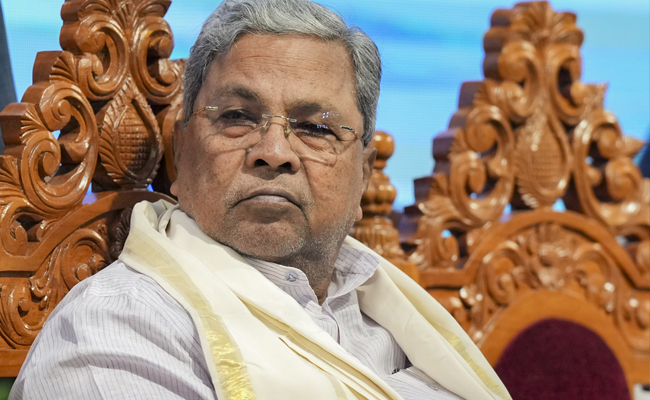
Bengaluru (PTI): Alleging a “criminal conspiracy” by BJP candidate D N Jeevaraj in the Sringeri Assembly poll recounting, Karnataka CM Siddaramaiah on Tuesday said the outcome was manipulated after valid postal ballot votes in favour of Congress leader T D Raje Gowda were tampered with during the recounting process.
Following a Karnataka High Court order on an election petition filed by Jeevaraj, challenging Raje Gowda’s election, the reverification and recounting were conducted on Saturday.
After the reverification and recount of postal ballots for the Sringeri Assembly constituency, votes polled in favour of Raje Gowda were reduced by 255, the returning officer said.
A report on the matter has been submitted to the Election Commission of India for further action, the officer added.
Congress leader Raje Gowda had won the 2023 Assembly polls from Sringeri by 201 votes, defeating his nearest rival Jeevaraj.
Addressing a press conference in Bengaluru, Siddaramaiah said the High Court had directed the recounting of postal ballots and that irregularities were noticed during the exercise conducted on May 2.
“This is a clear case of criminal conspiracy,” Siddaramaiah said, alleging that valid votes cast in favour of Raje Gowda were altered after being accepted by counting agents of all parties, including Congress, BJP, and JD(S).
He claimed that during the recounting of postal ballots, 255 votes were initially accepted as valid by all agents but were later tampered with by subordinate officials.
“There is a second mark on the votes polled in favour of Raje Gowda. They had accepted these as valid votes. Subsequently, another mark was made by officials. This is a clear case of criminal conspiracy,” he said.
When asked who was behind the alleged conspiracy, the CM replied, “It was hatched by Jeevaraj and others. It is planned.”
Siddaramaiah further alleged that the returning officer acted improperly by declaring the result despite the presence of an Election Commission observer during the recounting.
“Immediately after the counting, the returning officer announced the result. He should not have done so; this is against the law,” he said.
He pointed out that Raje Gowda had originally won by 201 votes, but after the recounting, the BJP candidate was declared the winner by 52 votes.
“The BJP has committed a criminal act of conspiracy. This is not vote chori but vote dacoity,” he alleged.
The CM said a police complaint had already been filed by Raje Gowda’s election agent, Sudhir Kumar, and emphasised the need for electoral integrity.
“We want transparency and free and fair elections. That is what our Constitution mandates,” he added.
Stating that the government would pursue legal remedies, Siddaramaiah said, “We are preparing an appeal challenging the returning officer’s announcement in a court of law.”
Responding to a separate query on elections in other states, the CM said there appeared to be an anti-incumbency factor in West Bengal, while results in Tamil Nadu were “surprising,” adding that Vijay’s party was emerging as the largest there.
Following the victory of party candidates in Bagalkote and Davanagere South, Siddaramaiah expressed confidence about future electoral prospects in Karnataka.
“Even in 2028, we will win the Assembly elections. We will come back,” the CM said.
Siddaramaiah added that he would order a forensic examination into the alleged tampering of postal ballots.