Hong Kong government suspends divisive extradition bill
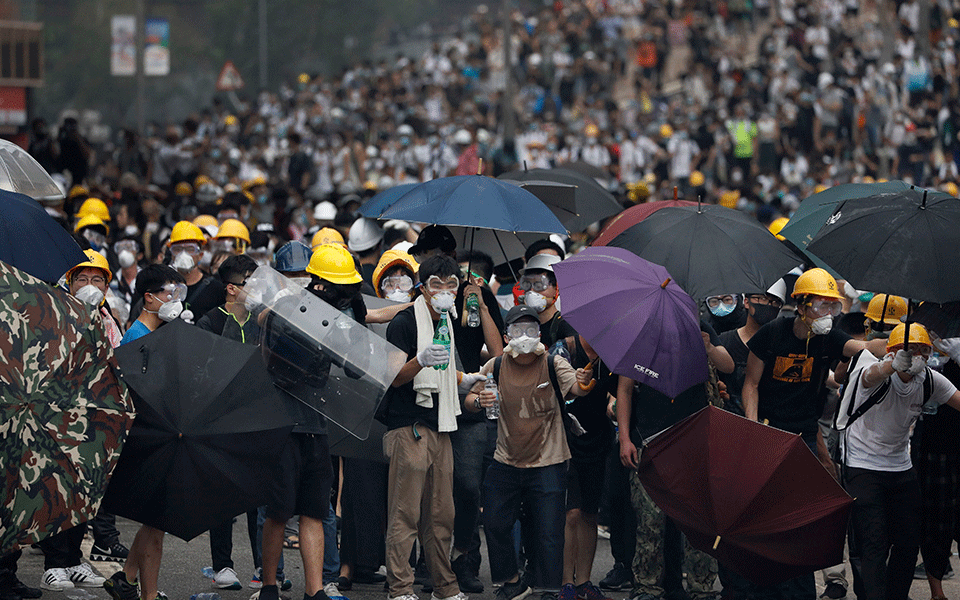
Hong Kong: Hong Kong's embattled leader on Saturday said a divisive bill that would allow extraditions to China would be "suspended" in a major climbdown from her government after a week of unprecedented protests.
The city's pro-Beijing leader Carrie Lam has come under huge pressure to abandon the controversial legislation, including from her own political allies and advisers.
"The government has decided to suspend the legislative amendment exercise, restart our communication with all sectors of society, do more... work and listen to different views of society," Lam told reporters Saturday.
"We have no intention to set a deadline for this work and promise to report to and consult members of the legislative council panel on security before we decide on the next step forward." The international finance hub was rocked by the worst political violence since its 1997 handover to China on Wednesday as tens of thousands of protesters were dispersed by riot police firing tear gas and rubber bullets.
As criticism mounted, signs also emerged of a growing discomfort among Communist Party leaders in Beijing, and Lam held her press conference Saturday at the same government complex that was besieged by protesters earlier in the week.
The South China Morning Post said Lam held an emergency meeting on Friday night with her advisers while Chinese officials were also meeting in the nearby city of Shenzhen to map a way out of the impasse.
Tensions were running high with protest organisers planning another mass rally on Sunday.
Lam, who is appointed by a committee stacked with Beijing loyalists, had previously refused to consider abandoning the bill, despite months of criticism from business and legal bodies -- and a record breaking rally on Sunday where organisers said more than one million protesters hit the streets.
"I feel deep sorrow and regret that the deficiencies in our work and various other factors have stirred up substantial controversies and disputes in society following the relatively calm periods of the past two years," Lam said.
On Friday she found herself facing growing calls from within her own political camp to reverse course and tamp down spiralling public anger -- including from hardline pro-Beijing lawmakers.
"Shouldn't (we) cool the citizens down? I think to postpone it for a little bit is not a bad thing. At this moment, the government should self-examine," Ann Chiang, a hardcore pro-Beijing lawmaker, told i-Cable News.
But others have warned against Lam bending to the protesters.
"If the government caves in to violence and external influences, in the long run that would also make Hong Kong ungovernable," pro-Beijing lawmaker Regina Ip told reporters.
Opposition to the extradition bill has united an unusually wide cross section of Hong Kong. Protest organisers had been calling for a full withdrawal of the bill, not a postponement. James To, a lawmaker from the city's pan-democrat camp, called on Lam to step down.
"The credibility of our chief executive has already been written off, it's a kind of government that cannot have any credibility to rule anymore," he told reporters Friday.
Beijing has vocally supported the bill and earlier this week threw its full support behind the Lam administration, calling protesters "rioters".
But it has since sought to distance itself as public anger spiralled.
"The central government gave no instruction, no order about the... amendment," Lu Xiaoming, the Chinese ambassador to Britain, told the BBC.
"This amendment was initiated by the Hong Kong government." On Friday night, thousands of parents gathered in a park in the heart of the city's commercial district to condemn the use of rubber bullets and tear gas against predominantly young protesters on Wednesday.
Y Chan, a 50-year-old mother of two, said she was outraged watching the scenes unfold.
"It's calling for all mothers who had enough already of what happened the other day," she told AFP. "My kids were out there also that day. And although I want them to be safe, want them to be at home, but this is their home. They are defending it."
Let the Truth be known. If you read VB and like VB, please be a VB Supporter and Help us deliver the Truth to one and all.
Rajnath to top commanders: Outmaneuver adversaries with strategic surprise
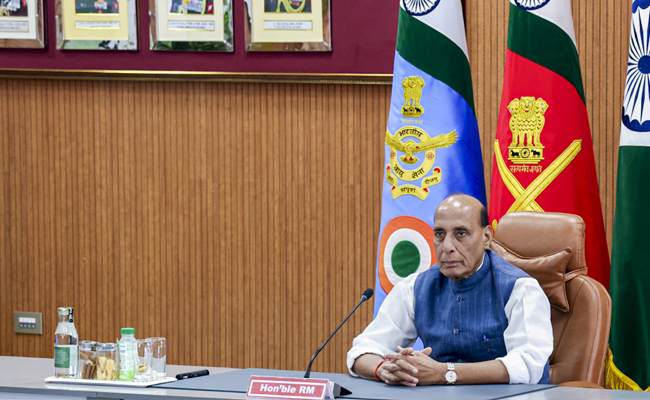
Jaipur/New Delhi (PTI): Defence Minister Rajnath Singh on Friday directed the top military commanders of the three services to integrate an "element of surprise" into modern warfare to outmaneuver India's adversaries and bolster strategic posture.
In his address at the joint commanders conference in Jaipur, Singh also described the Operation Sindoor as a testament to the "swift, precise, and joint response" of the Indian armed forces to safeguard national interests and called upon the military to remain ready to deal with any security challenges.
In their two-day deliberations, the commanders carried out a comprehensive review of the combat preparedness of the military in the wake of the evolving regional security situation.
Operation Sindoor was a demonstration of India's growing capabilities and a symbol of the nation's collective resolve and new military ethos, Singh said, a day after the first anniversary of Operation Sindoor.
He also unveiled a 'Joint Doctrine for Integrated Communication Architecture' that is aimed at strengthening doctrinal clarity, interoperability and integrated communications across the armed forces in future multidomain operations.
The joint commanders' conference, themed 'Military Capability in New Domains', brought together the top leadership of the defence ministry and the three services to deliberate on emerging security challenges and future readiness.
Comprehensive deliberations were held on future warfare, multidomain operations, technological transformation and joint capability development.
The conference witnessed extensive discussions on cognitive warfare, cyber resilience against evolving quantum and AI-enabled threats, military capability development in emerging domains, indigenous innovation and AI-enabled warfighting concepts.
It was attended by Chief of Defence Staff Gen Anil Chauhan, Chief of the Naval Staff Admiral Dinesh Kumar Tripathi, Chief of the Army Staff Gen Upendra Dwivedi, Chief of the Air Staff Air Chief Marshal AP Singh and Defence Secretary Rajesh Kumar Singh among others.
In his remarks, Singh asked the commanders to remain "future-ready" by learning from the operation as well as the current global security landscape.
He underscored the need to strengthen capabilities in artificial intelligence, autonomous systems, data analytics and secure communication networks to stay prepared in the rapidly evolving geopolitical security scenario. He emphasised that future conflicts will increasingly be shaped by hybrid threats, information dominance and operations conducted simultaneously across cyber, space, electromagnetic and cognitive domains, according to an official readout.
Highlighting the transformative impact of emerging technologies, Singh stressed on the importance of ensuring integrated national preparedness across all spectrums of conflict, it said.
Singh's remarks at the conference came a day after the first anniversary of Operation Sindoor.
The defence minister appreciated the progress achieved in enhancing jointness, integration and technological adoption across the three services, the readout noted.
Singh said that jointness constitutes a pivotal dimension within the transformative changes sweeping across the global defence sector.
"Future wars will not be won solely through weaponry, but through innovative thinking and enhanced synergy," he said.
The defence minister exhorted the commanders to cultivate the "element of surprise" to remain unpredictable to the nation's adversaries and secure a strategic edge in any given situation.
He, however, urged them to remain vigilant of the element of surprise of the enemy and always stay two steps ahead.
Singh also reiterated the Narendra Modi government's commitment to enhancing the capabilities of the defence forces through state-of-the-art weapons and platforms. He added that special focus is being laid on research in niche domains.
During the conference, he released a documentary film on Operation Sindoor.
The film reaffirms the nation's and defence forces' commitment to operational preparedness and decisive national response capabilities.
Demonstrations of advanced systems and platforms developed for intelligence fusion, operational planning and information management were also showcased during the conference reflecting growing integration of cutting-edge technologies into joint operational structures, according to the defence ministry.
The discussions will contribute significantly towards shaping India's future military transformation and integrated operational preparedness, it said.